The Art of the Possible
Enabling Policy Interventions for Community Wealth Building in the United States
Nairuti Shastry (Center for Economic Democracy)
Introduction
The Community Wealth Building (CWB) movement in the United States, while innovative, lacks a cohesive analysis of and agenda for political change. Among practitioners, from Denver to Seattle to St. Louis, there has been significant work advocating for a legislative agenda that enables various elements of CWB. However, despite significant wins over the past century — from the establishment of collective bargaining for private sector employees (i.e. National Labor Relations Act of 1935) to the more recent legislative fight led by the Coalition for Worker Ownership and Power (COWOP) in Massachusetts to make the state’s Center for Employee Ownership a permanent line item in the budget (S.B. 261) — this work falls short on two fronts.
First, policy advocates are often eager to advance change within one of the Five Pillars [1] — perhaps because it requires fewer resources and is the most politically palatable —but often miss the interventions that would enable the full suite of actions across the Pillars [2]. Second, in fighting and waiting for comprehensive legislative reform, we miss the opportunity to strategically leverage policy to enable CWB activities on the ground.
In this essay, I examine the existing landscape (and its gaps) of CWB-related policy and provide an updated analysis of the various terrains of struggle for policy negotiations. As a result, I hope that CWB practitioners, researchers, and policymakers will use this overview to demystify and assess their local landscape and borrow from and innovate upon these interventions to advance a more enabling environment for CWB activity in their own communities.
The Relationship Between Legislation and Policy
So, what are the key differences between legislation and strategic policy? And why might investing in the latter, especially in the current political landscape as articulated in the introductory essay, be especially important for cities across the US still looking to advance CWB?
Put simply, legislation is all about what an entity can or cannot legally do. An enabling legal platform also helps to unlock new capital for CWB activity. Sometimes, legislation, particularly at the federal level, can introduce new narratives into the public discourse and bring broad coalitions together around a common aim. However, much like the law itself, the realm of legislation can be quite narrow and restrictive. Additionally, advocating for legislative change is a lengthy process requiring significant resources like time and money.
Policy, on the other hand, is considered to be the enabling vehicle for existing legislation. When activated strategically, policy allows for effective implementation of a particular piece of legislation, making policy much more dynamic and responsive to the current moment. Though much policy is arbitrated by non-elected government workers (meaning it is not as beholden to electoral politics), it does not always need to be. Other economic actors, from community groups to local businesses, can make sense of legislation and expand its reach through strategic policy. Using incentivizing or disincentivizing policy (i.e. the carrot and stick approach), policymakers can influence behavior, and thereby also shape narratives about what is possible.
Take, for example, the need for a proliferation of inclusive and democratic enterprise (IDE). This is integral to CWB because it demonstrates a direct shift from corporate to collective, local ownership of capital (DAWI 2014). One prevalent form of IDEs in the US is the cooperative. In this case, primary legislation can make it legal to set up a cooperative enterprise in a particular locality. However, it is the realm of strategic policy that makes the dream of cooperative ownership possible. From building a cooperative ecosystem in which technical assistance providers for small businesses are incentivized to provide legal and financial assistance to worker cooperatives to one in which anchor institutions prioritize cooperative businesses in their procurement processes, I call such strategic policy interventions for advancing CWB “the art of the possible.”
Method
To inform this overview of and opportunities for CWB policy interventions in the US, I employed four key methods. First and foremost, during the course of my year-long CWB Fellowship at TDC, I tracked key policy and legislative advancements across the Five Pillars of CWB from several partner listserves [3]. Second, as one of the co-leads of TDC’s CWB Community of Practice, I facilitated several group conversations with practitioners from twelve American localities advancing CWB4 to determine priority areas for policy intervention within each pillar [4]. Third, I conducted 16 semi-structured interviews with policy experts on CWB [5]. Finally, I examined the policy platforms (all released within the past five years) of four key movement organizations, including the Climate Justice Alliance (CJA), Movement for Black Lives (M4BL), New Economy Coalition (NEC), and Rising Majority (RM), as a way to integrate broader conversations about economic policy into a discussion about CWB.
The Policy Landscape of CWB
The landscape for enabling policy for CWB in the US is complex and nuanced. Over the past decade, leading organizations like CJA, M4BL, NEC, and RM have worked with their members to create visionary platforms that help inform a more rigorous pursuit of political change towards a new economy. By examining best practices around the country, each of these national movement formations has articulated not only the why but also the how of moving from an extractive to a regenerative economic system through investments in CWB-esque activity. For example, NEC’s Pathways to a People’s Economy and CJA’s People’s Orientation to a Regenerative Economy both emphasize worker ownership, housing, and community-controlled financial institutions. CJA, M4BL, and RM center abolitionist practice, which demands a commitment to reimagining public safety and human flourishing without the invasive presence of the policy and military state, as integral to creating a new economic system that puts people over profits. All four platforms call for climate justice and more democratic governance of our political and economic systems.
So, what’s the holdup?
Challenges and Limitations
As a country with a population of well over 300 million people, legislation and policy operates on three, oft-siloed fronts: national, state-level, and local. Across all three levels, one thing is certain: few legislative and policy agendas advance a comprehensive approach to CWB. Instead, many advocate for and advance CWB activity within one to three of the Five Pillars, most commonly related to jobs, housing, and procurement.
Though there have been a handful of strategic policy interventions at the federal level — several of which have promoted progressive procurement strategies to support small, women and minority-owned businesses — much of that progress has been rolled back during the second Trump administration. As a result, practitioners have had more luck advancing enabling policy at state and local levels.
Bluer states like New York have seen some progress in the realm of social housing (Miranda 2024) and public banking (Abello 2024) legislation. Illinois, for example, has taken steps toward workforce development and economic access, equity, and opportunity by designing a state-level Community Reinvestment Act (Hill 2024). However, the rise of preemptive legislation over the past few decades has also hindered the effectiveness of state-level policy intervention. State preemption is a legislative tool used by state governments to preclude local, often more progressive legislation (ChangeLab Solutions 2019; Meyerson 2024). In particular, conservative state legislatures often pass preemptive legislation that targets local legislation, policy, and regulations—from minimum wage laws and sick days laws to local rent control to municipal broadband to local sanctuary policies (DuPuis et al. 2018)—directed at supporting cities’ most vulnerable residents, particularly those of color (Blair et al. 2020).
Finally, policy across all levels of government does not always disincentivize business as usual and/or traditional economic development activities. As a result, in many places, we find a plethora of cooperatively-owned businesses, for example, operating alongside — rather than actively supplanting — big box stores and other large corporations. As one TDC Community of Practice member shares, “Broadly, [policies that enable CWB should] tilt the playing field so that extractive economic practices are at a disadvantage and CWB practices are at an advantage” (September 2024).
Knowing this context, might there still be opportunities for policy intervention by pillar that address these challenges and call forth and enable the full wedge of CWB?
Opportunities, by Pillars
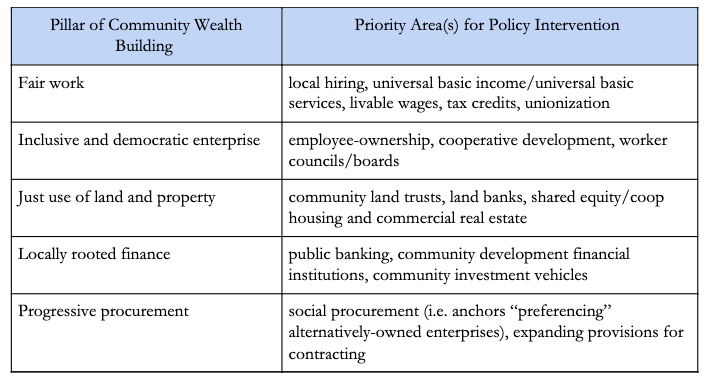
In conversations with practitioners from places as diverse as Seattle, WA to Meadville PA, we discussed in-depth which elements of CWB were most popular/favored. The table below summarizes the 3-5 priority areas for policy intervention (by pillar) as identified by these 20+ practitioners in TDC’s CWB Community of Practice.
Fair work
In an economic system inextricably linked to wage labor, fair and dignified work is a critical part of building collective wealth. Though many states are preempted (EPI 2025) from legally requiring a minimum or prevailing wage and federal tax credits are increasingly under threat (CBPP 2025), there is still an opportunity to protect workers through local hiring and collective bargaining.
For example, in Austin, TX, the Better Builder Program incentivizes general contractors to heighten labor standards and building inspections by expediting their building permits. Engineered by organizers at the Workers Defense Project, the Program better protects construction workers by advocating for living wages, OSHA safety training, worker’s compensation, and local hiring, all in a place like Texas, a state ranked 45th (out of 52) on Oxfam’s 2025 Best States to Work index (Oxfam 2025). This example not only demonstrates a commitment to fair work, but also deploys progressive procurement strategies and supports the just use of land and property.
Additionally, as gig work expands, so, too, should portable benefits, like health insurance and retirement plans that follow the worker as opposed to staying tied to employers (Padin 2025). These benefits don’t necessarily require legislative intervention and can be administered by trade unions, ideally rooting finance more locally. In this way, economic mobility is available to a greater diversity of workers, including those who are unable to access more traditional employment (i.e. undocumented workers, justice-impacted workers, disabled workers, parents, etc.). Further, portable benefits pave the way for the formation of more inclusive and democratic enterprises, as workers have more financial flexibility and the personnel costs for a new business are less inhibitive.
Inclusive and democratic enterprise
We know that when local businesses thrive, communities thrive. As such, investing in local businesses that can (out)compete with traditional markets is critical. The simplest way to do this is to expand the resources available to traditional small businesses to alternatively-owned enterprises (Armeni et al. 2023), such as cooperatives. The Small Business Anti-Displacement Network (SBAN), housed at the University of Maryland’s National Center for Smart Growth, offers several non-legislative interventions — from zoning to legacy business programs to commercial tenant protections — to preserve commercial real estate and local business corridors. Through these strategies, not only are real estate costs associated with operating a business dramatically reduced, land is taken off the speculative market and put back in the hands of communities themselves.
Another strategy to promote both inclusive and democratic enterprise and fair work is to collaborate with employers and unions to establish worker councils and/or boards that facilitate worker organizing and thus increase worker power (Elliot and Fine 2024). For example, though eventually formalized by legislation in 2023, organizers with SEIU 721 in Los Angeles worked to establish the country’s first-ever council of fast food workers, nearly half a million in the state of California.
Just use of land and property
Beyond safe, affordable, long-term housing, when communities own their own land, they are better able to preserve their neighborhoods and thus a sense of place and belonging. In recent years, innovations like land banks and community land trusts have taken land off the speculative market and reintroduced parcels into the hands of local residents. Indeed, local governments can use affordable housing development dollars for such wealth-building entities instead of rental properties. In one guide for local governments, the National League of Cities (NLC) shares how municipalities can leverage strategic policy to preserve the affordability of public land (Lowery et al. 2021).
Other institutions like banks can also support these aims all while relocalizing their dollars. In Chicago, for example, $1 million in settlement funds from a $17 billion settlement between Bank of America and the Department of Justice over the sale of bundles of risky mortgages to investors (DOJ 2014) was awarded to the Chicago Community Loan Fund (CCLF) to support the creation of community land trusts in Cook County (CCLF 2015).
Locally rooted finance
We know that values-aligned public and private financial flows are an invaluable enabling condition for advancing CWB activity in a particular place. Community-controlled infrastructure in particular, such as public banks, credit unions, and community development financial institutions (CDFIs), allow for more and better money to be funneled into wealth-building projects. However, as the current presidential administration proposes significant cuts to the CDFI Fund (OFN 2025), localities will have to be much more creative in seeding financial infrastructure that enables significant community investment.
Progressive procurement
When anchor institutions like hospitals, universities, and local governments take their commitment to place seriously, entire communities benefit. Procurement policies that preference women and minority-owned businesses, for example, allow local businesses the opportunity to compete for large contracts. However, in some cities, this kind of preferential treatment is considered illegal and not all local businesses are equipped to place bids for large contracts. As a result, cities like Norfolk, VA practice “debundling”: the act of taking a large contract and breaking it down into multiple, smaller contracts to which smaller businesses are better able to apply. In 2024, the city broke down a $2.3 million janitorial contract into eight smaller contracts, six of which were offered to Black-owned businesses (Munro 2024). In this way, progressive procurement enables fair work, expands the reach of inclusive and democratic enterprise, and keeps dollars circulating locally.
Updating Our “Terrains of Struggle” To Activate the Full CWB Wedge
In a conversation with Johanna Bozuwa, Executive Director at the Climate & Community Institute (CCI), she spoke about the necessity of updating our “terrains of struggle.” Essentially, CWB practitioners must work to have a clear-eyed assessment of which sociopolitical moments are ripe for infusing CWB-related policy across the three key assets of our economy: land, labor, and capital.
To illustrate her point, Bozuwa shared the example of CCI’s work with the Chicago Teachers Union (CTU) to bargain for the common good (Rutgers et al. n.d.), or expand the scope of union contract negotiations beyond individual employees’ wages and benefits. In their latest negotiation, CTU included climate justice as a key element of their collective bargaining agreement (CTU 2025). Specifically, they integrated into their campaign a demand for solar energy for school buildings. In this way, CTU saw the five-year construction plan for the school district as a “terrain of struggle”, an opportunity to advocate for more sustainable infrastructure that not only meets ecological needs, but also builds community wealth and climate resilience in Chicago.
Multi-year construction plans for public infrastructure and associated contracts are excellent examples of a terrain of struggle linked to the democratic ownership and governance of land, a key asset of our economy. Recent developments in social housing – a portfolio of “systems and conditions that enable more community stewardship of housing…[putting] more control of pricing, quality, and meeting community needs in the hands of people who need shelter” (Rosales et. al 2025) — as a solution to the corporate capture of land in our country provides another opportunity to consider strategically leveraging policy to advance CWB. But land use reform goes well beyond housing. In places like Brazil and India, landless farmers have been organizing for decades to gain stewardship of their own land. Not only do these movements build wealth for individual farmers and their families, they also promote Indigenous stewardship of land, resulting in more sustainable farming practices. American CWB practitioners can learn a lot about non-commodified uses of land for the public good from such struggles for land justice in the global South and apply them to zoning and other land-based terrains.
In the realm of labor, contract negotiations are, of course, invaluable opportunities to make the case for CWB. But for non-unionized workers, both supply- and demand-side organizing is critical to advancing community wealth. On the supply side, we can better leverage small business development resources to translate to cooperative development. Furthermore, beyond worker-owned cooperatives, we can engage other stakeholders, like consumers, to participate in the ownership structure of a small business. For larger corporations, we can infuse governance practices and organizational by-laws with requirements for worker representation, such as worker councils. On the demand side, anchor institutions like hospitals, universities, and local governments can flex their purchasing (and hiring!) power to support local entrepreneurship. From bid advantages (Eidy n.d.) to public participation before, during, and after the procurement process, social and high road procurement (ITPR 2023) strategies are yet another often undertapped lever of considerable CWB opportunities.
Finally, while tax code reform is the most sweeping, effective way to influence both public and private capital, other municipal infrastructure can be leveraged to expand eligibility for and access to CWB opportunities. In Boston, for example, a grassroots coalition organized to reform the city’s charter to enable residents to participate in the budgeting process (Boes et al. 2023). In this way, organizers were able to influence the very mechanisms through which community members could access more social services and, thus, build wealth.
Conclusion
In this piece, I demonstrate three key gaps for CWB-related policy in the United States:
An overemphasis on one pillar (namely jobs, housing, and procurement) over the full wedge—largely due to funding constraints and political feasibility;
Preemption in states with a conservative legislature; and
An underemphasis on policy that disincentivizes activity that inhibits CWB.
Simultaneously, I offer opportunities, pillar by pillar, and new terrains of struggle, from multi-year construction plans to labor contract negotiations to supply and demand side organizing, for how we might leverage policy at the local level to advance CWB. It is important to note here that as the conservative political machine mobilizes vast amounts of capital to push back against progressive policy, adopting a build and resist posture to advance CWB will be critical in the years to come. Investing in each of these efforts with a blind eye to power-building and bringing more people in our movement will not pay off. Indeed, while important, leveraging strategic policy to advance CWB in the US is only as efficacious as the governance structures and practices through which we operate. At the Center for Economic Democracy (CED), where I now work, we often talk about co-governance as critical to moving towards a new economic system.
In a 2023 report, our partners Race Forward and Partners for Dignity & Rights, define co-governance as “a collection of participatory models and practices in which government and communities work together through formal and informal structures to make collective policy decisions, co-create programs to meet community needs, and ensure those policies and programs are implemented effectively” (12). Fundamentally, co-governance is all about democracy—within and beyond the State. Our colleagues at the Municipalism Learning Series take this one step further, describing radical municipalism,
a political and social philosophy that advocates for transformative change at the local level, with a focus on participatory and grassroots democracy. Radical municipalism emphasizes community self- governance, civic engagement, and the establishment of local, directly democratic institutions to transform existing power structures. It is the vision that our movements can and will move away from coercive and hegemonic structures and move towards alternatives based on direct democracy and the solidarity economy. Radical municipalism aims to build alternative politics based on the commune to replace the nation-state, patriarchal power structures, and colonial capital accumulation (5).
In order to fully animate the art of the possible, we must all be willing to both fight for and maintain—through shared governance—collective ownership of land, labor, and capital. As Margaret Mead reminds us, “Never doubt that a small group of thoughtful, committed citizens can change the world. Indeed, it is the only thing that ever has.”
Notes
[1] The Five Pillars of CWB include: fair work, inclusive and democratic enterprise, just use of land and property, locally rooted finance, and progressive procurement.
[2] This is known as the “CWB Wedge”. When communities engage in actions across the Five Pillars, the cumulative impact has the force of a wedge—disrupting and, eventually, displacing the existing extractive economy and bringing forth a new, more democratic economy (TDC n.d.).
[3] These include newsletters and other digital content from the following peer organizations and networks: The Brookings Institution, the Center for Economic Policy & Research, Local Progress, the National Community Reinvestment Coalition, the New Economy Coalition, Next City, Nonprofit Quarterly, The Roosevelt Institute, Shelterforce, and the United States Federation of Worker Cooperatives.
[4] The localities represented in TDC’s CWB CoP include: Atlanta, GA; Baltimore, MD; Chicago, IL ; Denver, CO; Fairfax County, VA; Los Angeles, CA; Meadville, PA; Richmond, VA; Seattle, WA; St. Louis, MO; Twin Cities, MN; Washington DC.
[5] Experts include Amanda Janoo (Wellbeing Economy Alliance), Chris Griswold (American Compass), Cuevas Peacock and Jacqueline Robles (New Growth Innovation Network), Diana Goldsmith, Justin Chu, and Rosanna Mulcahy (National League of Cities), Johanna Bozuwa (Climate and Community Institute), Lolly Lim (The Greenlining Institute), Mohit Mookim (Sustainable Economies Law Center), Pete Davis (Democracy Policy Network), Shahrzad Habibi (In the Public Interest), Tarsi Dunlop (German Marshall Fund of the United States), Valerie Piper (Fairfax County Housing and Community Development), Will Flagle (Rashida Tlaib’s Office), and Zen Trenholm (Democracy At Work Institute).
References
“Access to Startup Capital | Democracy Policy Network.” Accessed February 13, 2026. https://democracypolicy.network/agenda/open-country/open-economy/startup-capital
U.S. Department of Justice. August 21, 2014. Bank of America to Pay $16.65 Billion in Historic Justice Department Settlement for Financial Fraud Leading up to and During the Financial Crisis.” https://www.justice.gov/archives/opa/pr/bank-america-pay-1665-billion-historic-justice-department-settlement-financial-fraud-leading
Boes, Andrew, Libbie Cohn, and Aaron Tanaka. 2023. Rewrite the Rules: Democratizing City Charters in Boston and Beyond. Center for Economic Democracy (CED).
Center on Budget and Policy Priorities. June 17, 2025. “By the Numbers: House Republican Tax Agenda Favors the Wealthy and Leaves Millions of Working Families Behind.” https://www.cbpp.org/research/federal-tax/by-the-numbers-house-republican-tax-agenda-favors-the-wealthy-and-leaves
Chicago Community Loan Fund. 2015. Community Blueprint: CCLF’S Newsletter of Ccommunity Development Projects, Issues & Features.
Democracy At Work Institute (DAWI), 2014. Creating Better Jobs and a Fairer Economy with Worker Cooperatives.https://institute.coop/resources/creating-better-jobs-and-fairer-economy-worker-cooperatives
DuPuis, Nicole, Trevor Langan, Christiana McFarland, Angelina Panettieri, and Brooks Rainwater. 2018. City Rights in an Era of Preemption: A State-by-State Analysis 2018 Update. National League of Cities (NLC).
Economic Policy Institute. “Preempting Progress: State Interference in Local Policymaking Prevents People of Color, Women, and Low-Income Workers from Making Ends Meet in the South.” Accessed February 13, 2026. https://www.epi.org/publication/preemption-in-the-south/
Economic Policy Institute. “Workers’ Rights Preemption in the U.S.: A Map of the Campaign to Suppress Workers’ Rights in the States.” Accessed February 13, 2026. https://www.epi.org/preemption-map/
Elliot, Brian, and Janice Fine. 2024. Setting Standards Is Not Enough: Labor Standards Boards Must Facilitate Worker Organizing and Robust Enforcement. The Workplace Justice Lab @ RU.
Foster, Kesi, Vina Kay, Leah Obias, Ben Palmquist, and Philippa Rizopoulos. n.d. Co-governing Toward Multiracial Democracy. Race Forward and Partners for Dignity & Rights.
ChangeLab Solutions. 2019. Fundamentals of Preemption.
Goldbaum, Nathan. June 27, 2025. “CTU Applauds Passage of Healthy Green Schools Resolution.” Chicago Teachers Union. https://www.ctulocal1.org/posts/green-schools-resolution-passes/
“Alternative Ownership Enterprises Report – Transform Finance” Accessed February 13, 2026. https://drive.google.com/file/d/1RktMnhsyEpMdjPAb0eIlujyIynLMOXUP/view?usp=embed_facebook
In the Public Interest and Local Progress. 2023. Harnessing the Power of Procurement: Issues, Considerations, and Best Practices to Advance Equity in the Contracting of Public Goods and Services.
Hill, Kevin. June 17, 2024. Illinois Legislature Provides A Roadmap For Progress With Its State-Level Community Reinvestment Act » NCRC. Views. https://ncrc.org/illinois-legislature-provides-a-roadmap-for-progress-with-its-state-level-community-reinvestment-act/
Rutgers School of Management and Labor Relations’s Center for Innovation in Worker Organization, Action Center on Race and the Economy (ACRE), and Georgetown University’s Kalmanovitz Initiative for Labor and the Working Poor, n.d. Key Elements of Bargaining for the Common Good Campaigns.
Lowery, Lauren, Matt Weber, Jenee Gaynor, Natasha Leonard, Tina Lee, and Alexis Butler. 2021. Community Land Trusts: A Guide for Local Governments. National League of Cities (NLC).
Oscar Perry Abello. May 21, 2024. “A Major New Step Toward Public Banking in Rochester.” Accessed February 13, 2026. https://nextcity.org/urbanist-news/a-major-new-step-toward-public-banking-in-rochester
Meyerson, Harold. February 6, 2024. “Pre-Preemption.” The American Prospect. https://prospect.org/2024/02/06/2024-02-06-pre-preemption/
Munro, Ian. January 2, 2024. “Norfolk Finds New Way to Increase Contracting with Minority, Women-Owned Businesses.” https://www.pilotonline.com/2024/01/02/norfolk-finds-new-way-to-increase-contracting-with-minority-women-owned-businesses/
OFN. March 15, 2025. “OFN Statement on Executive Order and Potential Threats to the CDFI Fund.” https://www.ofn.org/news/ofn-statement-on-executive-order-and-potential-threats-to-the-cdfi-fund/
Padin, Laura. March 23, 2025. “Why Workers Need Real Portable Benefits.” National Employment Law Project. https://www.nelp.org/insights-research/why-workers-need-real-portable-benefits/
Rosales, Christina, Tram Hoang, D’Ana Pennington, and Mia Loseff. 2025. Housing For the People: How Local Governments Are Building Social Housing Solutions for Public Good. Local Progress.
Roth, Laura, Bertie Russell, and Matthew Thompson. 2023. “Politicising Proximity: Radical Municipalism as a Strategy in Crisis.” Urban Studies 60(11): 2009–35.https://doi.org/10.1177/00420980231173825
“The Best States to Work in the US 2025.” Accessed February 13, 2026. https://www.oxfamamerica.org/explore/issues/economic-justice/workers-rights/best-states-to-work/
The Democracy Collaborative. “How It Is Practiced | Empower Local Economies - Get Informed.” Accessed February 13, 2026. https://www.democracycollaborative.org/how-it-is-practiced
“The Plan to Bring Social Housing (Back) to New York.” Accessed February 13, 2026. https://nextcity.org/features/the-plan-to-bring-social-housing-back-to-new-york
Nairuti Shastry is the inaugural Director of Policy & Research at CED, where she leads the organization's translocal efforts to seed an economy that works for us all. Prior to joining CED, Nairuti spent eight years as a movement operative, supporting organizations and communities to hospice the old and birth the new in pursuit of more just economic futures. Nairuti holds a BA in sociology, French & Francophone studies, and public health from William & Mary.