New Books: The Menace of Prosperity
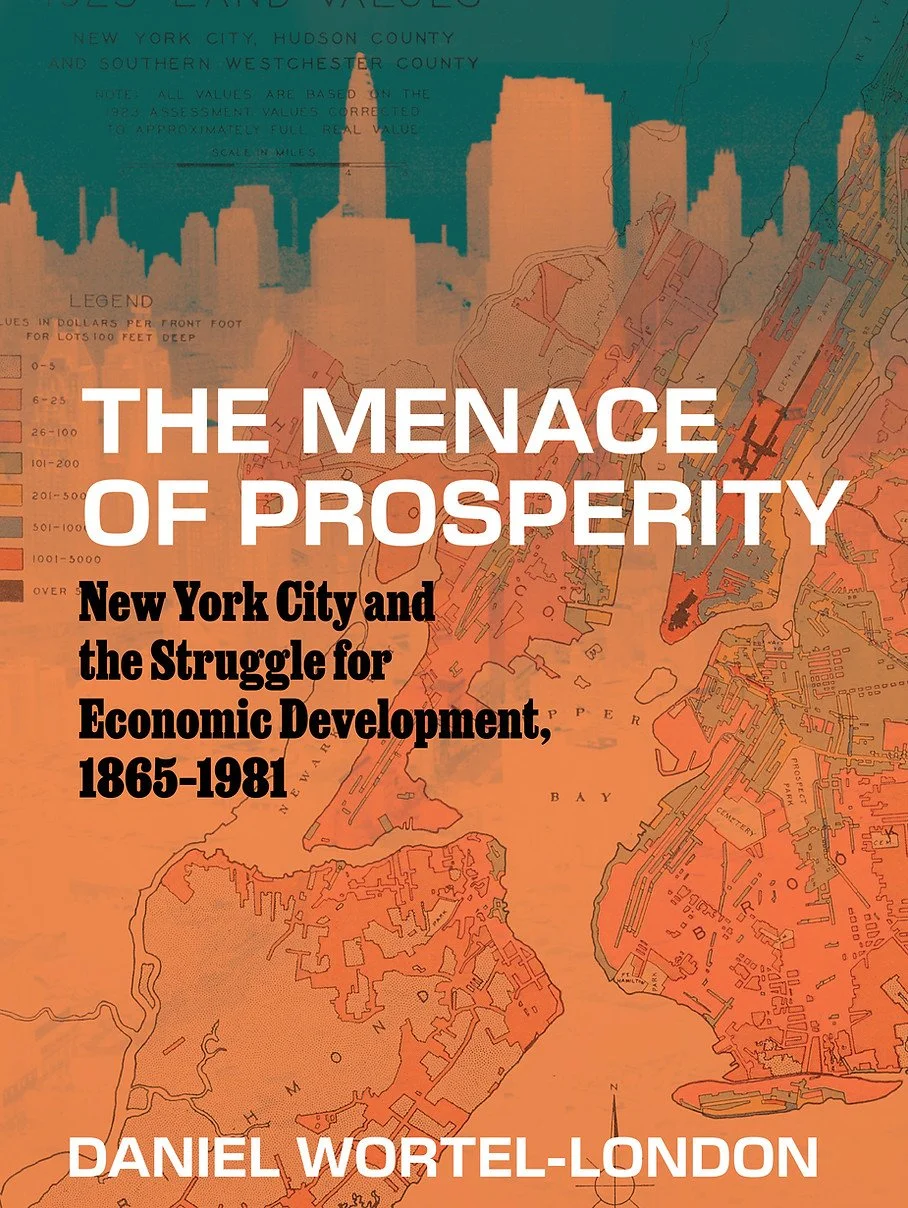
In this episode, we’re speaking with Daniel Wortel-London, author of The Menace of Prosperity: New York City and the Struggle for Economic Development, 1865-1981. In this book, Dr. Wortel-London chronicles how periodic economic crises have shaped New York City’s modern history — and how alternative strategies for sustainable, democratic growth are possible.
-
Daniel Wortel-London
I think you know the fundamental one would be we can't finance progressive policies through taxes on a regressive economy. I think for most of the 20th century, both liberals and conservatives have disagreed on how much we should tax the wealthy. How much we should tax corporations, but they've generally agreed we need the wealthy and large corporations to basically build up the economy for cities and what my book shows is they're not necessarily reliable as a way of financing cities, providing quality jobs and not only is it difficult to rely on them, but the costs of promoting them often create a kind of growth trap where we're not only promoting growth to achieve benefits, but we need to achieve growth to stave off disasters. Once the city, like New York is going into debt to finance subways or to finance other things, it needs that growth to happen. So this becomes a dangerous game.
Emily
Hi, this is Emily Holloway, and you’re listening to UAR Remixed, a podcast by the journal Urban Affairs Review. You just heard from Daniel Wortel-London, author of The Menace of Prosperity: New York City and the Struggle for Economic Development, 1865–1981, from the University of Chicago Press.
Daniel Wortel-London
So my name is Dr. Daniel Wortel-London. I am a visiting assistant professor at Bard College. My area of research is in American history, focusing on economic thought and policy.
Emily
Daniel, we’re very excited to learn more about your book. How did this project come about?
Daniel Wortel-London
I had been interested in urban history for some time before I started the dissertation. I grew up in Hoboken, NJ, right across from New York. I went to school in the suburbs, and I started thinking early on about the differences between suburban and urban styles of physical development. I was living in the city from 2008 to 2020 and I had been involved in various campaigns for economic justice. I was on the Town Planning committee of Occupy Wall Street. I was in the DSA. But I hadn't really thought about alternative styles of economic development for the city until the Amazon HQ2 debates which was a debate about whether New York should be offering so many subsidies to lure Amazon to place one of its headquarters in the city. And at the time there were a lot of debates over this, some people felt was going to bring a lot of jobs. Other people felt it was a waste of taxpayer money. We were going to pay for things like a helipad, and as I was looking at this debate, I started thinking, well, how can we historicize this? Have there been other times in New York history where people have fought over different strategies of economic development, of what defines good economic development? And are there any things we can learn from those struggles about how we arrived where we are now, and what are alternatives for developing a better kind of urban economy. So, I'd say it's my biography, my activism, and sort of the contingency of that discussion really propelled me into this.
Emily
And based on that biography, what kinds of readers are you hoping to reach with this work? How has your background informed your research?
Daniel Wortel-London
Well, I think a lot of my work has been outside of academia. I was like I said, I was on Occupy Wall Street. I was in the well-being economy alliance, the global parliament of mayors, and a few other advocacy groups. And so I wanted to bridge the world of academia, advocacy groups, and activists more generally with this work, as well as reach policymakers, too. I think for policymakers, I want to bring up that they're are all alternative ways of growing an economy, and we don't have to just rely on the 1% or trickledown economics to create a robust, resilient urban economy. I think for citizens, I want them to know that the economy of cities is not natural. It is designed by us. We get to choose what economy we have, and I think by showing sort of the genealogy of our current strategies of economic development, we can see there were paths not taken and we as citizens can help decide the future of our city. So I want to emphasize agency for citizens, and then for scholars, I tried to, really, I think especially for historians, I want to for us to rethink some of our narratives around how we arrived where we are now in terms of inequality, oligarchy, what have you and some of this involves using new concepts like fiscal imagination, some of it means pushing back against older narratives, most of which emphasize new liberalism as the big culprit. But I want this project to open up new research avenues into how we got where we are.
Emily
What makes New York such a great case study for this project?
Daniel Wortel-London
Yeah, well, I think New York is both, you know, exceptional and very representative. If you look at the way a lot of cities were trying to grow their economy between the 1870s and the 1980s, the sort of time frame of my book, they will serve using the same sort of strategies. They were using infrastructure to try to lower development, they were offering tax subsidies. They were promoting urban renewal.
I think New York, in some ways it was advancing these policies a little earlier. In other cases, it was actually behind the curve. But I don't think it was necessarily exceptional in terms of its strategies. I think what makes it exceptional are the way those strategies were put under immense media pressure, immense public pressure, because in New York you had such a range of different actors from all sides of the political spectrum. All sides had newspapers. They were pretty, vocal about their opinions on these things. So for me at least, by looking at New York and taking advantage of sort of the rich amounts of commentary on these development decisions, I think that it allows us to get a sense of how these decisions were politicized and understood in other places as well.
Emily
And so thinking about the intellectual or academic interventions you’re staking out, the debates or conversations you want to join here, where does this book fit in?
Daniel Wortel-London
I think there's sort of two main interventions here. I think the first is that growth creates costs. Different kinds of growth strategies create social costs, and this can take the form of emotional damage or ecological damage, and economic damage. To sort of assume that we can rely on one form of growth to solve our problems is not necessarily always valid, because growth itself creates problems and how those costs get understood and politicized becomes a big question of history and of political economy in our own time.
I think the other big intervention is that there are multiple ways of building up an economy, and if we think of the economy as just how we meet our material needs, there are multiple ways of doing that. You can do it through, you know, capitalist enterprises, mutual aid, theft. Any of these things and all of them have advantages and disadvantages, but what becomes interesting is why we choose one strategy over another, and how the benefits and costs of those are understood, politicized, and become the basis of political movements. So, I think this intervention there is a lot of scholars think of, for example, neoliberalism as the triumph of the economy over social goods, of economic thought over social goods.
And to a certain extent, that's giving it too much credit, because neoliberalism is a very narrow understanding of what the economy is. And in some ways it's not efficient. It's not effective. It doesn't deliver on its promises. So, I think a lot of the work historians can do is reconstruct the fiscal imagination of past actors and see the way they understood how to meet their material needs and maybe through that we can figure out those material needs today.
Emily
Could you talk through the periodization in your study? Why this period, 1865-1981? What structured that framework, and how did it guide your analysis?
Daniel Wortel-London
Well, I think I wanted to sort of orient the book around fiscal crises and the responses to them to show how, in the wake of a collapse of the old assumptions that, let's say, elite-driven growth will lead to unlimited perennial prosperity. By looking at fiscal crises over time and response to them, we can see how the debates around these alternatives to those strategies widens or narrows.
And New York experienced three major fiscal crises between the 1860s and the 1980s. You had the one in the 1870s, the one in the 1930s and the one in the 1970s. And so, by looking at those fiscal crises and responses to them over time, you could see the way the debate changed and expanded or narrowed. So that was my sort of logic for choosing that time frame.
Emily
Your book challenges the prevailing idea that attracting and retaining the wealthy is the primary path to urban economic development. Could you elaborate on why you describe this as "The Menace of Prosperity" and how this perspective upends our understanding of urban growth, crisis, and politics?
Daniel Wortel-London
I think the way that a lot of cities try to promote growth now is by lowering and retaining wealthy actors and industries, and this has actually been a relatively long strategy. Cities have been doing this since at least the 1870s, but that hasn't spared cities from fiscal crisis. We've seen in New York's case, 3 fiscal crises in the 1870s, 1930s, and 1970s, and those crises stem from the social costs of this elite driven growth strategy. So how does this happen? On the one hand, the city spends money to try to attract groups that often don't come. If you build it, they will not always come. New York went into debt dramatically during the 1920s and the 1860s to promote new infrastructure. It spent money on street pavings, on public facilities. All these sort of things to try to lure new development. And those were costs that often did not bear out. So on the one hand, we have those sort of the cost of subsidies, but on the other hand, growth itself has externalities. What happens, as, for example, land values grow, is housing becomes more expensive, people need to spend more of their money on rent and they're not able to afford, let's say, to purchase consumer goods, but it means they might have less money for healthcare, that has economic consequences. Also, as land values rise, it means it's more expensive, for example to put it manufacturing industries or other kinds of job opportunities. So by promoting real estate development, the city cost itself some kinds of certain kinds of jobs and opportunities for maybe low income people, and the city then has to spend money on welfare services for those people, along with perhaps spending, you know, money on pollution control, highway development, and all the other things that come with rapid growth. So the city has to lure money to attract and retain groups, and then it has to spend money to deal with the costs of that growth.
And this is what Lewis Mumford called the “menace of prosperity” and instead of planning for, you know, just rapid unlimited growth, Lewis Mumford was saying how about we plan for making the city livable for the people who already live here and leverage their existing assets their existing skills to build economies that are locally oriented and that leverage the cities’ existing resources, so I think, you know, there are various ways of doing that. But the idea that prosperity brings with it costs is at the core of this idea of the menace of prosperity.
Emily
You introduce the concepts of "social costs" and "fiscal imaginaries" as central to your analysis. How do these concepts allow us to re-evaluate what "the economy" is and to identify the hidden damages and inefficiencies often overlooked in mainstream economic discourse?
Daniel Wortel-London
I think a lot of mainstream economic discourse is very narrow and sort of neoclassical, where, you know, externalities are rare. They're the exception. It doesn't always happen, but when you think of social costs as encompassing on the one hand, the cost for city governments, but on the other hand, the cost of missed lost opportunities, of emotional damage, of all these things, then the costs of mainstream growth are just pervasive. And this was what Henry George in the 1870s was talking about. He wrote this book progress and poverty. And his point was that poverty is accompanying progress and often – so if we think about social costs broadly on the one hand it encourages us to think of what are the externalities, the hidden harms that get passed on to the public sector and to citizens? And there are various ways of doing that. You know this urbanist David Imbroscio has the idea of a public balance sheet where we're able to weigh the costs and benefits of different development decisions, so I think that's one approach. But then the idea of fiscal imagination is just if we think about what our material needs are, there are multiple ways of meeting those needs, some of which have greater or less social costs. And there are a lot of very interesting experiments and doing that now. You know, you're getting this with nonprofit enterprises, with social housing, community land trusts. These are all ways of providing jobs, goods, and services to people and not assuming that private owners, motivated by short term profit needs, are the best actors to deliver goods and services. So I think using fiscal imagination is sort of a provocation for us to check our assumptions, check our priors, and think about are there other ways of achieving what we need.
Emily
Your research suggests that local elites, rather than being fiscal saviors, contributed to local fiscal crises. Can you provide some compelling historical examples from New York City that illustrate this argument?
Daniel Wortel-London
So I mean during the 1920s, we'll just use that example, New York was promoting real estate growth both vertically and horizontally. It was building a lot of subways out into the outer boroughs and it was promoting skyscraper development through very generous zoning allowances and very low tax rates on buildings. And there was an assumption that, again, if you build it, they will come. There's no limit to demand for these kind of structures. And as New York was doing this, it was going into debt and many banks were getting money off of both buying up New York bonds, but also of investing in the real estate that that infrastructure was going to lead to, they were investing in housing, often in very poor neighborhoods like tenements, hoping that the land under that housing was going to become skyscrapers and they would get a windfall from that, so you had all of these pressures for the city to grow pretty rapidly.
Basically, financial actors and public bodies both had interests in raising the value of land insurance companies and saving banks, accelerate realty loans and places and to recoup those investments, they encourage local governments to promote debt financed improvements that would service the new construction. Local governments are dependent on property values for revenue, and so they're pretty happy to oblige. But these assumptions around sort of unlimited growth aren't necessarily accurate, and by trying to basically service the needs of these banks, in some ways, the city lost sight of reality, and by the 1930s it was stuck with enormous skyscrapers like, you know, set the Empire State Building, having very high vacancy rate; by swaths of upper income housing, having very low amount of tenants. And a lot of banks that had bought land underneath tenements, hoping that it would be brought up for skyscrapers, they wind up having these properties that couldn't pay their own way. So the banks collapsed because they weren't getting the revenue, and the city relied on those banks for its own debt services, and then the banks were asking for money that the city didn't have. So, it was this chain reaction of real estate collapse, bank collapse, and urban finance, because they all had what Frederick Ackerman called a stake in congestion. They all hoped that land values would rise. So you know, that sort of shows a little bit the sort of domino theory here of how all these cities made huge investments to promote land value growth. And when those investments didn't pay off, it creates this cascade that ultimately hurt city finances and the people who rely on it.
Emily
In a world still largely pursuing elite-driven growth, what lessons can be drawn from the historical struggles of New Yorkers for radical reconstruction of local economies, and what might a "new civic consciousness" around economic development look like?
Daniel Wortel-London
Well, I think you know the fundamental one would be we can't finance progressive policies through taxes on a regressive economy. I think for most of the 20th century, both liberals and conservatives have disagreed on how much we should tax the wealthy. How much we should tax corporations, but they've generally agreed we need the wealthy and large corporations to basically build up the economy for cities, and what my book shows is they're not necessarily reliable as a way of, financing cities, providing quality jobs and not only is it difficult to rely on them, but the costs of promoting them often create a kind of growth trap where we're not only promoting growth to achieve benefits, but we need to achieve growth to stave off disasters. Once a city like New York is going into debt to finance subways or to finance other things, it needs that growth to happen. So this becomes a dangerous game. I think the first one is we can't rely in the long term on financing progressive policies through levies on regressive economies.
I think the other lesson here is that cities that focus on their existing assets, things like their anchor institutions and land on the skills and know-how of their residents, they have the capability of building up pretty resilient and in some ways very sustainable economies and a lot of this involves thinking creatively about how to leverage the purchasing power of cities, the contracting and procurement power of anchor institutions to buy things locally, to reserve public or nonprofit land for different purposes, but basically trying to create a counter power to relying on the typical corporate actors for promoting economic development. And this is not to say that cities can be entirely self-sufficient. This is not to say that, you know, doing this sort of thing will solve all the problems with our macro economy. But in the very process of pursuing those alternatives, it can achieve greater political power and political consciousness for citizens.
I think if you look at the union movement to the parties, social democracy, all of those depended in their beginnings on these kind of mutual aid projects, worker cooperatives, etc, showing that another way of meeting material needs was possible. And I think people like Zoran have a possibility through his initiatives of, let's say, municipal groceries, of showing that people can meet their material needs not just by relying on, publicly subsidized private actors, but through businesses with other ownership structures. So, you know, I would say there's lots of opportunity here for thinking creatively in history can help us open up our imagination.
Emily
Do you think there are lessons from this book that also apply to other cities or historical contexts? Or perhaps other examples, from other times and places, that scholars and policymakers could draw on or consider in light of some of the lessons in your book around inequality, municipal finance, and political economy?
Daniel Wortel-London
Well, I think in the present you have the example of Preston in the UK, which was sort of a Rust Belt city that had tried to lure a big Convention Center to revive its economy, and that fell through. But it has been able to bounce back from that and become a very prosperous, livable place by relying on worker cooperatives, public procurement, publicly owned land, and trying to connect them through these different strategies, the model that underlies that is called community wealth building.
And the idea is basically trying to make sure that money that is generated in a community stays in the community and is used to build up local enterprises and basically, ensure that good jobs are retained and there's not a kind of leakage of money and jobs outside of it. So I think Preston's a good example, and I think historically in the United States, you had, for example, municipal socialists in Milwaukee who ran campaigns not just about, redistribution and economic justice, promoting economic development in their communities through a very efficient, very strategic, through very efficient, very strategic government activities they were, unlike other enterprises in other cities where basically economic development decisions were based on who you knew or who bribed the most. In Milwaukee and these other places, municipal socialists were very careful to weigh different options. They tried to make development decisions in the open and be more transparent.
And you saw this and I think they had a stake in this because if socialists wanted to promote the government as a means of uplifting people, they needed to show that the government could deliver, that it was efficient, it was effective. And in some ways, those administrations were the most efficient and effective of American cities during the early 20th century. So I think looking ahead, we need to think both of how cities can raise this revenue in alternative ways. But in order to do that, we need to have a commitment to efficiency and transparency. And frankly, you know, New York City has had some pretty corrupt mayors recently, and I think people like Zoran, well, it's incumbent on them to show that there is honesty and transparency behind these initiatives to roll out new economic development strategies.
Emily
So your book is really building on a rigorous archival research agenda that took you to archival collections around the country. What was that process like? What were you looking for?
Daniel Wortel-London
So I went to plenty of archives for this. You know, I went to ones in the city. These included the Tamiment Museum, City Hall, the City Hall Archive, Columbia University’s archive. There are also plenty outside the city. Cornell University has an amazing collection of urban planning documents. I went to Yale University and Washington, DC for some other things, but in general I was trying to look for public actors who were involved in economic development decisions, groups and civil society that were had a stake or in some investments in development decisions, a lot of real estate groups in particular, and then looking at a broader constellation of media, individuals, activists who weighed in or who showed up in some of those decisions or who commented on them and you know that the project began not necessarily about economic development. When I began the project, I was still interested in basically the pattern of the city's growth rather than debates over growth. And I looked at Columbia, the oral history collection, and they have an incredible collection of interviews with city officials going back to the 1940s. And they were, they've been transcribed. So I went to the interview with the head of the city's tax department. And I found that this head of the city's tax department for about 13 years was a Georgist, was a dyed in the wool believer in the land value tax and this was just very surprising to me that there was an individual in a pretty prestigious office who was a follower of this radical. And in doing that, I read about his assumptions about how the city should grow and his assumption was that if you tax land a lot, it will encourage land owners to build a lot of skyscrapers and development on it, so I had not thought of tax policy as an instrument of promoting skyscraper development, but that led me to, you know, think about well if this was his approach, why was it so controversial, and what were some of the consequences of this? So, you know that was one example of, this discovery that kind of led me to change my research orientation a bit but there have been plenty of others that just, popped up. I think, I have records of been very prestigious civil servants like George Mcenany talking about how a certain urban redevelopment program will financially benefit himself and some of his colleagues.
There are plenty of maps and images in the book, and by zooming in on some of them I was able to read signs that talk about how, for example, oh, the city is going to pay for new infrastructure in this community, or it's all these new homes are tax exempt. And these things provided a lot of additional evidence for what I was trying to say about how municipal policies were undergirding every aspect of the city's development, and all these were based on assumptions that weren't always true. So, you know, part of me wishes there was an easy search feature in an archive where I could just look up, find every document that says do not show this to anyone or please burn this document after reading. And I think I didn't exactly find those, but there was plenty of stuff that were for private eyes only that I tried to bring out into the surface for this one.
Emily
And maybe in terms of the intellectual work you did – what was the approach or framework you were working through to understand all of these documents?
Daniel Wortel-London
So I think the general framework here was from historical institutionalism, and particularly the field of American political development, which puts a lot of weight on institutions and critical junctures as areas to investigate, as sort of as holding some of the causal mechanisms behind economic and policy changes, and the idea that urban regimes are upheld by a mixture of coalitions, resources, and ideas. That's something that's been taken up by people like Richardson Dilworth and Timothy Weaver and I really drew a lot from them, particularly their idea that it's during periods of fiscal crisis that the economic assumptions often linked different groups and the coalition. It's during those periods of fiscal crisis that those assumptions are shown to barren and people need to come up with new alternatives, so I think the sort of work in APD helped draw my attention to these critical junctures in the form of fiscal crisis and trying to trace out, you know, how those did or didn't change economic assumptions.
I think beyond that, you know the work of David Harvey and the work of people in the sort of urban growth machine literature like Harvey Molotch were very influential here. Just thinking about the political economy of cities, and on a broader level, thinking about the costs of growth, their whole field of ecological economics, including people like Herman Daly and people in some of the degrowth field today, have been writing a lot on the cost of different growth strategies and what alternatives would look like. So a lot of what I tried to do in this work was historicize those current day concerns around sustainability and see whether and how people looked in the past to try to come up with more sustainable urban economies.
Emily
Before we wrap up, I also wanted to see if you could talk about where this work fits into conversations around neoliberalism – another fuzzy or chaotic concept that is very interdisciplinary and also pretty unruly. Did your research prompt you to think differently about contemporary neoliberalism, or to historicize it differently?
Daniel Wortel-London
I think a lot of scholars view moderate inequalities as a result of turning away from social responsibility and social commitments and embracing the market as the sort of arbiter of value and of well-being. And a lot of people think of that assumption as basically a neoliberalism understanding the origins of our ills is coming from neoliberalism is, I think, pretty common among urban historians and a lot of them say, for example, that before the 1970s New York is committed to social democracy, to the welfare state, then after the 1970s it switched to promoting corporate growth.
And what I found was that New York was promoting corporate growth well before the 1970s, and it was promoting these welfare services, and it was still leading to fiscal crisis. So we can't just assume that the 1970s neoliberalism represented something new, or that the welfare state is somehow antithetical to corporate growth and taking a different framework.
What I found is that New York's social democracy depended on taxes from corporate actors in large part, and that created a kind of fiscal dependency that was politically damaging and economically damaging, and these sorts of assumptions that if you tax the rich, it'll pay for services on behalf of the poor, that was a long-standing assumption well before the 1970s, and it undergirded not just assumptions in New York, but in some ways the whole Social Democratic politics of that period, whether through the New Deal or in the form of, you know, European welfare states.
Daniel Wortel-London
So I think focusing on neoliberalism as the culprit and focusing on taxing the wealthiest the solution ignores how our dependence on the wealthy has led well before the 1970s to fit fiscal crisis and political dependency. And I think historians can look back and see how and why those assumptions about taxing the rich and paying for everybody else when those started to come up, who was behind them, what were the alternatives and what were the costs. I think that would be a good sort of research agenda going forward.
Emily
My thanks to Daniel Wortel-London, author of The Menace of Prosperity, from University of Chicago Press. You can find a link to the book in our show notes.
You’ve been listening to UAR Remixed, a podcast by Urban Affairs Review. Special thanks to Drexel University and the editors at UAR. Music is by Blue Dot Sessions. This show was mixed and produced by Aidan McLaughlin and written and produced by me, Emily Holloway. You can find us on Bluesky at @urbanaffairsreview.bsky.social for updates on the journal and the show. Please rate, review, and subscribe on Apple, Spotify, or wherever you get your podcasts. Daniel Wortel-London
I think you know the fundamental one would be we can't finance progressive policies through taxes on a regressive economy. I think for most of the 20th century, both liberals and conservatives have disagreed on how much we should tax the wealthy. How much we should tax corporations, but they've generally agreed we need the wealthy and large corporations to basically build up the economy for cities and what my book shows is they're not necessarily reliable as a way of financing cities, providing quality jobs and not only is it difficult to rely on them, but the costs of promoting them often create a kind of growth trap where we're not only promoting growth to achieve benefits, but we need to achieve growth to stave off disasters. Once the city, like New York is going into debt to finance subways or to finance other things, it needs that growth to happen. So this becomes a dangerous game.
Emily
Hi, this is Emily Holloway, and you’re listening to UAR Remixed, a podcast by the journal Urban Affairs Review. You just heard from Daniel Wortel-London, author of The Menace of Prosperity: New York City and the Struggle for Economic Development, 1865–1981, from the University of Chicago Press.
Daniel Wortel-London
So my name is Dr. Daniel Wortel-London. I am a visiting assistant professor at Bard College. My area of research is in American history, focusing on economic thought and policy.
Emily
Daniel, we’re very excited to learn more about your book. How did this project come about?
Daniel Wortel-London
I had been interested in urban history for some time before I started the dissertation. I grew up in Hoboken, NJ, right across from New York. I went to school in the suburbs, and I started thinking early on about the differences between suburban and urban styles of physical development. I was living in the city from 2008 to 2020 and I had been involved in various campaigns for economic justice. I was on the Town Planning committee of Occupy Wall Street. I was in the DSA. But I hadn't really thought about alternative styles of economic development for the city until the Amazon HQ2 debates which was a debate about whether New York should be offering so many subsidies to lure Amazon to place one of its headquarters in the city. And at the time there were a lot of debates over this, some people felt was going to bring a lot of jobs. Other people felt it was a waste of taxpayer money. We were going to pay for things like a helipad, and as I was looking at this debate, I started thinking, well, how can we historicize this? Have there been other times in New York history where people have fought over different strategies of economic development, of what defines good economic development? And are there any things we can learn from those struggles about how we arrived where we are now, and what are alternatives for developing a better kind of urban economy. So, I'd say it's my biography, my activism, and sort of the contingency of that discussion really propelled me into this.
Emily
And based on that biography, what kinds of readers are you hoping to reach with this work? How has your background informed your research?
Daniel Wortel-London
Well, I think a lot of my work has been outside of academia. I was like I said, I was on Occupy Wall Street. I was in the well-being economy alliance, the global parliament of mayors, and a few other advocacy groups. And so I wanted to bridge the world of academia, advocacy groups, and activists more generally with this work, as well as reach policymakers, too. I think for policymakers, I want to bring up that they're are all alternative ways of growing an economy, and we don't have to just rely on the 1% or trickledown economics to create a robust, resilient urban economy. I think for citizens, I want them to know that the economy of cities is not natural. It is designed by us. We get to choose what economy we have, and I think by showing sort of the genealogy of our current strategies of economic development, we can see there were paths not taken and we as citizens can help decide the future of our city. So I want to emphasize agency for citizens, and then for scholars, I tried to, really, I think especially for historians, I want to for us to rethink some of our narratives around how we arrived where we are now in terms of inequality, oligarchy, what have you and some of this involves using new concepts like fiscal imagination, some of it means pushing back against older narratives, most of which emphasize new liberalism as the big culprit. But I want this project to open up new research avenues into how we got where we are.
Emily
What makes New York such a great case study for this project?
Daniel Wortel-London
Yeah, well, I think New York is both, you know, exceptional and very representative. If you look at the way a lot of cities were trying to grow their economy between the 1870s and the 1980s, the sort of time frame of my book, they will serve using the same sort of strategies. They were using infrastructure to try to lower development, they were offering tax subsidies. They were promoting urban renewal.
I think New York, in some ways it was advancing these policies a little earlier. In other cases, it was actually behind the curve. But I don't think it was necessarily exceptional in terms of its strategies. I think what makes it exceptional are the way those strategies were put under immense media pressure, immense public pressure, because in New York you had such a range of different actors from all sides of the political spectrum. All sides had newspapers. They were pretty, vocal about their opinions on these things. So for me at least, by looking at New York and taking advantage of sort of the rich amounts of commentary on these development decisions, I think that it allows us to get a sense of how these decisions were politicized and understood in other places as well.
Emily
And so thinking about the intellectual or academic interventions you’re staking out, the debates or conversations you want to join here, where does this book fit in?
Daniel Wortel-London
I think there's sort of two main interventions here. I think the first is that growth creates costs. Different kinds of growth strategies create social costs, and this can take the form of emotional damage or ecological damage, and economic damage. To sort of assume that we can rely on one form of growth to solve our problems is not necessarily always valid, because growth itself creates problems and how those costs get understood and politicized becomes a big question of history and of political economy in our own time.
I think the other big intervention is that there are multiple ways of building up an economy, and if we think of the economy as just how we meet our material needs, there are multiple ways of doing that. You can do it through, you know, capitalist enterprises, mutual aid, theft. Any of these things and all of them have advantages and disadvantages, but what becomes interesting is why we choose one strategy over another, and how the benefits and costs of those are understood, politicized, and become the basis of political movements. So, I think this intervention there is a lot of scholars think of, for example, neoliberalism as the triumph of the economy over social goods, of economic thought over social goods.
And to a certain extent, that's giving it too much credit, because neoliberalism is a very narrow understanding of what the economy is. And in some ways it's not efficient. It's not effective. It doesn't deliver on its promises. So, I think a lot of the work historians can do is reconstruct the fiscal imagination of past actors and see the way they understood how to meet their material needs and maybe through that we can figure out those material needs today.
Emily
Could you talk through the periodization in your study? Why this period, 1865-1981? What structured that framework, and how did it guide your analysis?
Daniel Wortel-London
Well, I think I wanted to sort of orient the book around fiscal crises and the responses to them to show how, in the wake of a collapse of the old assumptions that, let's say, elite-driven growth will lead to unlimited perennial prosperity. By looking at fiscal crises over time and response to them, we can see how the debates around these alternatives to those strategies widens or narrows.
And New York experienced three major fiscal crises between the 1860s and the 1980s. You had the one in the 1870s, the one in the 1930s and the one in the 1970s. And so, by looking at those fiscal crises and responses to them over time, you could see the way the debate changed and expanded or narrowed. So that was my sort of logic for choosing that time frame.
Emily
Your book challenges the prevailing idea that attracting and retaining the wealthy is the primary path to urban economic development. Could you elaborate on why you describe this as "The Menace of Prosperity" and how this perspective upends our understanding of urban growth, crisis, and politics?
Daniel Wortel-London
I think the way that a lot of cities try to promote growth now is by lowering and retaining wealthy actors and industries, and this has actually been a relatively long strategy. Cities have been doing this since at least the 1870s, but that hasn't spared cities from fiscal crisis. We've seen in New York's case, 3 fiscal crises in the 1870s, 1930s, and 1970s, and those crises stem from the social costs of this elite driven growth strategy. So how does this happen? On the one hand, the city spends money to try to attract groups that often don't come. If you build it, they will not always come. New York went into debt dramatically during the 1920s and the 1860s to promote new infrastructure. It spent money on street pavings, on public facilities. All these sort of things to try to lure new development. And those were costs that often did not bear out. So on the one hand, we have those sort of the cost of subsidies, but on the other hand, growth itself has externalities. What happens, as, for example, land values grow, is housing becomes more expensive, people need to spend more of their money on rent and they're not able to afford, let's say, to purchase consumer goods, but it means they might have less money for healthcare, that has economic consequences. Also, as land values rise, it means it's more expensive, for example to put it manufacturing industries or other kinds of job opportunities. So by promoting real estate development, the city cost itself some kinds of certain kinds of jobs and opportunities for maybe low income people, and the city then has to spend money on welfare services for those people, along with perhaps spending, you know, money on pollution control, highway development, and all the other things that come with rapid growth. So the city has to lure money to attract and retain groups, and then it has to spend money to deal with the costs of that growth.
And this is what Lewis Mumford called the “menace of prosperity” and instead of planning for, you know, just rapid unlimited growth, Lewis Mumford was saying how about we plan for making the city livable for the people who already live here and leverage their existing assets their existing skills to build economies that are locally oriented and that leverage the cities’ existing resources, so I think, you know, there are various ways of doing that. But the idea that prosperity brings with it costs is at the core of this idea of the menace of prosperity.
Emily
You introduce the concepts of "social costs" and "fiscal imaginaries" as central to your analysis. How do these concepts allow us to re-evaluate what "the economy" is and to identify the hidden damages and inefficiencies often overlooked in mainstream economic discourse?
Daniel Wortel-London
I think a lot of mainstream economic discourse is very narrow and sort of neoclassical, where, you know, externalities are rare. They're the exception. It doesn't always happen, but when you think of social costs as encompassing on the one hand, the cost for city governments, but on the other hand, the cost of missed lost opportunities, of emotional damage, of all these things, then the costs of mainstream growth are just pervasive. And this was what Henry George in the 1870s was talking about. He wrote this book progress and poverty. And his point was that poverty is accompanying progress and often – so if we think about social costs broadly on the one hand it encourages us to think of what are the externalities, the hidden harms that get passed on to the public sector and to citizens? And there are various ways of doing that. You know this urbanist David Imbroscio has the idea of a public balance sheet where we're able to weigh the costs and benefits of different development decisions, so I think that's one approach. But then the idea of fiscal imagination is just if we think about what our material needs are, there are multiple ways of meeting those needs, some of which have greater or less social costs. And there are a lot of very interesting experiments and doing that now. You know, you're getting this with nonprofit enterprises, with social housing, community land trusts. These are all ways of providing jobs, goods, and services to people and not assuming that private owners, motivated by short term profit needs, are the best actors to deliver goods and services. So I think using fiscal imagination is sort of a provocation for us to check our assumptions, check our priors, and think about are there other ways of achieving what we need.
Emily
Your research suggests that local elites, rather than being fiscal saviors, contributed to local fiscal crises. Can you provide some compelling historical examples from New York City that illustrate this argument?
Daniel Wortel-London
So I mean during the 1920s, we'll just use that example, New York was promoting real estate growth both vertically and horizontally. It was building a lot of subways out into the outer boroughs and it was promoting skyscraper development through very generous zoning allowances and very low tax rates on buildings. And there was an assumption that, again, if you build it, they will come. There's no limit to demand for these kind of structures. And as New York was doing this, it was going into debt and many banks were getting money off of both buying up New York bonds, but also of investing in the real estate that that infrastructure was going to lead to, they were investing in housing, often in very poor neighborhoods like tenements, hoping that the land under that housing was going to become skyscrapers and they would get a windfall from that, so you had all of these pressures for the city to grow pretty rapidly.
Basically, financial actors and public bodies both had interests in raising the value of land insurance companies and saving banks, accelerate realty loans and places and to recoup those investments, they encourage local governments to promote debt financed improvements that would service the new construction. Local governments are dependent on property values for revenue, and so they're pretty happy to oblige. But these assumptions around sort of unlimited growth aren't necessarily accurate, and by trying to basically service the needs of these banks, in some ways, the city lost sight of reality, and by the 1930s it was stuck with enormous skyscrapers like, you know, set the Empire State Building, having very high vacancy rate; by swaths of upper income housing, having very low amount of tenants. And a lot of banks that had bought land underneath tenements, hoping that it would be brought up for skyscrapers, they wind up having these properties that couldn't pay their own way. So the banks collapsed because they weren't getting the revenue, and the city relied on those banks for its own debt services, and then the banks were asking for money that the city didn't have. So, it was this chain reaction of real estate collapse, bank collapse, and urban finance, because they all had what Frederick Ackerman called a stake in congestion. They all hoped that land values would rise. So you know, that sort of shows a little bit the sort of domino theory here of how all these cities made huge investments to promote land value growth. And when those investments didn't pay off, it creates this cascade that ultimately hurt city finances and the people who rely on it.
Emily
In a world still largely pursuing elite-driven growth, what lessons can be drawn from the historical struggles of New Yorkers for radical reconstruction of local economies, and what might a "new civic consciousness" around economic development look like?
Daniel Wortel-London
Well, I think you know the fundamental one would be we can't finance progressive policies through taxes on a regressive economy. I think for most of the 20th century, both liberals and conservatives have disagreed on how much we should tax the wealthy. How much we should tax corporations, but they've generally agreed we need the wealthy and large corporations to basically build up the economy for cities, and what my book shows is they're not necessarily reliable as a way of, financing cities, providing quality jobs and not only is it difficult to rely on them, but the costs of promoting them often create a kind of growth trap where we're not only promoting growth to achieve benefits, but we need to achieve growth to stave off disasters. Once a city like New York is going into debt to finance subways or to finance other things, it needs that growth to happen. So this becomes a dangerous game. I think the first one is we can't rely in the long term on financing progressive policies through levies on regressive economies.
I think the other lesson here is that cities that focus on their existing assets, things like their anchor institutions and land on the skills and know-how of their residents, they have the capability of building up pretty resilient and in some ways very sustainable economies and a lot of this involves thinking creatively about how to leverage the purchasing power of cities, the contracting and procurement power of anchor institutions to buy things locally, to reserve public or nonprofit land for different purposes, but basically trying to create a counter power to relying on the typical corporate actors for promoting economic development. And this is not to say that cities can be entirely self-sufficient. This is not to say that, you know, doing this sort of thing will solve all the problems with our macro economy. But in the very process of pursuing those alternatives, it can achieve greater political power and political consciousness for citizens.
I think if you look at the union movement to the parties, social democracy, all of those depended in their beginnings on these kind of mutual aid projects, worker cooperatives, etc, showing that another way of meeting material needs was possible. And I think people like Zoran have a possibility through his initiatives of, let's say, municipal groceries, of showing that people can meet their material needs not just by relying on, publicly subsidized private actors, but through businesses with other ownership structures. So, you know, I would say there's lots of opportunity here for thinking creatively in history can help us open up our imagination.
Emily
Do you think there are lessons from this book that also apply to other cities or historical contexts? Or perhaps other examples, from other times and places, that scholars and policymakers could draw on or consider in light of some of the lessons in your book around inequality, municipal finance, and political economy?
Daniel Wortel-London
Well, I think in the present you have the example of Preston in the UK, which was sort of a Rust Belt city that had tried to lure a big Convention Center to revive its economy, and that fell through. But it has been able to bounce back from that and become a very prosperous, livable place by relying on worker cooperatives, public procurement, publicly owned land, and trying to connect them through these different strategies, the model that underlies that is called community wealth building.
And the idea is basically trying to make sure that money that is generated in a community stays in the community and is used to build up local enterprises and basically, ensure that good jobs are retained and there's not a kind of leakage of money and jobs outside of it. So I think Preston's a good example, and I think historically in the United States, you had, for example, municipal socialists in Milwaukee who ran campaigns not just about, redistribution and economic justice, promoting economic development in their communities through a very efficient, very strategic, through very efficient, very strategic government activities they were, unlike other enterprises in other cities where basically economic development decisions were based on who you knew or who bribed the most. In Milwaukee and these other places, municipal socialists were very careful to weigh different options. They tried to make development decisions in the open and be more transparent.
And you saw this and I think they had a stake in this because if socialists wanted to promote the government as a means of uplifting people, they needed to show that the government could deliver, that it was efficient, it was effective. And in some ways, those administrations were the most efficient and effective of American cities during the early 20th century. So I think looking ahead, we need to think both of how cities can raise this revenue in alternative ways. But in order to do that, we need to have a commitment to efficiency and transparency. And frankly, you know, New York City has had some pretty corrupt mayors recently, and I think people like Zoran, well, it's incumbent on them to show that there is honesty and transparency behind these initiatives to roll out new economic development strategies.
Emily
So your book is really building on a rigorous archival research agenda that took you to archival collections around the country. What was that process like? What were you looking for?
Daniel Wortel-London
So I went to plenty of archives for this. You know, I went to ones in the city. These included the Tamiment Museum, City Hall, the City Hall Archive, Columbia University’s archive. There are also plenty outside the city. Cornell University has an amazing collection of urban planning documents. I went to Yale University and Washington, DC for some other things, but in general I was trying to look for public actors who were involved in economic development decisions, groups and civil society that were had a stake or in some investments in development decisions, a lot of real estate groups in particular, and then looking at a broader constellation of media, individuals, activists who weighed in or who showed up in some of those decisions or who commented on them and you know that the project began not necessarily about economic development. When I began the project, I was still interested in basically the pattern of the city's growth rather than debates over growth. And I looked at Columbia, the oral history collection, and they have an incredible collection of interviews with city officials going back to the 1940s. And they were, they've been transcribed. So I went to the interview with the head of the city's tax department. And I found that this head of the city's tax department for about 13 years was a Georgist, was a dyed in the wool believer in the land value tax and this was just very surprising to me that there was an individual in a pretty prestigious office who was a follower of this radical. And in doing that, I read about his assumptions about how the city should grow and his assumption was that if you tax land a lot, it will encourage land owners to build a lot of skyscrapers and development on it, so I had not thought of tax policy as an instrument of promoting skyscraper development, but that led me to, you know, think about well if this was his approach, why was it so controversial, and what were some of the consequences of this? So, you know that was one example of, this discovery that kind of led me to change my research orientation a bit but there have been plenty of others that just, popped up. I think, I have records of been very prestigious civil servants like George Mcenany talking about how a certain urban redevelopment program will financially benefit himself and some of his colleagues.
There are plenty of maps and images in the book, and by zooming in on some of them I was able to read signs that talk about how, for example, oh, the city is going to pay for new infrastructure in this community, or it's all these new homes are tax exempt. And these things provided a lot of additional evidence for what I was trying to say about how municipal policies were undergirding every aspect of the city's development, and all these were based on assumptions that weren't always true. So, you know, part of me wishes there was an easy search feature in an archive where I could just look up, find every document that says do not show this to anyone or please burn this document after reading. And I think I didn't exactly find those, but there was plenty of stuff that were for private eyes only that I tried to bring out into the surface for this one.
Emily
And maybe in terms of the intellectual work you did – what was the approach or framework you were working through to understand all of these documents?
Daniel Wortel-London
So I think the general framework here was from historical institutionalism, and particularly the field of American political development, which puts a lot of weight on institutions and critical junctures as areas to investigate, as sort of as holding some of the causal mechanisms behind economic and policy changes, and the idea that urban regimes are upheld by a mixture of coalitions, resources, and ideas. That's something that's been taken up by people like Richardson Dilworth and Timothy Weaver and I really drew a lot from them, particularly their idea that it's during periods of fiscal crisis that the economic assumptions often linked different groups and the coalition. It's during those periods of fiscal crisis that those assumptions are shown to barren and people need to come up with new alternatives, so I think the sort of work in APD helped draw my attention to these critical junctures in the form of fiscal crisis and trying to trace out, you know, how those did or didn't change economic assumptions.
I think beyond that, you know the work of David Harvey and the work of people in the sort of urban growth machine literature like Harvey Molotch were very influential here. Just thinking about the political economy of cities, and on a broader level, thinking about the costs of growth, their whole field of ecological economics, including people like Herman Daly and people in some of the degrowth field today, have been writing a lot on the cost of different growth strategies and what alternatives would look like. So a lot of what I tried to do in this work was historicize those current day concerns around sustainability and see whether and how people looked in the past to try to come up with more sustainable urban economies.
Emily
Before we wrap up, I also wanted to see if you could talk about where this work fits into conversations around neoliberalism – another fuzzy or chaotic concept that is very interdisciplinary and also pretty unruly. Did your research prompt you to think differently about contemporary neoliberalism, or to historicize it differently?
Daniel Wortel-London
I think a lot of scholars view moderate inequalities as a result of turning away from social responsibility and social commitments and embracing the market as the sort of arbiter of value and of well-being. And a lot of people think of that assumption as basically a neoliberalism understanding the origins of our ills is coming from neoliberalism is, I think, pretty common among urban historians and a lot of them say, for example, that before the 1970s New York is committed to social democracy, to the welfare state, then after the 1970s it switched to promoting corporate growth.
And what I found was that New York was promoting corporate growth well before the 1970s, and it was promoting these welfare services, and it was still leading to fiscal crisis. So we can't just assume that the 1970s neoliberalism represented something new, or that the welfare state is somehow antithetical to corporate growth and taking a different framework.
What I found is that New York's social democracy depended on taxes from corporate actors in large part, and that created a kind of fiscal dependency that was politically damaging and economically damaging, and these sorts of assumptions that if you tax the rich, it'll pay for services on behalf of the poor, that was a long-standing assumption well before the 1970s, and it undergirded not just assumptions in New York, but in some ways the whole Social Democratic politics of that period, whether through the New Deal or in the form of, you know, European welfare states.
Daniel Wortel-London
So I think focusing on neoliberalism as the culprit and focusing on taxing the wealthiest the solution ignores how our dependence on the wealthy has led well before the 1970s to fit fiscal crisis and political dependency. And I think historians can look back and see how and why those assumptions about taxing the rich and paying for everybody else when those started to come up, who was behind them, what were the alternatives and what were the costs. I think that would be a good sort of research agenda going forward.
Emily
My thanks to Daniel Wortel-London, author of The Menace of Prosperity, from University of Chicago Press. You can find a link to the book in our show notes.
You’ve been listening to UAR Remixed, a podcast by Urban Affairs Review. Special thanks to Drexel University and the editors at UAR. Music is by Blue Dot Sessions. This show was mixed and produced by Aidan McLaughlin and written and produced by me, Emily Holloway. You can find us on Bluesky at @urbanaffairsreview.bsky.social for updates on the journal and the show. Please rate, review, and subscribe on Apple, Spotify, or wherever you get your podcasts.