Social Context and Local Political Knowledge
Nick Clark (Susquehanna University) & Todd Makse (Florida International University)
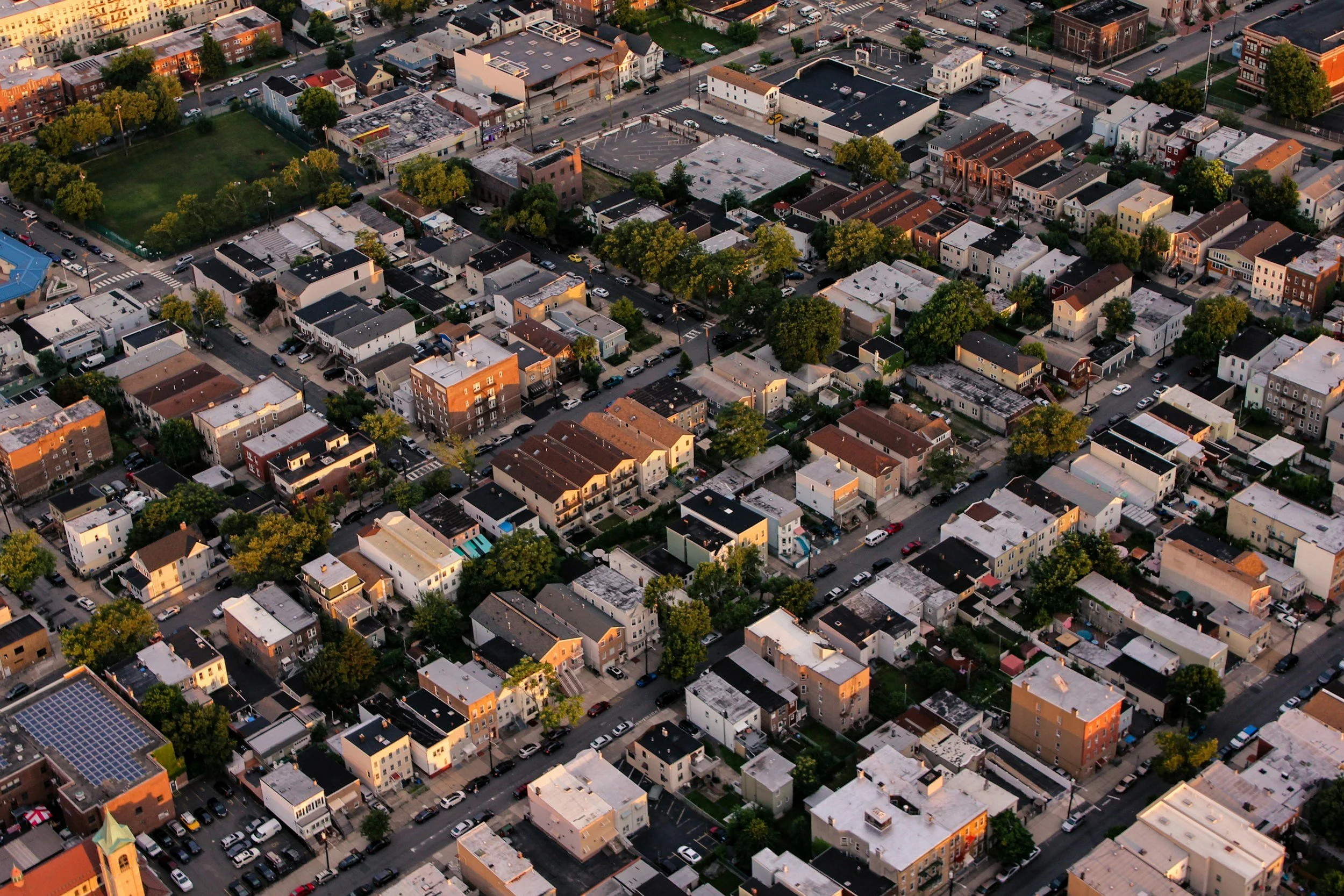
This article seeks to understand whether features of neighborhoods influence how knowledgeable individuals are about local politics. Whether we are interested in traits of urban neighborhoods or describing the entire range of communities along the urban-rural spectrum, many features of communities have been used to distinguish between neighborhoods and communities. Density, sprawl, walkability, and a variety of other concepts have been developed to describe related but subtly distinct features of a community and its built environment. Prominent scholarship in political science, other academic disciplines, and even non-academic work has identified linkages between the traits of communities and key outcomes such as political participation, engagement, voting behavior, and social capital. Political knowledge, however, has received much less attention in these conversations.
Studying local political knowledge in survey research is challenging for the simple reason that so many cities and other municipalities exist. The most common methodologies for assessing political knowledge require questions and/or answers that are specific to the level or body of government in question. For example, when studying political knowledge at the national level, common questions ask survey respondents to identify the Secretary of State or identify the branch of government that rules on the constitutionality of laws. But when we want to ask about local political figures or local political institutions, every city and town has its own public and elected officials, its own rules for governance, and its own organizational structure. Knowledge questions then must be tailored to the place where each respondent lives, making a nationally representative study of local knowledge all but impossible.
In our study, we look at twenty cities across the U.S., a number of cities that makes question tailoring manageable while still offering a reasonable representation of different types of cities from all regions of the country. Map 1 shows the location of the cities in our study.
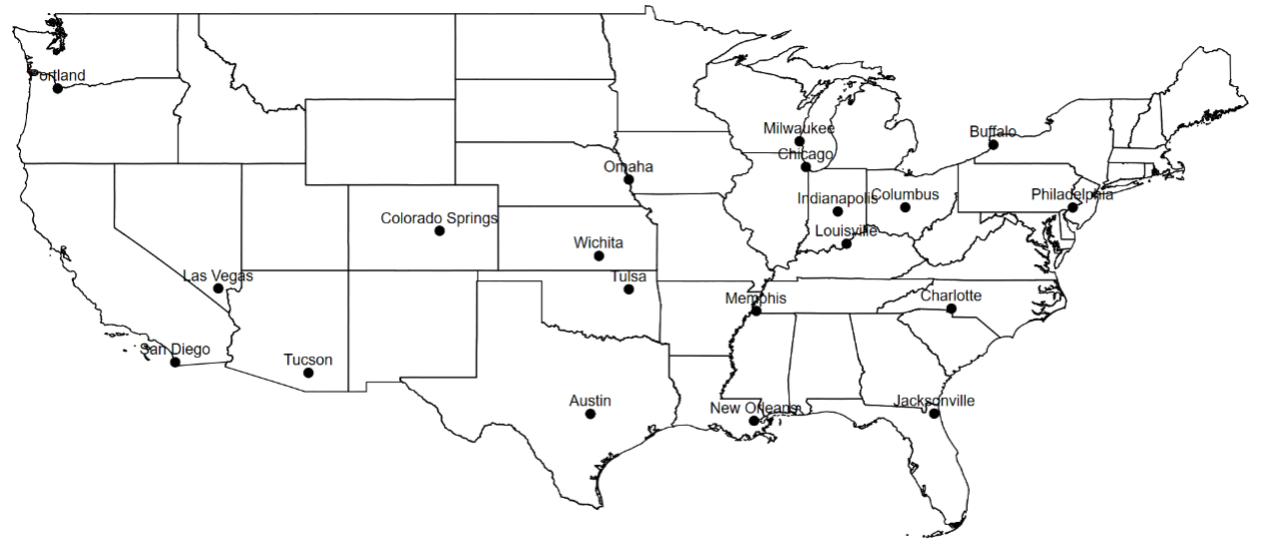
Map 1: Location of 20 Cities in the Study
Table 1 illustrates what the battery of questions looks like and how respondents performed on them. We ask each respondent whether they can identify the city’s mayor, the city’s police chief, the local office responsible for property valuations, and the term lengths and term limits faced by city mayors. (The table also reports results from an accompanying battery of questions regarding national political knowledge.)
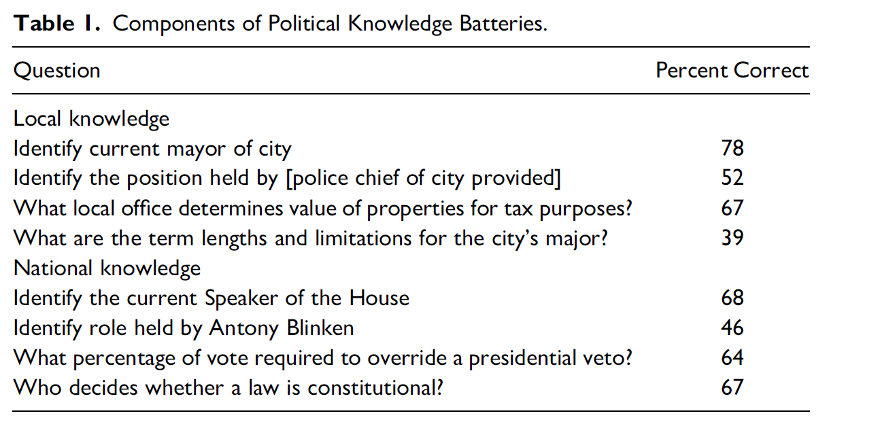
Focusing on the first two questions, 78% of respondents were able to identify the name of their mayor, while 52% could identify their police chief. Figure 1 also illustrates that these patterns vary across cities. For example, Louisville’s mayor and police chief were identified by the highest proportion of their constituencies, a pattern that might be traceable to their being in the news in 2022 in the wake of the Breonna Taylor shooting. At the other end of the spectrum, Colorado Springs citizens were among the last successful in identifying their mayor and police chief—understandable since both officials had taken up those positions less than a month before the survey was fielded.
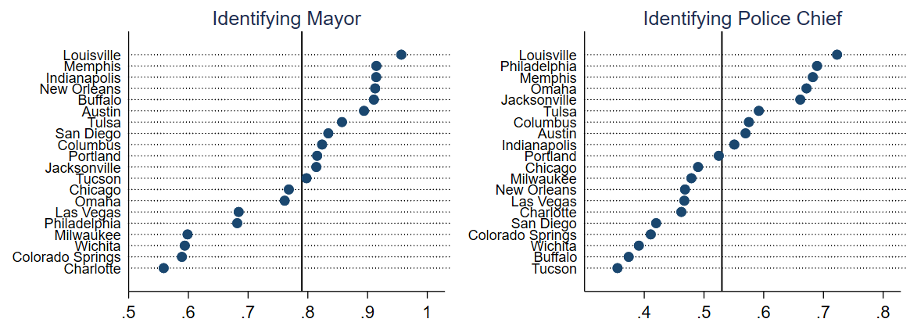
Figure 1: Proportion of City Respondents Identifying Officeholders Correctly
Returning to the question of neighborhood features, we looked at three traits often associated with discussions of sprawl (especially in prominent work by Hopkins and Williamson): population density, the proportion of residents who commute to work alone, and the median age of housing stock. We expected that denser places, places with less solo commuting, and places with older housing stock would promote stronger local political knowledge.
Our central finding is that age of housing stock is the one trait of neighborhoods (or to be more precise, ZCTAs) that is a consistent predictor of political knowledge. Persons who live in some of the oldest communities (i.e., a median housing age of 82 years) get 0.4 more questions correct (out of 4), on average, than persons who live in newer neighborhoods (i.e., a median housing age of 21 years). It is important to note that this finding is produced after controlling for a variety of other individual demographic traits. That is, similar persons (in terms of, for example, age, race, income, education, and gender) living in different types of neighborhoods have different levels of knowledge about local politics. Importantly, this linkage between housing age and knowledge holds only for knowledge about local politics, and does not extend to the second set of questions in Table 1 focused on national politics.
While other scholarship has treated age of housing stock as one indicator of sprawl, it is noteworthy that when it comes to political knowledge, this feature—and not more archetypal features of sprawl such as density and commuting—appears to be the crucial factor. Housing age, of course, does not just distinguish between older urban communities and new suburban developments. In cities with higher rates of new construction, housing age can also serve to distinguish between neighborhoods with historic single-family homes and neighborhoods with brand-new condominiums. And considering that our study focuses primarily on cities proper and less on their suburban peripheries, we should be hesitant to treat these findings as solely a story about suburban sprawl.
We hope that our work will begin a deeper exploration of political knowledge at the local level and continue to uncover the factors that explain differences across cities, across communities within cities, and over time.
Nick Clark is a professor of political science and chair of the Political Science Department at Susquehanna University. He teaches courses on public policy, comparative politics, the politics of Europe, and theories of democratic citizenship. His research broadly focuses on public opinion, political representation, and electoral behavior in advanced industrial democracies and seeks to empirically assess theoretical claims about the quality of democratic citizenship and governance in multilevel political systems.
Todd Makse is a professor in the Department of Politics and International Relations at Florida International University. His current research includes work on expertise and networks in state legislatures, the transmission of campaign information in social networks, and citizens’ knowledge about state and local politics.