Evidence from Texas
Jie Tao (Tarleton State University) and Brian K. Collins (University of North Texas-Denton)

Local officials face a stubborn challenge: public-safety gains can be fragile when budgets and political attention shift from year to year. Our new Urban Affairs Review study examines a practical governance tool that Texas communities have used to stabilize crime-control funding: Crime Control and Prevention Districts (CCPDs). The central takeaway is simple: cities that adopt CCPDs tend to see meaningful reductions in crime for several years.
What is a CCPD?
A CCPD is a citywide, voter-approved “subgovernment” that creates a revenue stream from local sales tax that is dedicated solely for crime control and prevention. Residents vote to add a small local sales tax, typically 0.25% or 0.5% and the money is earmarked for public safety rather than the city’s general fund. Texas law gives CCPDs wide discretion to fund a mix of strategies, from policing operations and technology upgrades to community prevention programs and diversion/treatment efforts. The CCPD is a form of collaborative local governance because it has its own board and budget but must coordinate with the city (often the police department) that carries out other programs using general funds.
CCPDs are especially common in the Dallas-Fort Worth (DFW) metroplex. In our study period (1985–2021), 32 DFW municipalities created citywide CCPDs, while 101 other municipalities in the same region did not. Adoption came in waves: the first district launched in the mid-1990s, many more followed in the late 1990s and 2000s, and a smaller set appeared after 2010.
Do CCPDs improve crime control and prevention?
That variation lets us ask a real-world question: when a city adopts a CCPD, does crime change compared with what likely would have happened otherwise?
The big finding: violence falls for a few years
We built a 37-year dataset for 133 DFW municipalities and compared CCPD adopters to “look-alike” municipalities with similar characteristics and pre-adoption crime patterns. This kind of apples-to-apples comparison is important to make the strongest argument.
Here’s what we found:
Violent crime: The strongest estimates indicate about 74 fewer violent crimes per 100,000 residents in year 2, and about 93 fewer per 100,000 in year 3. After about year 5, the effect shrinks toward “no difference.”
Property crime: Results are limited and inconsistent. Some estimates show declines, but most do not clearly differ from “no change.”
Homicide: We find no consistent, statistically detectable effect.
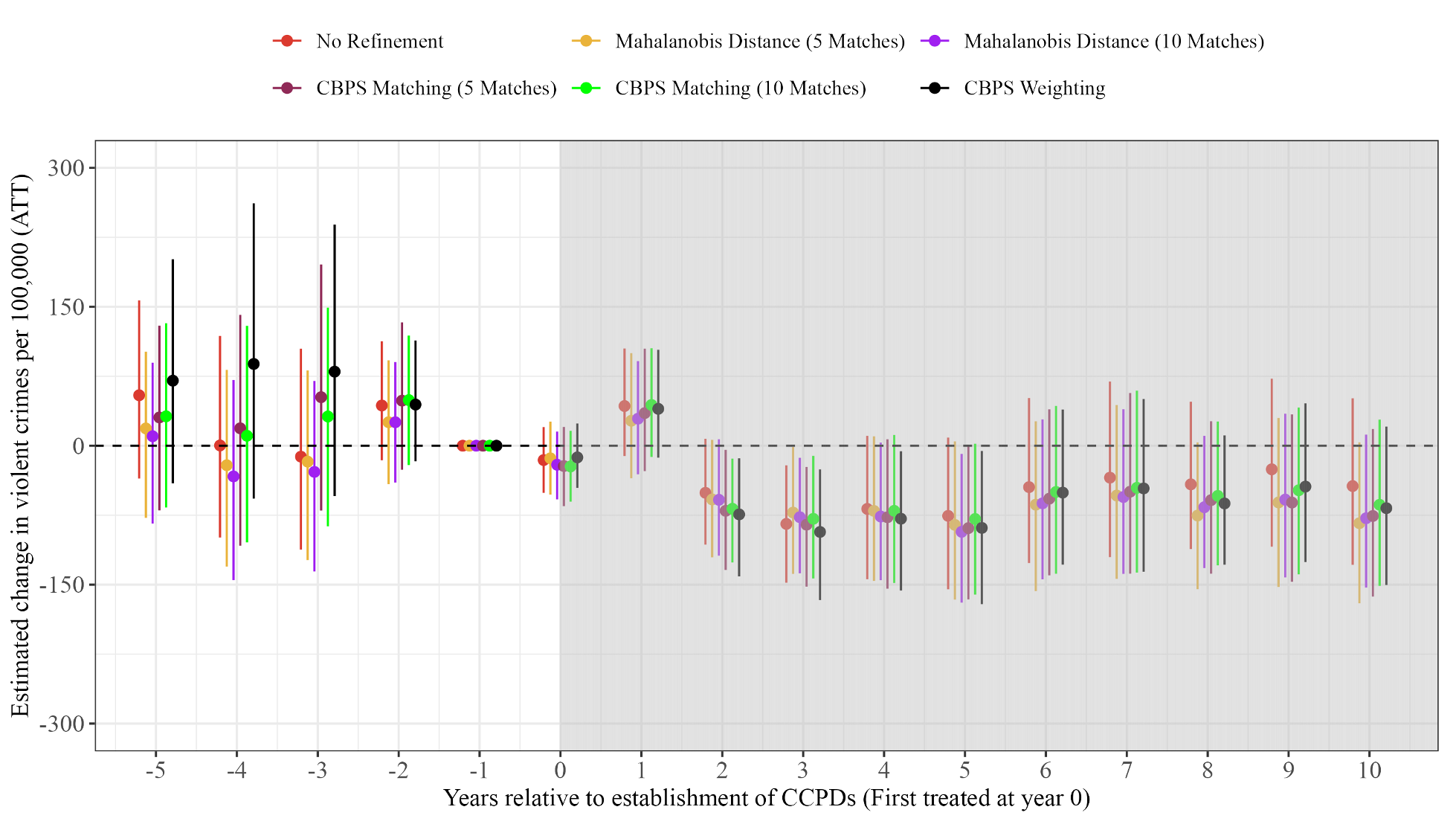
Figure 1. Estimated Effect of CCPDs' Creation on Violent Crimes (Matching Estimator)
Notes: The shaded region represents the post-treatment period. Vertical bars indicate 95% confidence intervals.
Why might CCPDs affect violent crime more than other crimes?
Violent crimes like assaults and robberies often cluster in particular hot spots and time windows, making them more responsive to strategies that increase visible guardianship (targeted patrol, rapid response, focused deterrence). Property crime is often more dispersed and opportunistic, and may require a different mix of programs like prevention partnerships, environmental design (lighting/visibility), and sustained work that changes routine opportunities for theft.
Homicide is also a relatively rare event in many municipalities. When counts are low, even meaningful changes can be hard to detect reliably.
The most actionable insight: plan for “year six” on day one
Our results suggest that stable funding can help create a short- to intermediate-run improvement in violent crime, but the benefit does not automatically last. One explanation is a “novelty effect”: new programs and resources initially bring extra focus, new deployments, and offender uncertainty. Over time, routines normalize and offenders adapt unless strategies keep evolving.
Another possibility is budget drift. Dedicated funds can gradually shift toward routine overtime, equipment replacement, administrative needs) instead of continually retargeted interventions. Fort Worth’s CCPD materials, for example, describe specialized deployments and overtime details aimed at specific activity centers. Such approaches can suppress violence in hot spots, but may not sustain broad reductions without ongoing adjustment. (Fort Worth Police)
What this means for voters and local leaders
CCPDs are a governance and finance tool that can create budget stability and programmatic innovation that matters for violent crime reduction. Three practical takeaways follow:
Treat a CCPD like a performance commitment, not just a revenue source. If residents approve a dedicated tax, they deserve clear goals, innovative programs, and plain-language reporting.
Build in scheduled strategy reviews. Expect that early gains can fade. Plan for formal “refresh” points (well before year 6) to retarget programs and modernize tactics.
Invest beyond enforcement. CCPDs can fund prevention and diversion, not only patrol. A diversified programmatic portfolio may be key to longer-run reductions.
One more point: unlike neighborhood-scale “extra services” districts that concentrate benefits in a few areas, DFW CCPDs are citywide. That design doesn’t guarantee equitable outcomes, but it should avoid building a few safe neighborhoods while leaving others behind.
Bottom line: Dedicated public-safety districts can help communities reduce crime. The communities that benefit most, however, will be the ones that pair stable funding with transparency and a willingness to adapt what they fund as conditions change.
Jie Tao is an assistant professor of public administration at Tarleton State University—Fort Worth. His research examines performance management, collaborative governance, and information and communication technologies, with an emphasis on artificial intelligence.
Brian K. Collins is an associate professor of public administration at the University of North Texas. He researches intergovernmental relations, citizen satisfaction, and public policy implementation in public health, finance, environmental regulation, and social equity.