Community Wealth Building Goes South
Reflections on Richmond’s Unfinished Journey to Build Community Wealth, 2011-2025
Thad Williamson (University of Richmond)
What happens when the former capital of the Confederacy sets out to become a capital of community wealth building?
This essay addresses that provocative question. First, I document efforts made in Richmond, Virginia since 2011 to develop and implement a coordinated strategy aimed at broadening socio-economic opportunity and reducing the city’s poverty rate, utilizing a “community wealth building” framework. Integral to this effort was the establishment of the nation’s first municipal Office of Community Wealth Building (OCWB) in 2014 by Mayor Dwight C. Jones, charged with leading “implementation of a comprehensive poverty reduction initiative for the City with the aim of improving access to educational and economic opportunities for residents of the city.”[1] This mission was affirmed by Jones’s immediate successor as mayor, Levar M. Stoney (2017-24), who expanded funding for the office, and the work of OCWB has also been embraced by Richmond’s newly elected mayor, Dr. Danny Avula (2025–present). Richmond’s poverty-fighting and community wealth building efforts have been sustained for over a decade, across three mayoral administrations—in itself, a significant accomplishment.[2]
Second, I document both known impacts from the work of the Office of Community Wealth Building, as well as observed macro-level changes in Richmond’s poverty rate over the 2008-12 to 2020-2024 period. Census data show that the poverty rate in Richmond fell from 26.7% to 18.2% over this period, the second-fastest fall among 19 comparable cities in the southeastern United States (with populations between 180,000 and 300,000). Available data indicate that this drop was not simply a result of displacement and gentrification, nor primarily a function of city population growth. Rather, it also reflected a significantly tighter labor market and demonstrable increases in earnings for workers with lower educational status, as well as significant increases in educational attainment among City residents in this period. Patterns of growth, mobility, and demographic change undoubtedly impacted Richmond’s decline in poverty, but OCWB workforce development initiatives, which can be construed as a municipal version of “active labor market policies,” appears to have made a tangible contribution to this observed progress. On the other hand, some of the ideas developed or piloted by OCWB over the past decade have yet to reach full fruition, and the city’s efforts to date to support affordable housing and offset gentrification are widely regarded as inadequate to the scale of the challenge of rising housing costs.
In the final section, I briefly reflect on the implications of Richmond’s experience with community wealth building for other U.S. cities.
Preliminaries: Defining “Community Wealth Building”
The term “community wealth building” was initially coined by the nonprofit organization The Democracy Collaborative in 2005 to describe economic development strategies aimed at deliberately broadening ownership of wealth, especially through institutional vehicles such as employee ownership, community land trusts, community development corporations, and other more democratic economic forms (The Democracy Collaborative, 2005; see also Williamson, Imbroscio, and Alperovitz, 2002). Early high-profile applications of the concept often turned to harnessing the purchasing power of large urban anchor institutions as a largely untapped mechanism for redirecting the flow of economic resources into neglected neighborhoods and fostering more democratic forms of ownership (Alperovitz, Howard and Williamson, 2010). The most sophisticated and impactful applications of this version of the concept are now widely acknowledged to be in the UK (e.g. “The Preston Model”), although a variety of U.S. cities have also adopted the approach (Guinan and O’Neill, 2019; The Democracy Collaborative, 2025).
In related work, Melody C. Barnes and I have sought to expand the Community Wealth Building concept from simply an economic development strategy to a broader governance paradigm that might be applied at the municipal, state, and even national levels (Barnes and Williamson, 2020). Community Wealth Building as a policy paradigm aims to guide both localities and higher levels of government in the specifics of building more equitable communities, informed by a robust commitment to inclusive democracy. In straightforward terms, community is seen as an indicating a commitment to egalitarian inclusion and to specific geographic places as the locus for action; wealth is understood as marking the critical significance of material (not only symbolic) distribution and redistribution of multiple types of tangible resources; and building is seen as a recognition that significantly altering the distribution of wealth, resources, and opportunity in any particular place is necessarily a long-term project, not a snapshot policy. This conceptualization of Community Wealth Building stipulates four principles of action:
Inclusive and meaningful participation of local community members and persons directly impacted in the design and delivery of policies and plans;
Establishing bold equity goals that measure not just activity but actual change in long-standing disparities;
Embracing a holistic approach to wealth, encompassing financial capital, physical capital, human capital and social capital, and all private, public, and community-held assets that impact financial, physical, social and relational well-being;
Commitment to inclusive economic strategies that produce shared prosperity by reshaping resource flows and ownership patterns in a more equitable direction, while bolstering the capital and resources available to communities
As seen below, Richmond’s approach was born in part of recognition of the need to develop a holistic strategy addressing the interconnected sectors of workforce development, economic development, housing, transportation, and education simultaneously.
Part One: Initial Development and Implementation of Richmond’s Community Wealth Building Program
In spring 2011 Richmond Mayor Dwight C. Jones announced the formation of the Mayor’s Anti-Poverty Commission, composed of over forty community members across multiple sectors, to “develop strategies to address poverty that have demonstrable results for increasing employment and educational attainment, improving transportation, and enhancing healthy communities for Richmond residents.”[3] The Commission’s 130-page final report, released in January 2013, provided a detailed statistical look at poverty in the City of Richmond; a historical section noting major decision points leading to the concentration of poverty in Richmond; and summaries of the commission’s research, findings, and policy proposals. The report identified five high-level policy priorities:
(1) improving Richmond’s educational system encompassing early childhood, K-12 education, and transition into college or workforce training;
(2) strengthening workforce development opportunities for city residents in ways tailored to their needs;
(3) creating or attracting more living-wage jobs to the city, including one or more major employers;
(4) developing a citywide strategy to expand affordable housing while pursuing redevelopment of public housing with a commitment to one-for-one replacement of public housing units; and
(5) developing a proper regional transportation system (City of Richmond, 2013).
With support from the mayor’s office, Councilwoman Ellen Robertson and I co-chaired an additional year of work to translate these general recommendations into practical action. That effort, dubbed the Maggie L. Walker Initiative for Expanding Opportunity and Fighting Poverty, included seven additional task forces tasked with identifying specific action steps to be undertaken by the city government, consistent with the framework of the Anti-Poverty Commission report. The initiative also established the Maggie L. Walker Citizens Advisory Board, consisting primarily of residents living in poverty or in low-income neighborhoods, to vet all proposals.
In March 2014, Mayor Jones introduced a budget proposal with $3.4 million dedicated to new poverty-fighting initiatives specified by the Maggie L. Walker Initiative. This included $1 million of initial capitalization for the city’s Affordable Housing Trust Fund, previously established but never funded; a local match on a federal application to establish a Broad Street Bus Rapid Transit line to connect the breadth of the city east-west; funding to expand the city’s pilot workforce development program, the Center for Workforce Innovation; funds for economic development including a social enterprise initiative; and funds for after-school programming for middle school students, an initiative to connect high school students to college opportunities, and early childhood education. The proposal also established a new entity within City Hall, initially termed the “Mayor’s Office for Community Wealth Building,” charged with coordinating implementation of the initiatives, communicating the overall plan to stakeholders within and outside of government, and providing ongoing policy and strategic guidance on poverty reduction efforts to the mayor. The adoption of the term “community wealth building” was a deliberate shift out of concern that “anti-poverty” might be heard as “anti-poor people,” intended to signal an emphasis on a holistic approach to community and human development. City Council approved these plans during the budget process, and I was appointed by Mayor Jones as the inaugural director of the Office of Community Wealth Building, effective June 1, 2014.
Much of our initial work in the Office of Community Wealth Building involved collaborations with established city agencies, as well as Richmond Public Schools, Richmond Redevelopment & Housing Authority, and key nonprofit partners. In June 2015, Mayor Jones and OCWB announced the formal goal of cutting overall poverty in the City of Richmond by 40% (i.e. from 25% to 15%) and child poverty by 50% (i.e. from 40% to 20%) by the year 2030.
The principal vehicle initially identified to spearhead progress on the goal was the city’s fledgling Center for Workforce Innovation (CWI), launched in 2010 as a partnership between the Department of Economic and Community Development and the Department of Social Services. The community wealth building initiative provided enhanced operating funds for the Center, which at the time had a small staff of workforce specialists and administrators working out of its ground level office directly across City Hall. In 2014-15, the new funding also permitted establishment of a holistic, family-based program, eventually titled BLISS, which sought to engage public housing residents with not only workforce development support but a wide variety of supports aimed at identifying and removing barriers to progress, with the goal of helping residents obtain secure employment and improved housing. The program used a comprehensive matrix capturing 18 areas of family well-being from “crisis” to “thriving,” tracking progress for each family in each category on a quarterly basis. In December 2015 both BLISS and the overall Center for Workforce Innovation were formally transferred to the Office of Community Wealth Building upon OCWB’s establishment as a permanent city agency. By 2016, the Center was helping over 200 residents a year find employment, a figure that would rise after OCWB received a five-year matching grant from the Virginia Department of Social Services to expand capacity starting in 2017.
The first iteration of community wealth building strategy in Richmond aimed to provide support to residents in obtaining living-wage jobs, via trainings, certifications, and additional supports; to expand access to existing employment opportunities regionally through better public transit; to expand the number of living wage jobs in the city itself; and to attempt to support and expand smaller businesses, especially Black-owned businesses, while working toward development of a social enterprise sector. The intent was to build linkages and connections between Richmond’s deep pockets of concentrated wealth and its deep pockets of concentrated poverty, so that subsequent growth might actually lead to tangible reductions in poverty (Griego, 2014). At the same time, this employment-based strategy would be matched with longer-term strategies to improve educational outcomes and housing, as well as advocacy for policy changes at both the local and state level. Progress on employment was seen as the leading edge of the strategy, insofar as it
(1) provided the most immediate means of getting cash to residents;
(2) could help stabilize families and thereby enhance learning and educational progress for children; and
(3) could make it easier for families to obtain quality housing.
Table 1 details the variety of specific policy and programmatic steps over the past decade undertaken by the City of Richmond, including but not limited to efforts of the Office of Community Wealth Building, in connection with the city’s stated commitment to poverty reduction. While most of these initiatives trace to the recommendations of the Mayor’s Anti-Poverty Commission and the subsequent work of the Maggie L. Walker Initiative described above, others reflect new ideas developed by OCWB as well as other city leaders and community partners over the past decade.
Table 1. Summary of Community Wealth Building-Related Policy Steps in Richmond, 2013-present
Education
● Establishment of RVA Future Centers (to support college and career planning for high school students), 2015-present
● Expansion of after-school programming, 2014 -present
● Establishment of a pre-K community reading program, 2015-present
● Establishment of an Early Childhood Action Council leading eventually to establishment of an Office of Children and Families (2014-present)
● Establishment of RVA Education Compact as collaboration framework among Mayor, City Council, School Board (2017-22)
● Significant expansion of city funding for Richmond schools (2017-present)
Employment/workforce
● Expansion of locally funded workforce development program offering training, job placement, wrap-around support services (2013-present, expanded dramatically after a 2017 Virginia Department of Social Services Grant)
● Creation of holistic family-based model of workforce support (BLISS) (2015-2023)
● Partnerships with employers, job fairs (2013-present)
● Launch of Mayor’s Youth Academy (summer teen employment program) in 2010; incorporated into Office of Community Wealth Building (2016 - present); served 700 youth in summer 2025
● Creation of satellite workforce development program within Parks & Recreation (2018-present)
● Expanded investment in Port of Richmond (2015-present)
● Various economic development projects/relocations/expansions drawing on tangible or intangible resources (2014-present)
● Office of Community Wealth Building/Virginia Interfaith Center for Public Policy Living Wage initiative (2018-2021)
● Increased pay for City Hall employees (2020-present; $20/hr minimum starting FY 2025)
● Approval of collective bargaining for City of Richmond and Richmond Public Schools employees and completion of initial contracts (2022 - present)
● Minimum wage increases in Commonwealth of Virginia (2021-2026, from $7.25/hr to $12.77/hr currently)
● Richmond Guaranteed Income Pilot Program (2020-present)
● Adoption of Strategic Plan for Equitable Economic Development (2022)
Transportation
● Establishment of east-west Bus Rapid Transit line (GRTC Pulse) (opened June 2018)
● Expansion of bus service in counties (2018 - present)
● Creation of an Office of Equitable Transit and Mobility within the Department of Public Works (2020)
● Zero-fare ridership (2020-present)
Housing and Health
● Community health resource centers in public housing communities (2009-present)
● Community health navigators program (2014-present)
● Informed Neighbors programs associated with public housing redevelopment (2013-present)
● Creighton Court (public housing) redevelopment (2016-present)
● Affordable Housing Trust Fund (funded and operational 2014-present)
● Maggie L. Walker Community Land Trust (launched in 2016; designated as city’s Land Bank, 2018)
● Eviction Diversion program design and launch, 2019-present
● Creation of Health Equity Fund, 2021-present (using American Rescue Plan Act funds)
● Establishment of affordable housing performance grants, 2023- present
Governance/Community Engagement
● Establishment of Maggie L. Walker Citizens Advisory Board (2014)
● Establishment of annual public reporting requirement for Mayor and Office of Community Wealth Building (2015)
● Establishment of “Ambassadors” program consisting of past OCWB participants, first for OCWB and now for City of Richmond (2017)
● Adoption of Richmond Equity Agenda (2021) detailing numerous policy commitments in support of racial equity
● Inclusion of specific economic equity and community wealth building goals in the Mayoral Action Plan (2025), the city’s current strategic plan
● Endorsement by three successive Mayors (Dwight C. Jones, Levar M. Stoney, Danny Avula) and four successive cohorts of City Council, 2014-2025
Part Two: Assessing Progress
Over the past decade, the City of Richmond has undoubtedly undertaken many activities aimed at mitigating or reducing poverty, with a specific strategic focus on helping low-income residents obtain better-paying employment. Have these efforts made an impact?
We begin a preliminary answer to that question by looking at macro-level changes in Richmond over the past decade. Table 2 below shows Richmond is over halfway towards meeting the stated objective of reducing poverty 40% (i.e. from 25% to 15%) and child poverty by 50% (from 40% to 20%). The most recent 5-year American Community Survey (ACS) data (reflecting the years 2020-2024) show poverty has fallen to just above 18%, and that child poverty has fallen to just above 28%. These changes reflect absolute declines in the number of people below the poverty line in Richmond, not just population increases. For instance, the 2008-12 5-year ACS data reported approximately 52,300 city residents in poverty; in 2020-2024, just 40,000 residents fell below the poverty line. Looking over the period 2008-2012 (the five years prior to the publication of the catalytic Mayor’s Anti-Poverty Commission Report) to 2020-2024 (most recent available five-year data point), the poverty rate in Richmond fell much faster than it did either statewide or nationally (see Table 3a).[4]
Equally notable, of nineteen cities in the southeastern United States (excluding Florida and Texas) with populations between 180,000 and 300,000, Richmond’s poverty rate fell the second-fastest in percentage terms over this twelve-year span, behind only Durham, North Carolina. (See Table 3 for detail.) This finding indicates that the decline in Richmond’s poverty rate does not simply reflect nationwide declines in poverty, but also more localized factors.[5] This decline is notable as well insofar as poverty did not increase in Richmond’s neighboring suburbs over this time period; nor did Richmond in fact redevelop the great bulk of its large public housing communities (the only traditional public housing in the region), although redevelopment of one of Richmond’s “big six” communities began in the early 2020s.
Table 2. Poverty by Demographics in Richmond: Continuity and Change, 2008 – 2024
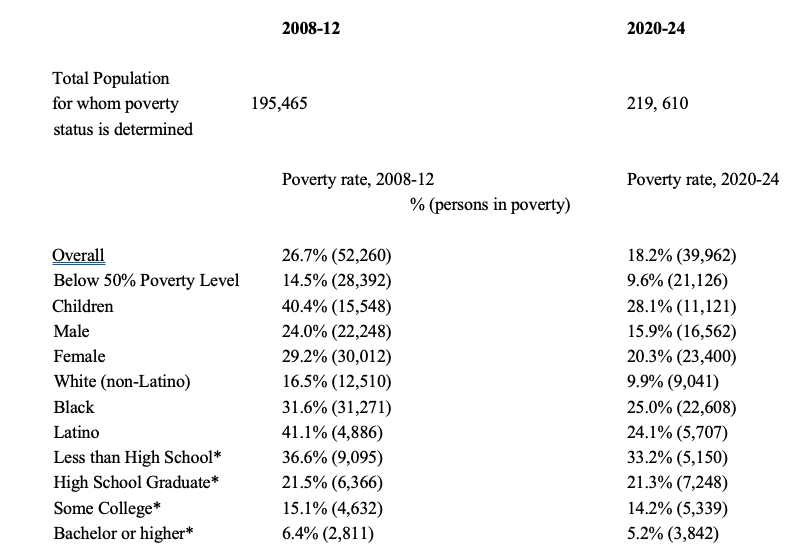
* Totals by educational status refer to adults aged 25 and over
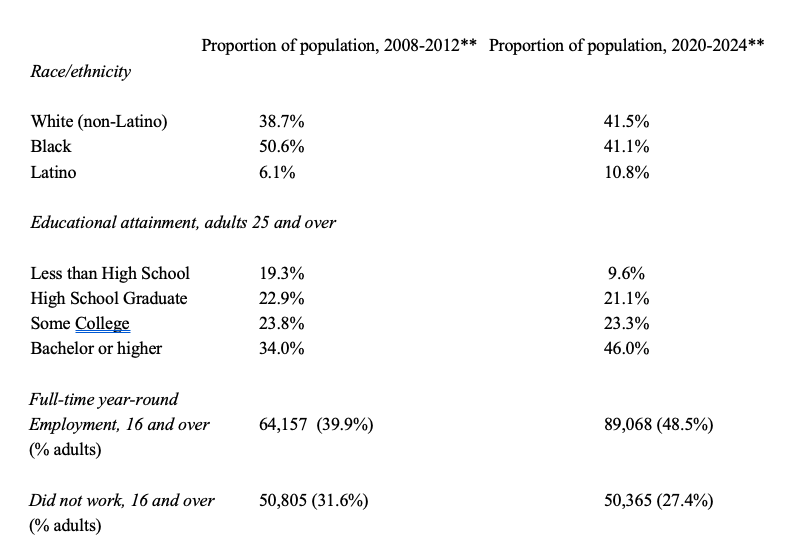
** Population totals and proportions refer to persons for whom poverty status is determined. Source: American Community Survey five-year estimates, 2008-12 and 2020-24
Table 3. City of Richmond Long Term Poverty Trend in Comparative Perspective
Proportion of residents in poverty, followed by total residents in poverty, in thousands (U.S. in millions).
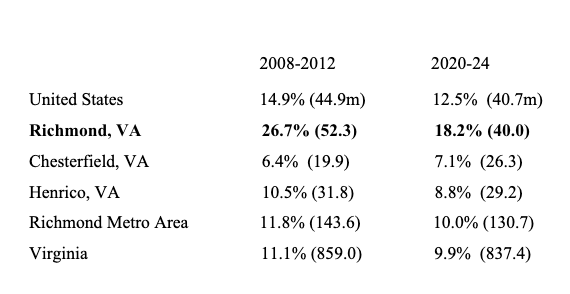
3a. Richmond Poverty Decline in Regional, State, and National Context.
Chesterfield and Henrico are Richmond’s two adjoining suburban counties. The Richmond Metro area comprises thirteen counties and four independent cities; Virginia independent cities are separate entities from counties and are treated as county equivalents by the U.S. Census.
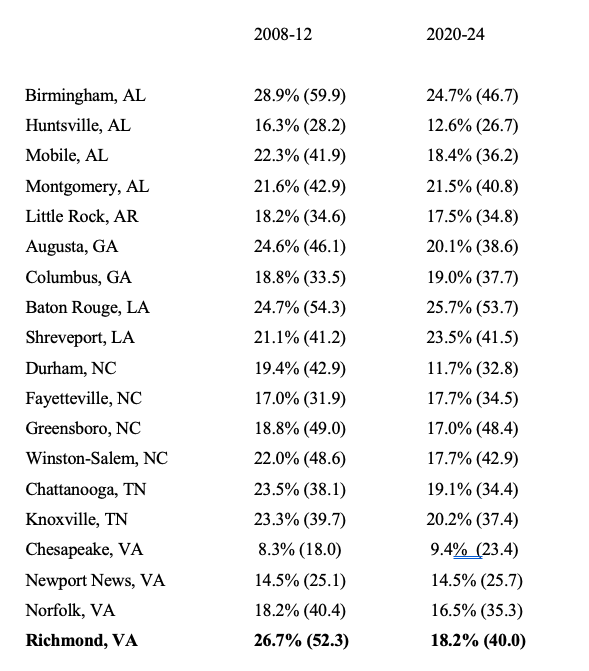
3b. Southeastern cities (AL, AR, GA, LA, MS, NC, SC, TN, VA) with 2020 population between 180,000 & 300,000. Richmond’s 2020 population was approximately 226,500.
Source: American Community Survey five-year estimates, 2008-12 and 2020-24.
Table 2 provides more detailed information about the intersection between demographic change and changes in the poverty rate. Three important facts stand out: first, the poverty rate declined among each of the three largest racial/ethnic categories in the City of Richmond in this time period. Second, the proportion of city residents in extreme poverty declined markedly, by one-third. Third, a considerable portion of Richmond’s poverty decline can be attributed to changes in the educational profile of the city population over this time period. Specifically, the percentage of residents without a high school diploma dropped by one-half, while the proportion of city residents with a college degree increased sharply, by over one-third. This significant change squarely aligns with the strategic goal identified by the Mayor’s Anti-Poverty Commission of nurturing a better educated residential population.[6]
Available data also shows, however, clear gains for economically disadvantaged residents in Richmond over the past decade, as shown in Table 4. The Black unemployment rate has fallen by one-third, while real per capita income for Black city residents has increased by nearly one-fifth. Most notably, estimated median earnings among Richmond’s least-educated residents (with less than a high school diploma) rose substantially over this time period, controlling for inflation: from $21,223 (2008-12) to approximately $28,783 (2020-2024), in 2024 dollars, an increase of over one-third. (The federal poverty line for a family of three in 2024 was $25,820.) The proportion of adults employed full-time year-round also increased by over one-fifth over this decade. (See Table 2). Finally, the proportion of city residents without health insurance declined by one-half, following implementation of the Affordable Care Act and (in more recent years) Medicaid expansion in Virginia.
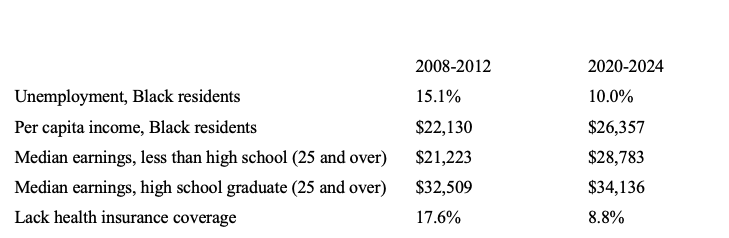
Table 4. Earnings and Employment, 2008-2024, Selected Indicators
All monetary figures in inflation-adjusted 2024 dollars
Source: American Community Survey five-year estimates, 2008-2012 and 2020-2024, via Social Explorer
Positive as they are, many of these changes closely track national trends–indeed, Black unemployment fell even faster nationally than it did in Richmond over this time period. On the other hand, one of the key metrics identified by the Mayor’s Anti-Poverty Commission as critical to future improvement– the proportion of adults working full-time year-round–increased much faster than the national trend.[7] Those observations lead to this question: To what extent did activities of the Office of Community Wealth Building contribute to these observed reductions in poverty and increase in earnings for disadvantaged groups in Richmond?
This is an inherently difficult question to answer definitively in the absence of longitudinal data tracking individuals’ economic and geographic mobility over time. Population-level estimates available through the Census do not allow us to conclusively determine the degree to which observed poverty reductions may reflect (a) low-income residents leaving the city due to rising housing costs associated with the city’s recent growth; (b) upwardly mobile low-income residents choosing to leave the city to access improved housing and better educational opportunities; or (c) in-place upward economic mobility whereby city residents increase incomes and choose to stay in the city.[8] That cautionary observation speaks both to the need for long-term longitudinal data and the need to complement city-level assessments with regional-level analyses of poverty and economic mobility in Richmond and other urban areas.
Here, too, it is important to stipulate that the goal of OCWB has always been to catalyze systemic policy change across multiple areas, including transportation, education, economic development, health, and housing, as well as workforce development. Over the past ten years Richmond has seen the development of BRT, the creation of the RVA Future Centers to help connect graduating RPS students to opportunities, establishment of a Living Wage initiative, various economic development successes, and initiatives to support affordable housing and the health and well-being of residents in public housing communities—in addition to the expanded investment in workforce development targeted to persons in poverty led by OCWB. OCWB’s approach is in effect threefold: pushing to improve policy by removing barriers and adding support for economically disadvantaged residents; creating more quality economic opportunities accessible to residents; and preparing and supporting residents to take advantage of those opportunities. It is this holistic picture which needs to be kept in mind, recognizing that it can be difficult to quantify.
Nonetheless, it is possible to quantify some elements of OCWB’s specific impact over this period. OCWB staff report that there were at least 2,420 employment placements through its workforce development programs between July 2014 and July 2024 (City of Richmond, 2025a). Including children living in these households, we can conservatively estimate that well over 3,000 people benefitted (at least temporarily) from living in a household with greater income due to enhanced employment. It is also possible that the thousands of other residents (including youth) who received summer employment, training or other services through OCWB derived economic benefits from this engagement. Given that the number of people in poverty (excluding undergraduate college students) in Richmond declined by about 8,300 over this period, it appears likely that OCWB services made a meaningful contribution to that trend that helped Richmond’s poverty rate decline more quickly than it might have solely as a function of positive national economic trends or local demographic changes.
Here it may be helpful to stipulate exactly how OCWB services benefit residents above and beyond previously existing programs. Richmond’s Department of Social Services previously ran, and continues to run, the VIEW (TANF) workforce program, and Richmond residents also have access to federally funded regional workforce centers and regional community college programming. The Office of Community Wealth Building, as a locally funded program, has broad flexibility to meet the needs of residents facing severe and complex challenges. Workforce services are open to all City residents, with no means testing, and there is no time limit on accessing services so long as participants remain active. OCWB provides general workforce preparation classes (including so-called “soft skills”) but also can pay for and help participants enroll in a range of certification, training, and educational programs. Participants are matched with case workers who seek to take a holistic approach to identifying and seeking to address common barriers to obtaining and sustaining employment, including frequent challenges with transportation and childcare, and also work with participants to develop a longer-term career plan. Promoting self-confidence and a sense of agency is also an important part of the approach. At the same time, OCWB has worked to build close relationships with employers, understand employer needs, and provide training and programming accordingly (sometimes, in partnership with local labor unions). The overall philosophy of maintaining a holistic approach to services, remaining available to all city residents without restriction, and seeking to match services offered with employer needs has remained consistent since OCWB’s inception.
Examining this evidence, the progress in poverty reduction in Richmond clearly is centrally related to a strong economy driving down unemployment, especially Black unemployment, as well as to a variety of policies aimed at raising minimum wages. The tight labor market means employers must go deeper into the pool of available workers to find new employees, and the enhanced wage level (and tighter labor market) means relatively low-skilled workers are getting paid more than a decade ago. These effects mirror the expectations laid out in recent scholarly analyses of the close connection between tight labor markets and poverty reduction (Jacobs and Newman, 2023). The Office of Community Wealth Building works to capitalize on these positive trends by making it easier for underemployed City residents to re-enter or strengthen their position in the labor market, and by building relationships with employers to make it more likely that OCWB participants can obtain available jobs. In short, OCWB acts as an “active labor market” institution proactively connecting residents with employers, acting as a bridge, a source of social capital, and as a certifying agent.
There are still of course many important unanswered questions. OCWB needs stronger longitudinal tracking tools to better prove its long-term impact on residents’ lives and economic prospects, and also to better understand the ongoing barriers residents face. There is concern that a significant downturn in the national economy could reverse these positive trends. And there is the reality that many of the structural factors reproducing racial and economic inequality, such as inequitable schools, inequities in transportation, and lack of affordable, quality housing, remain largely in place. Even if the nearly one-third reduction in poverty is sustained, further decreases may be more difficult to achieve without significant new resources and new investments to address long-standing needs.
Implications for Other Cities
The community wealth building initiative in Richmond has somewhat self-consciously acted in the modality of social change described by Erik Olin Wright as “symbiotic” in which there is an overlap of interest between elite and mass actors, creating space for action and resource redistribution benefitting mass groups over the long run (Wright, 2010). Very little of what has taken place officially under Richmond’s Office of Community Wealth Building has been perceived as threatening by elite interests in Richmond, and while the agency’s work has strong community support from the thousands of residents who have engaged with or benefited from the office, it has neither courted nor received much vocal support (or for that matter, criticism) from local activist voices.[9] Yet at some point to truly confront Richmond’s entrenched patterns of segregation, a more direct challenge—not simply to “elites,” but to the assumed prerogatives of relatively well-off, predominantly white residents–will be required, at both the local and state level.
In short, community wealth building in urban contexts is a long-term project that requires adept toggling between modalities of outside activist pressure to undertake or expand a specific action, and “insider” execution of programs and policies once political support for an idea has been developed. A key implication for progressive policymaking in other cities of what has happened in Richmond is the critical importance of focusing not just on policy but on institution-building. The creation of a city agency dedicated specifically to economic inclusion of the city’s most marginalized residents has given Richmond an established institutional vehicle for implementing ideas that were previously considered not politically or fiscally feasible (such as guaranteed income). The legally mandated public reporting process obligating the mayor to personally submit an annual public report to City Council has helped assure that neither the initiative nor the underlying inequities it seeks to address can long disappear from public view. Further, OCWB now has a body of work and reputation independent of any individual political figure or staff member and continues to have wide (though not always uncritical) buy-in from elected leaders. Progressive advocates should continue to look for opportunities within their own contexts to create or re-shape permanent institutional and governance mechanisms that both make equity and wealth building concerns part of the permanent work of local government and that elevate their salience for both elected leaders and citizens.
Notes
[1] City of Richmond ordinance (2015-240-236), adopted December 14, 2015.
[2] Disclosure: I played a significant leadership role in this effort, especially over the period 2012-2017, including authoring the Mayor’s Anti-Poverty Commission Report, co-chairing the subsequent implementation planning process, serving as the inaugural director of the Office of Community Wealth Building (OCWB) from 2014-2016 under Mayor Dwight C. Jones, and helping obtain expanded funding for OCWB in 2017 in my role as senior policy advisor to Mayor Levar M. Stoney (2017-18). I currently serve (2025 – present) as senior policy strategist for Mayor Danny Avula. This paper reflects my own analysis and does not represent the views of the City of Richmond or any other organization.
[3] This section of the paper draws in part from Williamson, Hayter and Howard (2024), pp. 175-180.
[4] One factor driving the decline in the absolute number of persons in poverty in Richmond is a nearly one-third decline in the number of undergraduate college students included in the Census’s poverty estimates between 2008-12 and 2020-24, likely as a result of dormitory expansion by Virginia Commonwealth University downtown in this time period. College students living in dormitories are not counted in official Census estimates of poverty. Excluding undergraduate college students altogether, the poverty rate in Richmond fell from 24.3% in 2008-12 to 16.9% in 2020-24–over a 30% decrease.
[5] Notably, Durham itself also launched a “Mayor’s Poverty Reduction Initiative” under Mayor Bill Bell in 2014, which targeted resources to high-poverty census tracts in Durham. Durham has also experienced rapid population growth in the past decade, likely contributing to the decline in its poverty rate. Fuller discussion is beyond the scope of this paper but certainly merits further study and comparative analysis.
[6] At the same time, this trend raises complex questions about the extent to which this observed change may reflect various factors such as (1) generational transition (2) improved high school graduation rates and connections to post-secondary opportunities (3) the influx of new, better-educated residents and (4) patterns of displacement related to gentrification. There is good reason to think each of these factors, and likely others, are in play in Richmond. Notable in this regard is that the estimated number of teenagers (16-19) in Richmond not employed and not enrolled in school (often referred to as “opportunity youth”) declined from 1,488 (11.2%) in 2008-12 to 587 (4.9%) in 2020-24–a dramatic decline not mirrored in national data or readily explained by mobility patterns. Further examination of these factors in Richmond and comparable cities is warranted.
[7] Nationwide, the proportion of adults (for whom poverty status is calculated) working full-time year-round rose from 41.8% to 44.4% between 2008-12 and 2020-24, compared to an increase in Richmond from 39.9% to 48.5%.
[8] Schools facilities as well as educational outcomes in neighboring Henrico County and Chesterfield County are markedly stronger than in Richmond Public Schools; geographic mobility (leaving the city) for many households may be part of an upward mobility strategy.
[9] Here it is worth noting the tension between the aspirations of OCWB—which is itself generally supported and respected by residents—and other parts of recent Richmond mayors’ economic development agendas which have attracted significant activist opposition. In particular, City Council and voter referenda blocked major projects championed by Mayors Jones and Stoney as well as prominent business leaders over the 2015-2023 period. Related to this, Richmond explored but to date has not yet taken significant action on developing an anchor-based social enterprise initiative patterned after the Evergreen Cooperatives in Cleveland, although there is still interest in supporting cooperatives and worker-owned firms. (City of Richmond, 2025b.)
References
Alperovitz, Gar, Ted Howard, and Thad Williamson. February 11, 2010. “The Cleveland Model.” The Nation.
Barnes, Melody C. and Thad Williamson. 2020. “Becoming the American Community We Should Be—But Never Have Been,” in Melody C. Barnes, Corey D.B. Walker, and Thad Williamson, eds. Community Wealth Building and the Reconstruction of American Democracy: Can We Make American Democracy Work? Edward Elgar.
City of Richmond. January 18, 2013. Mayor’s Anti-Poverty Commission Report.
City of Richmond. October 14, 2025. Office of Community Wealth Building FY 2025 Annual Report.
City of Richmond. October 15, 2025. Mayoral Action Plan.
The Democracy Collaborative. 2005. Building Wealth: The New Asset-Based Approach to Solving Social and Economic Problems. Aspen Institute.
The Democracy Collaborative. 2023. “Action Guide for Advancing Community Wealth Building in the United States” available at https://www.democracycollaborative.org/whatwethink/community-wealth-building-action-guide.
Griego, Tina. November 7, 2014. “Can Concentrated Wealth Relieve Concentrated Poverty?” (interview with Thad Williamson) Washington Post.
Guinan, Joe and Martin O’Neill. 2019. The Case for Community Wealth Building. Wiley.
Newman, Katherine S. and Elizabeth S. Jacobs. 2023. Moving the Needle: What Tight Labor Markets Do for the Poor. University of California Press.
Williamson, Thad, David Imbroscio, and Gar Alperovitz. 2002. Making a Place for Community: Local Democracy in a Global Era. Routledge.
Williamson, Thad, Julian M. Hayter, and Amy L. Howard. 2024. The Making of Twenty-First Century Richmond: Politics, Policy, and Governance, 1988-2016. University of North Carolina Press.
Wright, Erik Olin. 2010. Envisioning Real Utopias, Verso.
Thad Williamson is Professor of Leadership Studies and Philosophy, Politics, Economics & Law at the University of Richmond. His publications include Making a Place for Community: Local Democracy in a Global Era (co-authored with David Imbroscio and Gar Alperovitz, 2002); Sprawl, Justice and Citizenship: The Civic Costs of the American Way of Life (2010); Property-Owning Democracy: Rawls and Beyond (co-edited with Martin O’Neill, 2012); Can We Make American Democracy Work? Community Wealth Building and the Reconstruction of American Democracy (co-edited with Melody C. Barnes and Corey D.B. Walker, 2020); and The Making of Twenty-First Century Richmond: Politics, Policy and Governance, 1988-2016 (co-authored with Julian Hayter and Amy Howard, 2024). He also has held several roles in Richmond city government across three mayoral administrations, including serving as the inaugural director of the city’s Office of Community Wealth Building.