AI and the Uneven Future of Urban Infrastructure
Eric Stokan (University of Maryland-Baltimore County), Aaron Deslatte (Indiana University Bloomington), and Jesse Barnes (University of Texas at San Antonio)

Cities are increasingly turning to AI to address many public service delivery challenges. From handling residents’ requests to modeling energy demand and detecting water leaks, AI tools offer local governments new ways to manage their core challenges. Despite considerable concerns, AI's promise is especially appealing to communities struggling with aging infrastructure, limited resources, and persistent environmental burdens.
But are the communities most in need of AI tools the ones best positioned to reap its benefits?
Research increasingly suggests that local governments with greater organizational capacities and overall capability are adopting AI more rapidly. This pattern raises concerns about an AI digital divide in which higher-capability cities use the most advanced models to address their challenges, while lower-capability governments are left behind. The implications grow when we move from using AI models to address resident comments to tackling energy, transportation, water, and infrastructure-related problems.
Connecting AI adoption with community needs
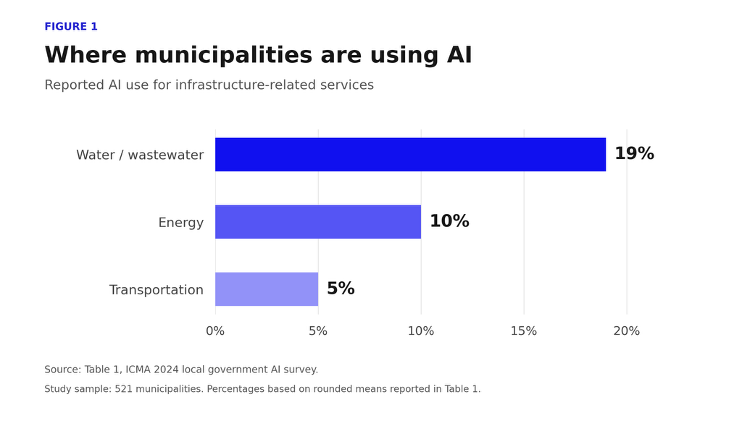
Our study examines AI use among 521 U.S. municipalities. We combined the International City/County Management Association’s 2024 national survey of local governments’ AI practices with neighborhood-level indicators from the federal Climate and Economic Justice Screening Tool. AI practices in the ICMA survey map onto neighborhood-level indicators in three policy domains: energy, transportation, and water/wastewater challenges.
Connecting these sources allows us to ask whether municipalities with greater burdens in a particular service area were more likely to use AI in that same area (See Figure 1).
By linking these data to other administrative data from the U.S. Census Bureau and other ICMA survey items, we examined whether organizational capabilities, technological competency, and departmental and regional fragmentation or connectedness changed the likelihood of using AI tools to address these challenges.
Greater need, lower adoption
We found that municipalities with greater water/wastewater burdens were less likely to report using AI to address these concerns. This finding persisted even after accounting for whether the municipality owned its own water utility, an important consideration given that ownership varies across local governments.
We observed similar negative relationships between environmental burdens and AI adoption in energy and transportation, although the evidence was less conclusive. Figure 2 presents these estimates alongside the organizational characteristics associated with adoption.
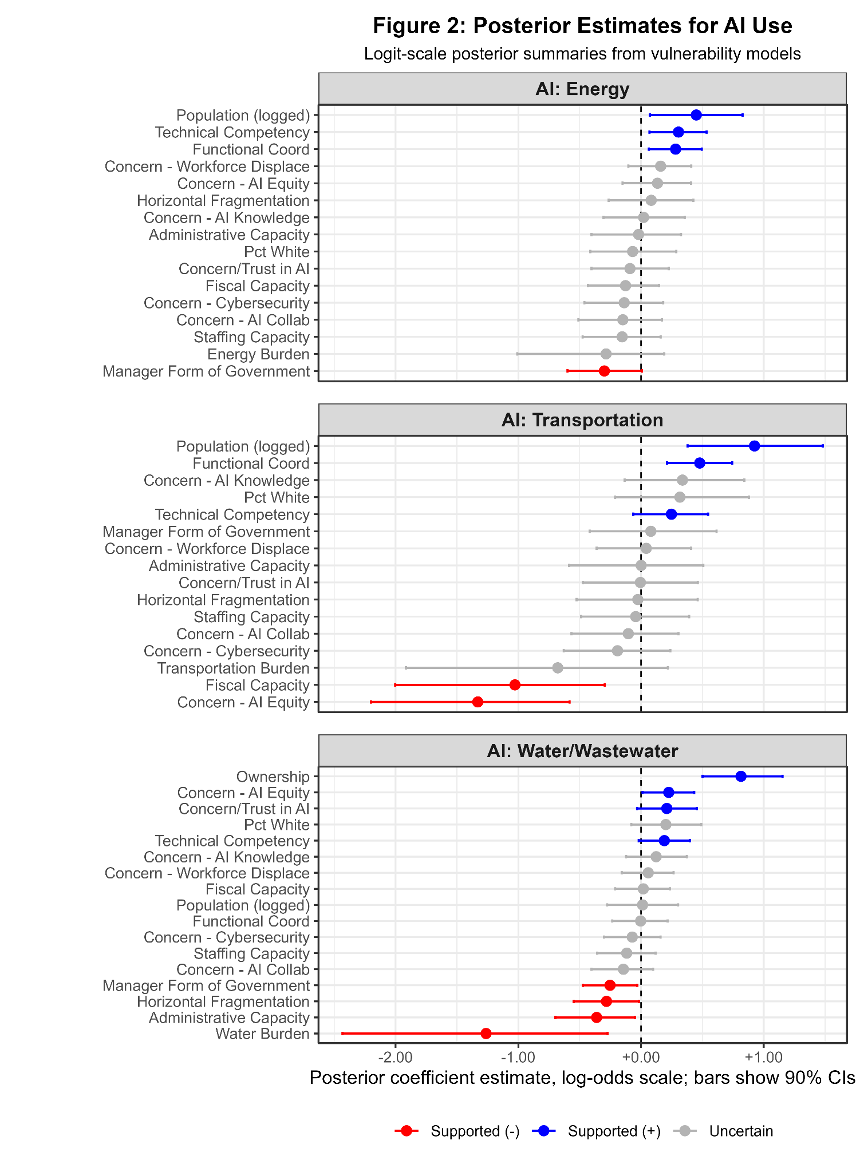
These findings suggest that infrastructure needs alone are unlikely to draw AI investment to the communities that need these models' potential benefits most.
Capability helps, but does it reach the problems?
Organizational capabilities mattered. AI-specific technical competencies were positively associated with adoption across all three infrastructure areas. Coordination across departments was associated with adoption in energy and transportation.
These relationships help explain what it takes to put AI to work. A transportation application, for example, may require cooperation among staff responsible for streets, planning, information technology, and public safety. Technical knowledge and cross-departmental arrangements can help governments pursue applications that span those responsibilities.
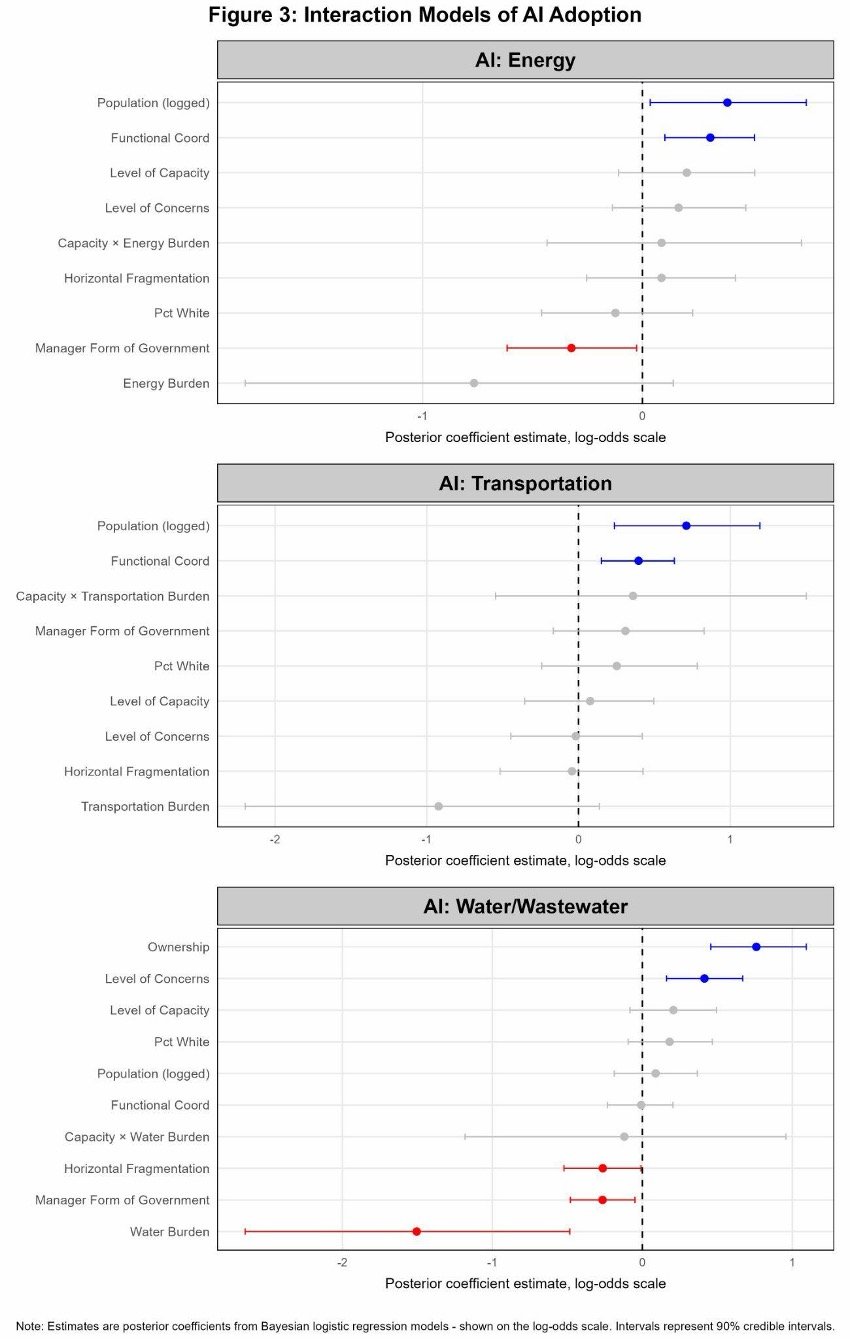
Yet we found little evidence that stronger organizational capabilities offset the negative relationship between environmental burdens and adoption (See Figure 3). Greater capability was associated with some infrastructure applications, but its presence offered no clear assurance that AI use would respond to greater community needs. Thus, high-capability governments with significant infrastructure challenges were not significantly more likely than lower-capability governments to adopt AI for those needs.
Will AI’s benefits spread?
One hopeful possibility is that early municipal adopters develop tools and knowledge that other governments can eventually use. Public health researchers describe an “inverse equity” pattern in which better-resourced communities benefit from innovations first, with gaps narrowing as those innovations spread.
For this process to help heavily burdened communities, early applications must address problems those communities face. Tools developed around one city’s infrastructure, data, and staffing arrangements may require substantial adaptation elsewhere. Communities with limited technical resources may struggle to make those adaptations, and off-the-shelf tools may present more problems than benefits.
Our findings raise concerns about assuming that benefits will spread automatically. This is one area where considerable change may be occurring rapidly, and ongoing quantitative and qualitative research is needed. How quickly these tools can be leveraged to address these challenges, and which governments are poised to benefit from these technological shifts, will remain important questions for future researchers.
Eric Stokan is an associate dean of Research and Creative Achievement in the College of Arts, Humanities, and Social Sciences at the University of Maryland Baltimore County and associate professor in the Department of Political Science. As a co-director of the MGMT Lab, he explores how local governments plan for climate-related disasters, balance social equity in decision-making, pursue economic growth, and use AI to address core infrastructure challenges.
Aaron Deslatte, PhD, is an associate professor and Paul H. O’Neill Professor in the O'Neill School of Public and Environmental Affairs at Indiana University Bloomington, where he founded and co-directs the MGMT Laboratory. His research focuses on the knowledge-based collective-action challenges surrounding local government resilience, sustainability, and technological innovation. This includes the capability and governance challenges surrounding the expansion of artificial intelligence (AI) to sustainability-related challenges in local governments.
Jesse L. Barnes is an assistant professor in the Department of Public Administration at the University of Texas at San Antonio. His research examines urban governance in the United States, focusing on how multilevel institutional dynamics influence local public management, particularly in infrastructure-dominant and technologically complex public service delivery domains.