Community Wealth Building
Online Symposium
Scholars of urban politics have long debated the issue of what cities can and should do to promote the economic well-being of their residents. As the of election Zohran Mamdani illustrates, urban residents are increasingly demanding that city governments do more to address the increasingly exorbitant costs of housing, childcare, and transportation. One obvious solution is to raise taxes on the private holders of wealth. By the same token, his election has prompted handwringing on the right about the “inevitable” flight of capital out of New York City. Scholarship that runs the gamut from the public choice school associated with the “city limits” perspective (Peterson 1981) through to Marxian accounts (Logan and Molotch 1987) all recognize that the private ownership of wealth and the mobility of capital puts cities in a bind, especially in a context of highly circumscribed levels of federal urban spending. Though several scholars (Logan and Swanstrom 1990; Kantor and Savitch 1993; Schragger 2016) have demonstrated that cities have greater latitude to promote egalitarian public policies than these perspective allow, few would argue that the deep structural problems of economic and social inequality can be fully resolved by tax-and-spend liberalism (Imbroscio 2010).
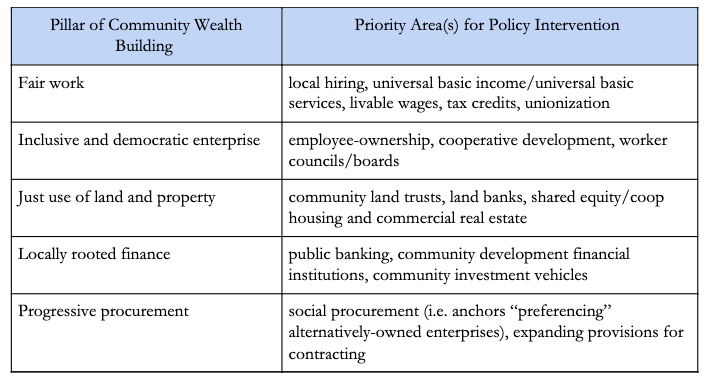
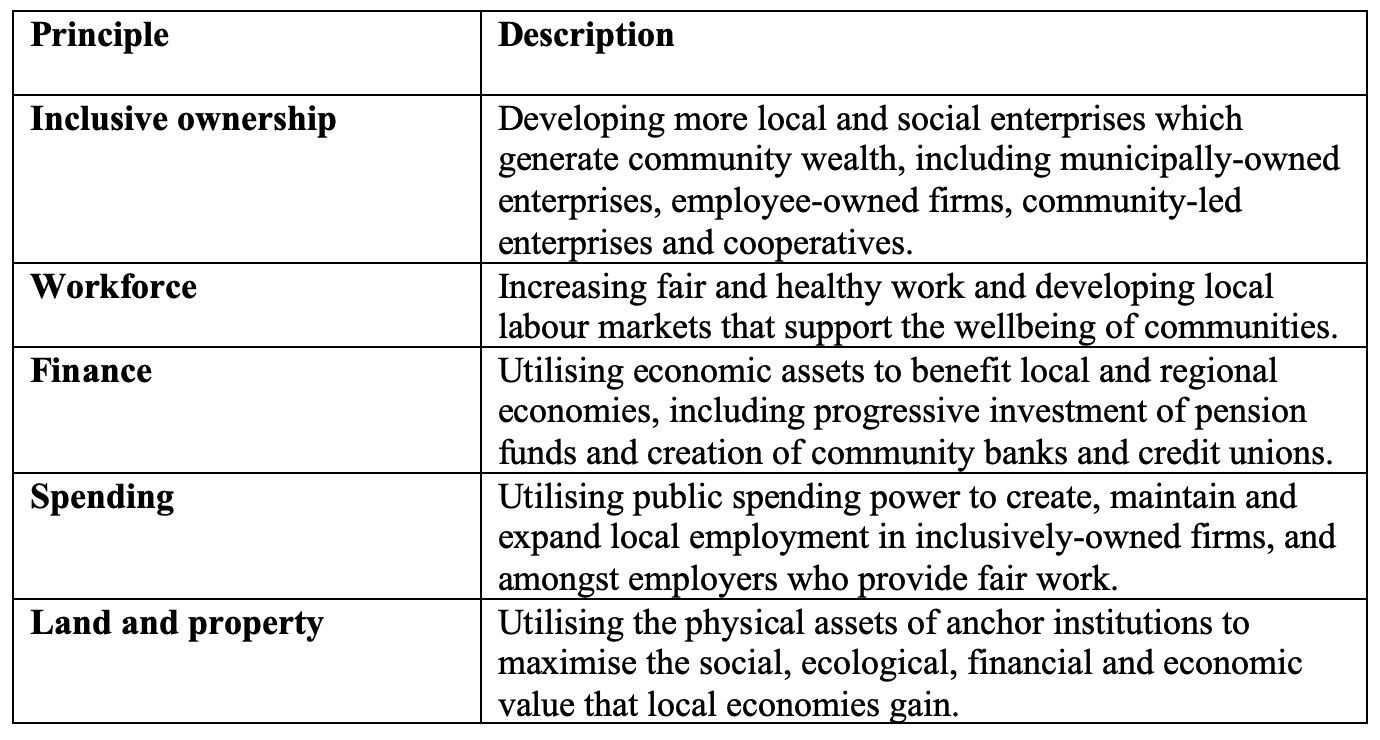
Community wealth building (CWB) is an approach that both understands the dilemmas presented by the extensive private ownership and control of capital and seeks to circumvent it by transforming the underpinnings of the political economy. Rather than trying to work within the system to make the neoliberal political economy more equitable via redistribution, CWB seeks to “breach” the division of labor between the state and market that oft bedevils efforts to engage in egalitarian policymaking (Imbroscio 2010, 23).
As these essays show both in theory and, increasingly, in practice, CWB stands to reconstitute the fundamental structure of local political economies by transferring ownership and control of capital from private actors into the hands of democratically accountable community organizations and workers and through redeploying publicly held resources in ways that redound to the public benefit. Such concrete measures, which promise to tackle systemic urban problems, will be of interest to scholars and practitioners alike.
Timothy Weaver, May 2026
References
Imbroscio, David L. 2010. Urban America Reconsidered: Alternatives for Governance and Policy. Cornell University Press.
Kantor, Paul, and H. V. Savitch. 1993. “Can Politicians Bargain with Business?” Urban Affairs Review 29 (2): 230–55.
Logan, John R., and Harvey Luskin Molotch. 1987. Urban Fortunes: The Political Economy of Place. University of California Press.
Logan, John R., and Todd Swanstrom, eds. 1990. Beyond the City Limits: Urban Policy and Economic Restructuring in Comparative Perspective. Temple University Press.
Peterson, Paul E. 1981. City Limits. University of Chicago Press.
Schragger, Richard C. 2016. City Power: Urban Governance in a Global Age. Oxford University Press.
Introduction
Theoretical Contributions
Case Studies
Future Directions