New Books: The Aesthetics of Belonging
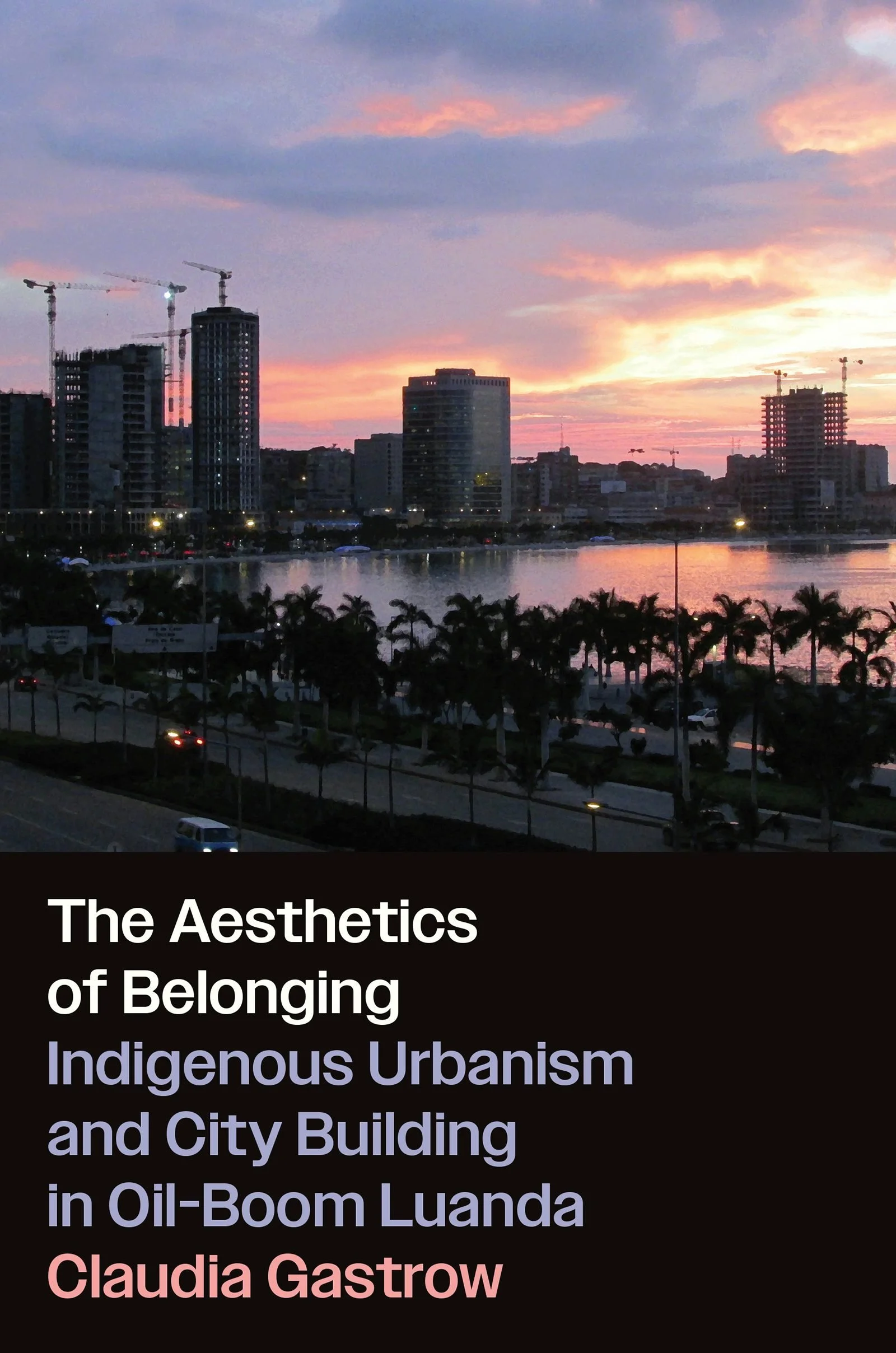
In this episode, we’re speaking with Claudia Gastrow, author of The Aesthetics of Belonging:
Indigenous Urbanism and City Building in Oil-Boom Luanda, published in 2024 by University of North Carolina Press. The Aesthetics of Belonging draws on archival and ethnographic research to explore the political significance of aesthetics in the remaking of Luanda.
-
Claudia Gastrow
But this was a phenomenon which I felt I was seeing and which wasn't being openly discussed or discussed enough in the scholarship and something that became very clear to me was that it was the construction of housing which provided this basis for people claiming that they were indigenous to the city, not necessarily to land, but to the city.
Emily
You’re listening to UAR Remixed, a podcast by the journal Urban Affairs Review. Today I’m speaking with Dr. Claudia Gastrow, the author of The Aesthetics of Belonging: Indigenous Urbanism and City Building in Oil-Boom Luanda from UNC Press. Claudia’s book explores how the aesthetics of the urban built environment in Luanda, Angola, mediate politics, identity, and belonging in the aftermath of the country’s long Civil War.
Claudia Gastrow
My name is Claudia Gastrow. I'm an assistant professor of anthropology at North Carolina State University. I'm an urban anthropologist, and most of it looks at the politics of design, architecture and urban planning in Africa, specifically Angola at the moment.
Emily
Thanks so much for joining us today, Claudia. Maybe to kick things off, could you talk about what prompted you to write this book? How and why Luanda?
Claudia Gastrow
I think this book has a lot of roots. I could go all the way back into childhood, growing up in a post-apartheid South Africa, seeing all these transformations that happened. As long as I can remember, I've been interested in cities. It's just something that's been an abiding part of who I am, but I think the roots of this book really came about...I had this interest in cities, and I had studied African history, and I already wanted to do research in a place that was not South Africa, actually, if I have to be honest. I'm from this generation, which was the first generation not to be born post-apartheid, but to come of age, post-apartheid and be thinking about what our relationship with the continent was. And so, when I was thinking about doing a PhD, I really wanted to do work in either Mozambique or Angola. And one of my close friends had done research and had grown up in Angola. And he said to me, if you're interested in cities, you have to go to Luanda, because the Civil War had just ended. There was just this massive moment of construction and social change, urban change.
But I think equally then it was really this moment where there was this shift in urbanism on the continent, and Luanda was really, and Angola were really at the forefront of that. This post, like early 2000s commodity boom, these narratives of Africa rising, where cities really became this symbol and focus of a lot of these hopes that people had of these major shifts in politics and wealth on the continent and so Luanda as the capital of a Petrostate was one of the spaces where these major shifts were happening and that was a new moment where master planning seemed to suddenly make a comeback. Large scale infrastructural investment. And so, you had this meeting of just personal interest but also these structural, global shifts that were really articulating themselves in a particular place. And I think Luanda for a lot of people became a symbol of this.
Emily
The Civil War in Angola casts a long shadow over your book, and you also use the end of it as a kind of starting point for the country’s recent transformations. Starting there, can you walk us through the project a bit more?
Claudia Gastrow
The book is broadly about the transformation of Luanda, Angola's capital during its post conflict construction boom, and maybe for listeners who don't know, Angola had a really brutal, very terrible civil war that lasted from independence in 1975 to 2002, which was partially driven by internal dynamics, partially by Cold War dynamics, and partially by the regional dynamics produced by apartheid.
And so, the book is really situated more broadly and telling the story of an oil rich country in this moment of transformation, in particular how this plays out in the city.
But where it zooms in on is the question of aesthetics, and I know when I began my project, I had a few people say, like they really don't understand why someone would look at aesthetics as a primary political question. This was a moment when there were mass demolitions happening in the city, where there were credible accusations of corruption. And so, questions about democratization, elections.
And so, for a lot of people, when I was talking about my project, the question of where aesthetics would fit in here, or why someone would choose to look at that seemed to them kind of strange. And this really came from the research, which is that I had initially planned to work with people whose homes had been knocked down for urban redevelopment projects, and when I spoke to them, what the interviews actually brought up again and again were people were very concerned about the materiality of the house that had been knocked down. Was it built from concrete block? Was it built from corrugated iron? Was it built from wood? How large was it? How small was it?
And so I started realizing that this medium of aesthetics, and whether that be design, people’s judgment of what is good or beautiful or what is appropriate, but also people’s embodied experience, or central embodied experience, the city was a place where people were able to voice political critique in what is a highly authoritarian society. And so, the book takes this lens of urban aesthetics to then tell a story about different aspects of this urban transformation and the questions of political inclusion, exclusion, class formation, understandings of the nation that emerge from that. And so I have two chapters which look at the question of mega projects and spectacle in contemporary urban construction and, for instance, look at how the question of aesthetic experience -- so like bodily comfort -- is something which can be politicized, which creates a relationship or conversation between states and citizens. And part of the reason of doing this is for instance, to push back against readings of mega projects as just these spectacles which just dazzle people and trying to get at the way that whether it's visual images, whether it's the aesthetic experiences which they're promising, how that works to create a certain domain of citizenship, a certain domain of political belonging, a certain imagination of the state and so part one of the arguments coming out of this conceptualization of aesthetics, is really to rethink the politics of master planning and construction.
The other one, and in many ways, I think this is really the key intervention of the book, is to try and get us to reconceptualize, especially in the African context, but I do think it could have broader applicability how we've understand the how we've understood the concept of informality. And I think we've had, I mean there's been brilliant work done especially in economic informality in Africa, but there has been a tendency to still implicitly assume that certain forms of modernist centralized planning are actually what urbanism should be.
And so, the result is that informality and especially material and spatial constituencies is still very often approached as a byproduct of poor planning and therefore ultimately something to be solved. Even if people recognize it as productive, as culturally productive, the materiality of it has at least in African Studies as a field, I would say critical urban studies in Africa, still been taken for granted as something which is a problem, something which is a poor quality or less desirable than ultimately a state-centric vision of a gridded planned city. And the point was not to say, well no one needs services or water, that's not the direction I'm going in, but through interviews, through historical research, and especially through being very lucky after finishing my degree to be exposed to really amazing scholars who are working in like spaces of black geographies, it really provided that literature and then the research I've done, provided a way for me to start to see these spaces of what I described as a black indigenous urbanism. And by that I try to reshape informality, not just as a product of poor planning, or a space of abandonment, but actually a space which has historicity in the ways in which construction happens and is also not just a product of mistake. There's an intentionality, an historical intentionality, in how it's solved. And so it's a product of what are called musseques in Luanda, the self built areas. I try to make the case that one can put them in conversation with other black geographies globally, if one thinks of them as products of and forms of global processes of racial capital and marginalization.
But I was also lucky to be able to draw on work on indigenous urbanism that's come out of North America to think about these also as indigenous spaces. There's a tendency, and it's actually a problem, I think, in African Studies to think of African authenticity as located in rural areas and so seeing these material formations, these spatial areas, this place making as something which produced a sense of belonging to the city and produced a political awareness that in fact reached back to an era of enslavement in the city, I think was very valuable for explaining these areas, not just as the negative of planning, but as a parallel urbanism. And so those are, I would say, the two primary contributions.
One is a rethinking of contemporary master planning, but the other one is really trying to reposition the way in which this very broad category of informality or self-building or construction has been understood in the African urban context.
Emily
The mussesques are a central spatial object in your study of Luanda – these informal settlements in and adjacent to the city. But in many ways, these settlements are really the product of the country’s post-conflict oil boom, as more and more Angolans left the countryside for city employment, and the city grew rapidly. You also lodge a kind of critique of some of the more received or dominant notions about informality in there – can you talk about this a bit more, the historical significance and development and demolitions of the musseques, what they signal politically and culturally, and how they are directly related to the massive macroeconomic changes that Angola experienced in the 2000s?
Claudia Gastrow
So historically, if you want, musseques have been glossed in the literature is informality, but like very similar to other areas like that. So I guess one is testing to find they are generally self-built areas of Luanda.
You will see a variety of forms of construction, largely concrete block nowadays, but with corrugated iron, etcetera. And I think what's important as a starting point is really to realize that many of these areas are as old as what is seen as the historical colonial city.
So these are not just areas that have sprung up recently. Some of them are more recent, but this phenomenon of musseque making and there is a really amazing and golden architect and urbanist called Angela Mingus who's done work on this, are really spaces of place making and spatial formation which emerged out of settlements of enslaved people and free Africans in the city. And whilst materials, etcetera, locations may have changed, this racialized logic and planning, and logic of construction and occupation that continues to exist. What happened is that during the country's civil war, these sites expanded exponentially because the government invested almost all its money in either buying weapons, in buying food because the city was very highly cut off some of the interior areas of the country where food was grown, and also unfortunately there were there is there was large levels of corruption so, but it is not just corruption which let people focus on they're also this larger conflict happening. And so, Luanda becomes a city ready, overwhelmed with people, growth, etcetera, but with a state which is really preoccupied with winning a war, rather than figuring out how to manage and what to do with this urban growth. And so, when the war ends as part of the wars won by the ruling party, which is the popular movement for liberation of Angola.
And so it really tries to stamp its authority of the country, but also its governmental presence through what it calls national reconstruction, which is really an umbrella term for large scale state investments, and really we're talking about billions and billions of dollars into state subsidized housing, into new infrastructural construction ,into building municipal services. So I mean it's multiple different things, multiple different projects which fall under this but Luanda already becomes the focus of this. It's the capital city, it's the place where it has the most control and this is then paralleled by a mass inrush of private investors.
This is the moment, 2002 to 2004, when the international price of oil starts to climb exponentially. So when the war ends, I think it's in the low 20s, and by 2011 it's over $100 a barrel. So this is a country where like 90% of its income about, I think maybe the majority of its income comes from oil and so it moves from being very indebted to all this money. And so the government starts, just everything, widening roads, building a massive satellite city through loans from China, starts putting in new infrastructures, major beautification projects, redesigning the city’s promenade.
But also, through these processes, continue something which had really initiated in the final year of the war, which is a series of mass demolitions. Basically these areas, musseques, where by far the majority of people in the city live, are as in many other places declared to be places that need to be eliminated, removed except for the good of the population, or to expand a road or to beautify an area, or very often just claim that people live in high risk areas, that government wants to build housing. And so, there's a variety of ways in which, as we've seen in other places, development becomes the basis for displacement.
So part of what I said what I wanted to look at was precisely the demolition of these areas, but one of the things that the book really tries to do then is look at how these aesthetic imaginations of the musseques as poorly built, as dirty, etcetera, play into the state’s capacity to publicly justify the elimination.
And then alternatively, look at how residents who live in these areas in fact read these materials as evidence of permanence, as evidence of creating an urban identity. And so, they are framed by the state as places and identify places that are subject to elimination that are understood by residents as places of aesthetic worth. And this is the central tension in the book, which is really trying to get us to ask the question about how our understandings of what constitutes the urban and urbanity carry with them numerous aesthetic assumptions about what a good building looks like, about what a good city looks like, and the violent politics that accompany that.
Emily
Another important intervention you make in this book has to do with these categories or definitions of certain identities – in particular, indigeneity and race. And you bring in this idea of indigenous urbanism, which is still fairly emergent in the field, to challenge or complicate African notions around indigeneity, which are really quite specific and very different from North American, Australian, or South American contexts, for example. So how did Luanda in particular generate this line of thinking?
Claudia Gastrow
I think Luanda it is unique, but there are other places we could look like Cape Ghost at Ghana or even Cape Town in South Africa for certain kinds of histories which emulate it. But it is if you want the oldest colonial-era city in sub-Saharan Africa, at least. So, it's established by the Portuguese as a slaving port. And so, in many ways, it's really one of the early spaces of what David Scott would describe as people being conscripted to a certain version of modernity. And so, I think it is an interesting place to think about what African and black modernity looks like and to not see those as oppositional. And there is a lot of existing literature. Ironically, in African cities, which are very uncomfortable with race and very uncomfortable with the idea of indigeneity within African cities and the reason for this is largely the way that African Studies as a field, and it’s excellent literature, but there's also limitations, have understood things like it's it has have studied the colonial construction of ethnicity, the colonial construction of certain kinds of indigeneity claims have seen these mobilized and very violently, let's say in places like Cote d’Ivoire, and so I think there is a hesitation from scholars. There's also a hesitation from African governments because African governments have historically been quite averse to the question of indigeneity, the question of First Nations, but I think there is an amazing scholarship that is coming up, which is scholarship that I've built on, and it's not it's not mine, someone like Hugo Canham at Unisa in South Africa has written an amazing book called Riotous Deathscapes, which is really trying to start to really send Africa to current discussions of black studies and indigenous studies.
Where I enter into this is, and I think it comes from my personal history of just watching the world around me, but then also in my scholarship, is the colonial states historically saw -- and we see this going back -- really positioned Africans as truly belonging to the rural. And so when you look at urban anthropology, when you look at the studies, there has always been a confusion in urban scholarship about how to understand African urban identity, so early anthropologists framed it as certain forms of mimicry of Europeanization, etcetera. And there's always been a pushback as well. However, from people like Bernard Magbanua saying you've missed who also studied processes of urbanization and urbanism, saying you've missed key structural elements, you're missing why people adopt and practices. And so, when I when I looked at Luanda and I looked at the scholarship, what became very clear to me when I spoke to people was many, not all, but many people I spoke to saw themselves primarily as belonging to the city. They didn't see themselves as belonging to a rural home. There was no talk of returning to an ancestral home. There is in much of Africa. So, I don't want to dismiss that language.
But this was a phenomenon which I felt I was seeing and which wasn't being openly discussed or discussed enough in the scholarship and something that became very clear to me was that it was the construction of housing which provided this basis for people claiming that they were indigenous to the city, not necessarily to land, but to the city. And this struck me as really interesting and there are people who've written beautifully if you want the cultural significance of musseque areas, that the scholarship again has largely overlooked, their materiality or spatial formations as being part of that cultural authenticity or cultural indigeneity or cultural nationalism, and so I think indigenous studies, both the stuff that is coming out of African scholarship and scholarship studies, obviously incredibly key work coming out of Canada and the United States as well, provides a language of thinking about indigeneity as a historical relational formation of identity that stands relation to power, that stands relation to land, that stands its processual, and I think if one starts to see forms of construction as posts of construction as creating certain architectural formations, certain forms of relation to community, to place, it becomes possible to think of an African indigeneity that comes out of cities. And I think for me that is something I would whether readers want to be affronted by it or embrace it, I would like them to grapple with, because I think that shifts in how we think about politics, how we think about identity and belonging, not just in Angola but in the continent more largely.
Emily
Talking to so many different authors about their fieldwork has been really interesting – just the process of being in the field, navigating different roadblocks or even environmental conditions, having to adapt to changing circumstances. How did it go for you? Did you have to make major changes to your project as you got comfortable in the field and embedded there?
Claudia Gastrow
I went in thinking about aesthetics, so I guess like at least one thing stayed the same, which usually doesn't happen. But I think really the way that I conceptualize the city and even the central focus, thinking about like objects and materials, really came from me having to shift around my project, so when -- I think I discussed it a bit in the book -- but it was really like a big change to me. I'd really thought I was going to. I was very enamored with this idea of doing a really detailed neighborhood study because I do still think that there's a shortage of them for studies of urban Africa.
And I was really enamored with this idea that I would like to do this really detailed, classic, ethnographic neighborhood, speaking to everybody as they. And I think once I really settled and I realized this wasn't going to be possible for a variety of reasons.
I was very lucky to be able to collaborate with some very generous community organizations and local NGO's that did work in various musseques around the city. And as I've started doing interviews and meeting people, I think what struck me so much was that there really was and that this is again I guess obvious, but I think it's one of those things almost have to pick up from the ground. There really was there wasn't one story of the city, and in some ways what was happening was so transformational that it was a story that needed to move across the city to grasp it. So I went from what I thought was going to be like a very located project to one which really moves around different parts of the city and that might seem small, but it also forced me to think about like what the city was, what the everyday obstacles were to movement, to getting things done. And I think that's when the city as object, to really source the aesthetic aspect of the work came in. So I think that was a really key shift was that objects and pipes, etcetera and I sourced themselves on me so that I really had to think about like, why does it matter that the water is not coming up the pipe today? I think another key thing, and it's something I really always champion now, because I think I haven't taken it as seriously till I got there was just the extent to which I actually did land up engaging representatives of the Angolan state in the research. I think there is a tendency very often to say, like it's these top-down plans. And so we this is like I don't know either very evil or there's -- it's not worth speaking to people because we're going to get a particular version. I was collaborating or being assisted by an organization that did a lot of amazing work in the musseque areas around service delivery and even teaching people to read budgets and things like that, but was also engaged with the state, and they encouraged me to actually like go to an office, write a letter and say I'd like to speak to someone about what they think about this project, and it for me, it was really transformational and really coming to grips with the way that different state offices, different people in the state, really thought about the city, and I think it really enriched my understanding of what was happening and I think I'd probably said in my proposals that I would speak to some people and say, but I don't think I appreciated how key it was for really thinking about the politics, recognizing that citizenship and belonging is this constant back and forth between different actors rather than just something which people in a position of one particular location are grappling with, so I would say like those two aspects were really key and changed what I was doing.
Emily
I guess the last thing as we start to wrap up – what are you hoping readers will take away from this book? Urbanists, anthropologists, geographers – maybe even architects and planners, I think the potential audience could be quite broad here. What do you want them to understand?
Claudia Gastrow
I think it's twofold, I would hope that at a very basic, someone might pick up the book and say like, hey, this idea of the way that aesthetics makes us see certain things as legitimate or illegitimate is really interesting, and maybe I'm doing research in, I don't know, Moscow, or maybe I'm doing research in Buenos Aires, but it's something that can move around and we can open up the conversation, but I hope and I don't know if I've been successful, I think there's a way in which trying to get the book out sometimes dampens the voices or the aspirations or the interests of the people we were engaged in about, like why they participated in the research, what was really happening in the city?
And so, I've tried, I don't think I've always been successful, but I've tried to -- I hope that some of the life of the city and some of those stories will stick with people I hope that there is something in the book that has done justice to that collection of stories that would maybe, if the student reads it or someone else, build an interest in Angola, or just develop an appreciation of what happened there, and maybe enable people to understand other processes around the world like that.
Emily
My thanks to Claudia Gastrow, author of The Aesthetics of Belonging from UNC Press. You can find a link to the book in our show notes.
You’ve been listening to UAR Remixed, a podcast by Urban Affairs Review. Special thanks to Drexel University and the editors at UAR. Music is by Blue Dot Sessions. This show was mixed and produced by Aidan McLaughlin and written and produced by me, Emily Holloway. You can find us on Bluesky at @urbanaffairsreview.bsky.social for updates on the journal and the show. Please rate, review, and subscribe on Apple, Spotify, or wherever you get your podcasts.