New Books: Marked Men
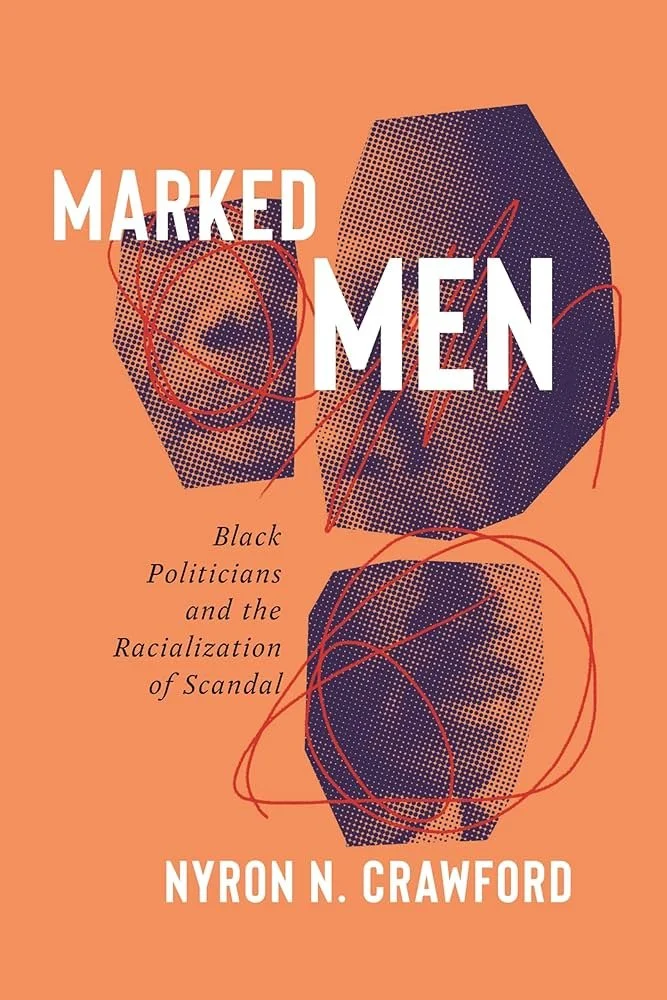
In this episode, we’re speaking with Nyron Crawford, author of Marked Men: Black Politicians and the Racialization of Scandal, published in 2024 by NYU Press. Marked Men complicates the common perception that Black elected officials are forgiven for their transgressions because of the commitments and benefits made to constituents. Instead, Crawford demonstrates that “racialized suspicion” shapes the way Black voters rally to protect their embattled Black political representatives.
-
Nyron Crawford
And so, the idea of racialized suspicion was born out of this concern that white political systems are engaged in untoward behavior to discredit and embarrass black elected officials who are representing primarily black constituencies. And so, I wanted to understand whether or not this was actually a psychological dynamic that might be taking place, because from a functional perspective, Suspicion does something interesting; suspicion will disrupt a cognitive process of information processing.
Emily
Hi, I’m Emily Holloway, and you’re listening to UAR Remixed, a podcast companion to the journal Urban Affairs Review. You just heard from Nyron Crawford, the author of Marked Men: Black Politicians and the Racialization of Scandal, from NYU Press.
Nyron Crawford
Hello, my name is Nyron Crawford. I'm an associate professor of political science at Temple University and faculty fellow in Public Policy and Law at Temple University. I study American politics, broadly defined, but with the focus on race, policy, and the American city.
Emily
Nyron, thank you so much for joining us. I’ve been looking forward to talking to you about your book, there’s a lot in the news this year that ties into this research directly that we’ll get into later in the conversation. Maybe to start, could you just talk us through how you came to this project? What sparked these questions about Black mayors, public perception, and this idea of racialized suspicion?
Nyron Crawford
So I happened onto this project a bit by accident, I was a bit serendipitous. My dissertation was something that was different. So, the book is only partially based on the growth of the dissertation. Initially in graduate school, I was interested in the idea of how white mayors were elected in majority black cities. And so thinking like places like Detroit and Baltimore and Gary IN, places that were postindustrial cities that were electing white mayors and they were strongly black, politically empowered at 65-80% black. And just trying to understand those dynamics. And one of the arguments that I made there was that economic decline could facilitate this kind of idea of ethno-racial transition of the mayor.
And previously, the literature focused primarily on kind of moving to white ethnics and never from a black mayor to a white mayor because of the short time horizon. But one of the things that came up was that there seemed to be a high threshold. I was focusing specifically on African American voting behavior here or political attitudes related to black and white mayors in these places.
And what I found was that there’s actually a high threshold, that African Americans did not in large numbers abandon black elected officials or candidates. So, there was something else going on. So raise a different question: Under what circumstances might African Americans kind of abandon black elected officials and one of the things that came to is that it had to be scandal and corruption, that that would be one space where there would probably be low tolerance among voters for untoward behavior from elected officials, particularly of the financial variety, and there's some notes of that in the book. And so I ended up going down that rabbit hole trying to understand what role does transgression or scandal or political scandal or public corruption play in maybe facilitating withdrawal from black elites and the circumstances. And so the book was born out of that idea, trying to understand what was happening. So one of the things that I found in the early research is that even that dynamic did not push African Americans that far away from black elected officials, and so I decided to kind of go fully in that direction.
Emily
And so how do you structure the book – you use this framework of racialized suspicion to get through these different examples, can you unpack that a bit, walk us through the book?
Nyron Crawford
So one of the challenges of the book was to do two things. The first is to lay out why black political elites are labeled corrupt, right. So that kind of set up the dynamics, but the primary goal of the book is to focus on the black mass public, to really understand the political psychology behind support for these scandalized mayors.
And so as I alluded to earlier, one of the things that I was saying is that there was not a lot of abandonment of black elected officials in a systematic way. And so, I wanted to understand why.
And so in thinking about kind of the psychology group dynamics and just the nature of black political empowerment in American cities and just some other historical dynamics, as I talked about related to post reconstruction, one of the things that occurred to me is that African Americans were really concerned that the government was engaged in untoward practices toward African Americans, right. And we talked about that historically and contemporarily, focused primarily on kind of what do systems do to black communities? But we've not paid a lot of attention to what it does to the black elites in service to those communities, right? And so we see plenty examples with this, again with FBI surveillance of civil rights leaders, and one of the consensus notes there were two points: one, that African American political leaders or elected officials are being investigated at a disproportionate rate to their population, right. And we see that in the empirical data from the United States Sentencing Commission, just like those who are charged or convicted of bribery, for example. Again, it's disproportionate in terms of race.
And so, the idea of racialized suspicion was born out of this concern that white political systems are engaged in untoward behavior to discredit and embarrass black elected officials who are representing primarily black constituencies. And so, I wanted to understand whether or not this was actually a psychological dynamic that might be taking place, because from a functional perspective, Suspicion does something interesting; suspicion will disrupt a cognitive process of information
So when you are suspicious that something is awry, you turn your attention to the thing that you think might be motivated or ill-motivated by some kind of act. And here is the extra-legal attention. And so I set out to understand this empirically.
But I also wanted to make sure that the story was grounded in a reality of actual politics, and sometimes political science can be a little too far removed from cases on the ground that actually help illuminate the story. And so racialized suspicion just simply means that people are going to redirect their cognitive resources and how they're thinking about an issue, and they're going to start asking different questions about why is that person being investigated and is this going to just disrupt this process?
And so I do a few different things. One, I do a survey experiment of African Americans where I vary the vignettes of a black and white mayor and the kind of transgression that they've been accused of, either sexual or financial. It is important to know that in the corruption literature broadly, crimes or scandals of corruption are more consequential, though sex scandals get the most attention, right? So, trying to kind of differentiate what might be happening there as well as the racial dynamics. In politics literature, there's not a lot of experiments, and so this is really an opportunity to kind of leverage a different methodology to tell a local story.
One of the other things that I do is that I supplement that with a survey from the Washington Post, which asks just specifically about the scandal involving then Mayor Marion Barry.
And so I struck through racialized suspicion in that way to talk first about the theoretical idea of racialized suspicion from a from a purely theoretical, empirical perspective, the experiment and see if it travels to the case of Washington, DC, while also looking at other cases throughout the history of African American mayoralties and City Council memberships to see whether or not this theme of racialized suspicion actually follows.
And I find that it does. African Americans were far more likely to be suspicious when it was an African American mayor accused of a financial crime. There was no difference for the sex scandal and I think part of the reason there is that things like infidelity will get a lot of attention, are not seen as abuses of power and they've kind of seen as just personal indiscretions that really have no bearing, whereas financial concepts, we implicate a whole bunch of things and would actually draw in the attention of a law enforcement agency, right. So, if you commit financial fraud, you're going to get a visit from the IRS or the FBI. And so the experiment kind of demonstrates that one, African Americans do experience racialized suspicion. They are more likely to believe that the African American official is being unfairly targeted for this legal attention.
Emily
You spend a bit of time looking at Marion Barry --
Nyron Crawford
And so, I looked at the case of Washington DC, which I've realized now that I have to explain because we've so far removed that students don't actually know who Marion Barry is. But for the audience recap, Marion Barry is a former mayor and City Council member from Washington, DC. He’s African American, a very popular Mayor. And in 1990, he was arrested in the Vista International Hotel in Washington, DC during a sting operation in which he was visiting a prior paramour lover, noting that the mayor was married at the time, but the actual incident that he was caught smoking crack cocaine on video.
And so this was of course a huge scandal event in Washington DC, where the local police were involved. The federal FBI were involved in this particular incident, but it also created a racial divide because while people were legitimately concerned about the mayor's drug use, they had an additional question, which was why was there surveillance equipment in the hotel?
And so this actually created a lot of discomfort among African Americans, both within the community and within even journalistic institutions of raising this question of whether or not the mayor had actually been a victim of entrapment, whether he had actually legitimately been set up. And so one of the tag lines in the chapter, the title of the chapter is – Hey, can I curse here? Bitch set me up, and right, so that is what he's yelling during this whole ordeal, is the bitch sent me up, right? The person who invited him to the hotel who also invited him to use the drugs and encouraged his use of the drugs, set him up to be in this,, to be surveilled and eventually arrested. Fast forward, he goes to jail and there's a mistrial. But he does spend time for possession, I believe. And in 1992, he is released and he gets reelected to city council first.
And then he is later reelected mayor of DC in 1994. And so, one of the questions that a lot of people were asking how does it happen that an elected official in a major American city is caught on camera smoking crack cocaine and is reelected to a position of importance that he had to forego previously because of this particular incident. Now telling that story now, you know from 1992, it's like, oh, of course you can look at current circumstances and say well, that makes sense. But then there wasn't a lot of precedence for it, right? And you compare Trump and Barry, you might say, well, they all just get away with it, and that's not the case.
And so Chris Rock, the famous comedian, did a show in Washington DC, and his first line was, how does someone who does this get reelected, right? How are all the other candidates so bad that you reelect a “crackhead. But this was the question that people were asking. And fortunately for me, the Washington Post was asking similar questions in their polling during the time. And so using that data and supplementing with other data, I find there were proxy questions in the Washington Post for racialized suspicion. Was he unfairly targeted, one, and was he unfairly targeted because of his race, two, and what I find from that data is that many African Americans in Washington, DC did believe that he was targeted unfairly because of his race. And so just finding evidence across different methodologies, triangulating methodologies to determine whether or not racialized suspicion is something that travels and then suggest that it did, at least in that case. And anecdotally, I try to point to other cases where that also might be true, and also where it might not be true, and there's certainly places where not all black elected officials benefit from racialized suspicion.
Emily
There’s also a fair amount of historical context framing this study – you look at Reconstruction politics and bring some of those insights into postwar urban politics. How did you draw those connections together?
Nyron Crawford
So black elected officials really, or black politicians really kind of emerged in the post reconstruction South after the Civil War, and what I was trying to do, at least on the front end of providing the historical context, is trying to explain how black politics has kind of become synonymous with corruption, and kind of framing what has happened over time. So thinking about post reconstruction and what we see is a lot of white folk in the South, frankly, saying that African American leadership is going to be incompetent and corrupt.
Which led to springs of violence, particularly in small black towns, and so kind of just setting up that when you look at the history of black political ascension that it has often been framed as corrupt, and you see that often when you hear scholars talk about Reconstruction America, they will often call it a failure, and the failure they attribute is largely to the presence of black political leadership. And so if you've ever seen Birth of a Nation, for example, there's a scene where black lawmakers are in the state capital eating chicken with their feet kicked up, and then you see the KKK car ride into the rescue of these uncivilized people who are now taking political leadership in these places. And then we see every construction time, the nadir, where there's increased heightened violence against African Americans.
If you comb through the book, there's a great picture, I think in the first chapter and you see some of the political cartoons that are emerging during this period of history, and each of them are reflecting things to white society, the dangers that black elected officials posed to white society. Right. And so, one big allegation during that period of time of rule was that African Americans were stuffing the ballot box right. So that was kind of the first charge of corruption. And so, one of the pictures that I include from Norman Jennett is the piece of the black vampires that are looming over white society with the words "Negro rule” over it, so the goal there was to reinforce the frame of danger related to the Negro rule of corruption related to the new rule of incompetence to the Negro. So I wanted to point that out because I think it's a good illustration of the thread that has pulled through each century since.
When you get to the 20th century as we experience the Great Migration, and as African Americans and others are moving North, particularly into the city, you see a different kind of integration and into politics, but the same kind of dynamics exist when thinking about African Americans as incompetent and corrupt. And so, when you see kind of the rise and fall of the political machine and the urban city, scholars have argued that the one reason that urban machines were able to exist as long as they did was because of the dependence of African Americans on the corruption of the machine.
And so, you see this thread through history. And so, in 1967, when African Americans start being elected in higher numbers at every level of government, you also see an increase in investigatory practices against those individuals as well. Members of Congress, local elected officials. We understand COINTELPRO, for example, was the very systematic surveillance of Black political leadership. And so you see this thread throughout, kind of based on this idea that African American politics is a corrupt project which facilitates and legitimizes the need for you to be dealt with as a criminal justice matter or as a criminal matter, rather.
Emily
Now, in your research, did you look at other variables, like class, or education, or gender?
Nyron Crawford
I did not, and it is something that I think a lot about now. I think that the book in many ways is less timely, you know? Research takes a long time, and I think there are circumstances that are different. There was some earlier evidence that there was really no big class difference in terms of income. But there was in terms of education. I did not look at the gender dynamic, but I tried to do that in different ways. One of the charges from Catherine Brown was that black women did not benefit from black protectionism in the same way.
But I do think class is an overlooked area in black politics, and so I'm trying to do some work now that that looks at this class dynamic, but outside of this context,
Emily
But you do start to address the issue of gender in your epilogue—it's kind of remarkable, there are so many Black women mayors running large cities across the country now compared to a decade or two ago.
Nyron Crawford
I want to say that I did try and get at this in the dissertation. So, this was an area where I tried to do an experiment where I vary the gender and sexual orientation of black elected officials to see whether or not those subtype and subgroup characteristics would matter to whether or not African Americans were still buffering in this way. It was underpowered, so it didn't really do it anything, and so I did not include that in the book, but I did recognize that black women had in the sense into black mayoralties, and the timeline was just bad for the book, right? But this happened after things were needing to wind down. So I wanted to take up the issue and the best case to my mind was Baltimore, MD. Baltimore, MD has similar dynamics. So Baltimore is unique in a few different ways, if you will allow me to a segue. Baltimore is, I think, the only city that has had multiple black women mayors. It now has had three: the first was indicted for theft, and resigned in disgrace. And then there were two others, and the third was convicted of corruption charges.
And then you have the state's attorney, who also found herself on the other side of an investigation in which she was also found to be guilty of corruption related activity. And so part of the epilogue was to anticipate the critique that there was not enough attention to black women in the book, and which I think is a fair critique. But the balance of power has been male. And so, these incidents have primarily affected male, but since black women have become mayors, they have also experienced disproportionate investigation.
And so I tried to use Baltimore as a case, but it is also true that this dynamic still continues with black women. And so one of the things I try to do in the epilogue is answer Catherine Russell Brown, who says black women don't really benefit from black protectionism. And Sheila Dixon lost the race to Catherine Pugh, who was the state senator. Catherine Pugh and Sheila Dixon are both mayors of Baltimore. Both ended up convicted of corruption related crimes, but Dixon came quite close to winning that election, which to me was evidence of black protectionism in Baltimore. I went down there during the primary and I talked to voters. And you know, this is really serendipitous. A few of them quoted scripture to me: “He who cast the first Stone has not found sin,” and so when I asked them what they thought about Sheila Dixon, I had two people say, They were not near each other, and so, you know, this idea that I cannot judge, I will not judge. And she lost that race by a very small margin. And so to me, that was evidence that perhaps there was something to the argument about racialized suspicion, because Sheila Dixon also experienced something said that when she went through her ordeal, people were alleging that white Republicans in the state were actually targeting this African American woman. So there are definitely parallels there.
Emily
What are you hoping readers will take away from this? You write a lot for public audiences, so I guess I’m interested to learn more about how you see this work filtering down into those conversations, outside of just the more academic debates.
Nyron Crawford
I think that has evolved a little bit, but let me tell you what I was thinking when I was finishing. I was trying to do a few different things. wanted to give African Americans agency. Often in political science, they are the subjects of attitudes, they are the subjects of behavior, they are not themselves the custodian of attitudes and behaviors, and that was very important for me to tell the story about African Americans. And so, I spent some time in the introduction explaining why, and focusing on black mayors and why I'm focusing on black public opinion, because in any other book, it would have been a comparison between Buttis Yancey and Marion Barry and how the different groups were experiencing those incidents in Providence and in DC, they would have been an interracial story, which is what dominates political science.
It was important for me to rescue the agency of African American and to explain the behavior. Now the behavior was important to explain because one of the common responses is that this behavior on the part of African Americans is also a reflection of incompetence and corruption. That part of the reason that you get a Marion Barry again is because African American voters are incompetent and corrupt. And you see this. And there are other scholars who kind of made this note. And this is a common story in the corruption literature, where they will, this idea of there's a trade, right, people are willing to tolerate bad behavior if there's a trade, if they're getting their needs met by these elected officials who are engaged in bad behavior. And I tell the story in the book about The Wire. So Clay Davis is a state elected official in Baltimore. There's a great scene from The Wire where he's on trial for embezzlement and other scandal behavior. And he basically says, I use this money to support my constituents, and he goes off in this great monologue to which all of the people in the audience of the courtroom are giving him a standing ovation. And he gets off on the case. And so that's kind of representative of this trade hypothesis. But for me that was too simplistic, primarily because African Americans were not always the beneficiaries of these trades. So when you think back to the political machine era, African Americans got some benefits, but comparing to Irish immigrants and others, they were not receiving the brunt of the spoils from that system. So, if it wasn't a fair trade, what else was going on? And part of what I wanted to argue is that there is actually a reason. There's a rational reason why African Americans might respond this way, and that rational reason is that states have engaged in behavior to discredit and embarrass popular politicians.
And so do not dismiss this as a simple trade. I want people to recognize that the state has engaged in untoward behavior toward black people, both in the mass public as well as in the elite sphere, in a way to undermine their progress, and that African Americans have responded in recognizing that particular dynamic as a way to protect black leaders. And so those two pieces were important.
Emily
Before we wrap up, and even though I know this is going to date this conversation, but I have to ask, since we’re recording this just before the New York mayoral primary. Can we talk about Eric Adams?
Nyron Crawford
So it's a fair question. New York's a different case, I think. Generally, Chicago's is the typical case study. New York is just a different place, but the dynamic is replicating in New York too, so there actually was some polling data but where it is the case that African Americans are still showing more support for Eric Adams and still demonstrating more suspicion.
Now, what has changed? The world has changed, you know, in many ways it sometimes feels like, you know, I do think that the basis of the book holds. But in the conclusion, I do make a case for a more critical black protectionism. And I think we're actually seeing that with Eric Adams. Eric Adams is not a particularly popular mayor. And here it's your earlier question. I do think there a generational and gender divides here. Younger people tend to be less supportive, of Eric Adams’ administration. I think that has been very evident, at least on social media. I think in the current, he's actually running right now, I think the current support for Mamdani I think is also indicative of that shift away from this notion of black protectionism, but you do still you see a generational difference between this, so older African Americans are still, because they come up with from the generation of the civil rights movement, of the Church Commission, of COINTELPRO, or at least have some great familiarity with it. They still seem to be more likely to support Eric Adams in this case. So, it remains to be seen what will happen. But I do think that there is a generational divide now that has a lower tolerance for that kind of behavior as a way of protecting blackness than it did during the earlier eras.
Emily
Any other thoughts or insights you want to share with the listeners before we wrap up?
Nyron Crawford
So I've spent a lot of time, or tried to spend a lot of time in the conclusion, because I didn't want people to walk away from the book thinking that I was justifying bad behavior on the part of elected officials.
That rather, I wanted people, as I stated previously, to recognize a set of political circumstances that for a good number of black voters, necessitated a protective posture on their part toward their leadership, when they felt that the state was trying to embarrass or discredit them. But it was important to also recognize that when black elected officials were engaged in untoward behavior or corrupt behavior, that they should be properly dealt with at the ballot box if they were in fact engaged in this behavior. I didn't want people to think that I was justifying that behavior. But also to point out that elected officials of all races, of all religions, of all parties, engage in corrupt practices.
And to explain rather why this particular thing is happening within this community, but I do think that it's important. Corruption drives up costs. It takes needed services away from the most vulnerable people and cities that experience high rates typically are not doing as well as others who don't.
It does do a disservice, this kind of bribery having decisions on the take have been deleterious to American cities from Detroit to Baltimore to DC to Cleveland, elsewhere. So those folks should be dealt with at the ballot box. But it was important to recognize that there was a dynamic explaining the behavior itself.
Emily
My thanks to Nyron Crawford, author of Marked Men, from NYU Press. You can find a link to the book in our show notes.
You’ve been listening to UAR Remixed, a podcast by Urban Affairs Review. Special thanks to Drexel University and the editors at UAR. Music is by Blue Dot Sessions. This show was mixed and produced by Aidan McLaughlin and written and produced by me, Emily Holloway. You can find us on Bluesky at @urbanaffairsreview.bsky.social for updates on the journal and the show. Please rate, review, and subscribe on Apple, Spotify, or wherever you get your podcasts.