New Books: Making Sanctuary Cities
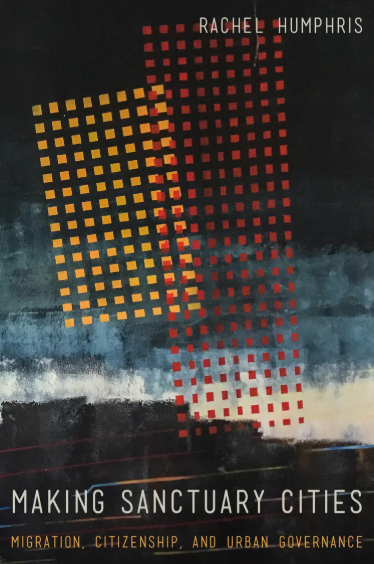
Tune in to hear from Dr. Rachel Humphris on her new book, Making Sanctuary Cities: Migration, Citizenship, and Urban Governance, published in 2025 by Stanford University Press. Making Sanctuary Cities investigates the complex policy frameworks that shape urban immigration and the politics of belonging through ethnographic and archival research on three cities: San Francisco, Toronto, and Sheffield, England.
-
Rachel Humphris
And also, within sanctuary cities, you can't get one definition of what it is anyway from the people who use the term. So, for me, because you can't say what it is, it actually didn't become a very useful thing to try to make the definition of it. I mean it just didn't have any purchase, any meaning, and so what I then tried to do was work out who was using the term, why it was being used and basically like the political and moral economies through which cities came to term themselves sanctuary cities, and what political potentials that opened or closed for that city and that then really became what the book was about.
Emily
Hi, this is Emily Holloway, and you’re listening to UAR Remixed, a podcast by the journal Urban Affairs Review. That was Rachel Humphris, the author of Making Sanctuary Cities, from Stanford University Press.
Rachel Humphris
My name is Dr Rachel Humphris. I'm currently a senior lecturer in the School of Politics and International Relations at Queen Mary, University of London. I trained as an anthropologist, so I would say that I am like a political anthropologist or a political ethnographer. So I try and trace the meanings around different kinds of state policies. So the main focus of my research has been around the immigration-welfare nexus. And really, I suppose how welfare states institutionalized racist practices and how that manifests through the treatment of migrants or mobile people.
Emily
Rachel, thanks for joining us today. Maybe we could start with the idea of the sanctuary city itself – I feel like there’s some misperceptions about what the term signals or means for some people.
Rachel Humphris
So sanctuaries are commonly thought about in terms of municipalities not cooperating with federal Immigration and Customs Enforcement or ICE, so that usually takes the form of them saying that they won't spend local police resources helping ICE officers, so they won't cooperate with them in that way and an important kind of mechanism that ICE uses are ICE detainer requests and usually that means that when ICE officers come, they have a civil warrant and they want to enter a building, and they want to round up undocumented people.
Because they are civil requests, you do not have to honor those requests, so that's where you may have heard of things like know your rights training. So, sanctuary cities often implement know your rights training. So that's to tell people that you do not have to honor civil ICE detainer requests. You do have to honor criminal warrants. So if it's been signed by a judge, and if there is a named person on the warrant, that is the kind of warrant that you have to comply with. And so that is the kind of framework that sanctuary cities operate within. And that is silly legal kind of discourse around sanctuary cities, harboring criminals and not complying with their legal responsibilities is not true. Sanctuary cities fully operate within the law.
Emily
Okay, thank you for that, that’s really helpful. So, to get back to your book and this broader research project – how did that come about?
Rachel Humphris
So, my PhD project was based on Roma coming to the UK and how the welfare state was really acting as a site of border control. And so I found that an extremely taxing project to spend, I spent 14 months living with these people who had moved and generally the conditions that they found themselves in and how they were subject to really pejorative forms of racialization. And then I was thinking about my postdoc project, and the Sanctuary City project was meant to be like my happy project and somewhere where I could see perhaps where people who are working at the front lines of the welfare state were actively trying to ameliorate some of those constraints for people on the move, particularly urban, racialized, poor people.
I really don't see sanctuary cities as a distinct policy category and more as like quite a dynamic field that involves policies, practices and social imaginations. And so, I suppose that's quite an important distinction. I would say that I specifically don't think that you can talk about sanctuary cities as policy containers.
Emily
So, I know I asked you at the beginning to give us a kind of working definition for sanctuary cities, but I think your book is really trying to show that there’s no set protocol or characteristics – you just mentioned, that sanctuary cities aren’t policy containers. Can you talk about your critique a bit more?
Rachel Humphris
I came to a particular understanding of it, basically because I tried to search for a definition of a sanctuary city and it's impossible both if you look like historically, when this term sanctuary city has been used and when it hasn't, and also in contemporary debate. Also, when it's invoked and when it's not. And also, within sanctuary cities, you can't get one definition of what it is anyway from the people who use the term. So, for me, because you can't say what it is, it actually didn't become a very useful thing to try to make the definition of it. I mean it just didn't have any purchase, any meaning, and so what I then tried to do was work out who was using the term, why it was being used and basically like the political and moral economies through which cities came to term themselves sanctuary cities, and what political potentials that opened or foreclosed for that city and that then really became what the book was about.
Emily
Right, and so you look at three different cities, three different sanctuary cities – how did you land on these?
Rachel Humphris
So I drew a lot from, I mean, I should probably say in the book I come up with this new methodology that I've called comparative policy ethnography that draws from decolonial feminist urban scholars like Gillian Hart, and also like Linda Peake who talk about really sort of looking at different cities as windows into embedded practices and thinking about conjunctures, really, to try to account for how globalized processes become manifest at the local level. So even though the book is about three cities, it really isn't like a comparison or a case study analysis. It really portrays something a bit different, which is a kind of anthropological sensibility towards thinking about how relations are embedded in particular places and really trying to get to the very contextual specificity of each of those cities.
So, I chose San Francisco, which is in the US, Toronto, which is in Canada, and Sheffield in the UK. So, I chose them because they were kind of the first or pioneering sanctuary cities in each of those countries. And so, I thought it would be really interesting to see why they took that step, particularly if given what I've just said about where sanctuary cities come from, that it's not like a neat definition, that it really comes out of a particular political or moral economy.
And so I went to them in the order that they became sanctuary cities. So, in San Francisco, it's like 85-89, the City of Refuge ordinance. Then you have Sheffield in 2007 and Toronto in 2013, and in terms of what was common or different about them, so you can make various kinds of comparisons, I suppose. Obviously, San Francisco and Toronto are in federalized state, so the unitary federal distinction it's very important, but I think there's a key kind of unifying context here, which is around how they are really a shared Anglophone-zoned space of law and governance through British imperialism. So that's like a big part of what I delve into the book, which is how we can see really how cities or how they emerged, I suppose, in the kind of settler colonial contexts of North America and how they really drew on models of British kind of municipal organization and how that kind of resonates now with what really, cities can do when it comes to migration control, which in reality of course is very little, but in fact maybe in federalized states, particularly in the US context, a bit more because you have those constitutional protections like in the 10th amendment, less so in in Canada, and even less in the UK due to the unitary governing structure.
Emily
You’re trained as an anthropologist, and you introduce this approach in your book that you call comparative policy ethnography that you mentioned a few minutes ago, and it’s really a mixed methods approach. How does this approach work, in practice? In this study, at least.
Rachel Humphris
So I think a really important part of the comparative policy ethnography approach – well to start off with, I had to do a real deep dive into the archives in each of the three cities I was trying to trace. Both like the emergence of this term, the sanctuary movement that became kind of the sanctuary city, and also really the as I mentioned like the history of cities and how really they govern mobile urban poor.
And I think when you look at the history of cities, one thing that I found those from the archives and also sort of like broader historical sociological and anthropological work, is that there's a real connection between the governance of migrants, or non-citizens, and the governance of failed citizens or racialized urban poor, and you can see actually, if you trace the history of cities, obviously you know, federal governments of – immigration wasn't preempted until 1875, so, cities did control who came in and came out, and no distinction was made. So, I think that really guided me throughout my whole ethnography, actually, to try and see those links between the more recently arrived urban, racialized, poor and the longer standing communities. And so that really guided the field work. And then I undertook lots of different kinds of entries into the field, as anthropologists often do. So there was the archival work. There was interviews with elected and non-elected officials. I volunteered in migrant-serving organizations. I accompanied people in court hearings. I went to protests, I went to churches. I basically tried to follow this term, the sanctuary city, wherever it emerged, and then tried to, I suppose, contextualize why, how, and where it was being used and for what purposes.
Emily
What was field work like? Can you describe the conditions you were working in, what was going on at the time you started this study?
Rachel Humphris
So I undertook the field work for this during the first Trump administration. So, I arrived in San Francisco just as the 9th Circuit appeal was hearing the case about whether federal funding could be stopped to sanctuary cities and there were a lot of cases around separated children being reunited to their families in San Francisco at that time. So, it felt very alive and very real and so I suppose that shaped a lot of that work in particular ways.
But then just in general, because anthropologists also don't have set questions to start out with and so the part of it is moving with the field and having very long conversations with people that aren't kind of like structured interviews or semi structured interviews for example. So, I mean I spoke to just so many amazing inspirational people that were putting so much work and really creativity and trying to build like intersectional solidarities, I suppose between different groups of people, for example, like Latinx communities and the API community in San Francisco or I would say a fascinating conversation was with one of a previous like civil rights defender in San Francisco, when she was talking about what was happening in the 1908s when you had refugees from El Salvador and Guatemala arriving in the Mission District and alongside organizing with Mexican undocumented workers. And I think there's a lot of conflation, sometimes in sanctuary city literature that doesn't separate, for example, the very different movements that happened and then some of the intersectional work that had to be done and how that was a real success, I suppose, for the kind of movement to be able to build those kinds of intersectional solidarity. So, I would say in terms of things that were surprising or also really hopeful in the face of quite harsh migration controls, I mean, 2019 was really nothing compared to what's going on now, but still there was some real – it's a real hope, I suppose, in what people can do when they build that sort of relational power on the ground, and then what people can achieve through that. So, I think that was I found that extremely inspiring and is what thing I really, take that forward with me now even when I'm feeling hopeless about the current situation.
Emily
Did you have a particular audience in mind for this book, are you writing primarily for academics, or is this also intended for activists and organizers? What, overall, do you want readers to take away from this project?
Rachel Humphris
I've written a number of different things from this project for different audiences. And I would say that this book, I have not aimed it to the activists on the ground, I think they might find it interesting, but actually I've written other things for them, which is much more about I'd called them like histories of memories of the sanctuary city. Which is really around this kind of fine-grained accounting of different oral histories of people organizing and how different struggles came together or not and sort of the genealogies, I suppose, of different social movements.
This book is really an academic book. I feel like the methodology is something that I will certainly take forward in other projects. And I feel like it bridges different disciplines like critical social policy, urban studies in terms of like some of the literature and policy mobility or policy transfer, and also anthropology of the state, anthropology of policy. So there is the methodological side. I also hope that readers would appreciate the kind of historical dimensions and what we can gain from really taking like that long term perspective, particularly in the face of what we are facing in this current moment, and I think that can be really helpful to trace, really take a long view to trace where some of these moralities come from and how embedded they are, for example. Or this this course on deservingness, or justice linked to deservingness which is so prevalent in migrant discourses, but also just on the urban poor in general and where that comes from, it's so embedded in western liberal democratic nation states, and if we want to think differently about how we might come out of our current moment or try to propose different ways of organizing or of organizing our societies of different kinds of political subjectivities, I think that can be really helpful and also, I try to open like the black box of government, really, of urban government and really go into very fine detail about, what happens in committee meetings, in judges hearings, in legal hearings, when people depute or are called upon for different reasons, how memoranda of understanding are formed, how policies are really made on the fly, are things that often in hindsight, again are asked and sanitized, and we put like a linear process on them, as if things just progress incrementally in a very logical and reasonable way, and for people who don't usually read about policies or urban government from that perspective, I hope it will just be very interesting to read some of the kind Yes Intricacies and messiness and personalities of how these things really get formed, which then generally has quite a big impact on our lives.
Emily
Have you been keeping tabs on any of the organizations or activists you worked with?
Rachel Humphris
I mean, it's difficult sitting as I am in London and not, being able at the moment right now, to actually have feet on the ground to help, accompany asylum seekers when they go to detention here normal asylum hearings and putting your body in between them and the ICE officers who that people have done, and been arrested for it, even elected officials, so, and it's also quite difficult to, I don't want to take up people's time right now and so actually in the work that I do, I just focus on the organizing that I can do in my own community right now.
As I feel like that's the most helpful thing and the other thing I feel like I can do is something that I think academics can more generally do. I've been drawing a lot from, the infrastructures of dissent literature. And I think that academics can really hold or unearth some of that fine grained collective memory way of organizing and not project organizing in a kind of linear way, which is also what I tried to do in the book, in terms of sanctuary city organizing. And I think that can also be very helpful. So not sanitizing that or creating a kind of linear progression, I think is really important so we can learn from history really. And I suppose that's another role that academics can play that aren't on the ground.
Emily
My thanks to Rachel Humphris, the author of Making Sanctuary Cities from Stanford University Press. You can find a link to the book in our show notes.
You’ve been listening to UAR Remixed, a podcast by Urban Affairs Review. Special thanks to Drexel University and the editors at UAR. Music is by Blue Dot Sessions. This show was mixed and produced by Aidan McLaughlin and written and produced by me, Emily Holloway. You can find us on Bluesky at @urbanaffairsreview.bsky.social for updates on the journal and the show. Please rate, review, and subscribe on Apple, Spotify, or wherever you get your podcasts.