Changing Notions of Urban Crisis
Richardson Dilworth, Managing Editor UAR
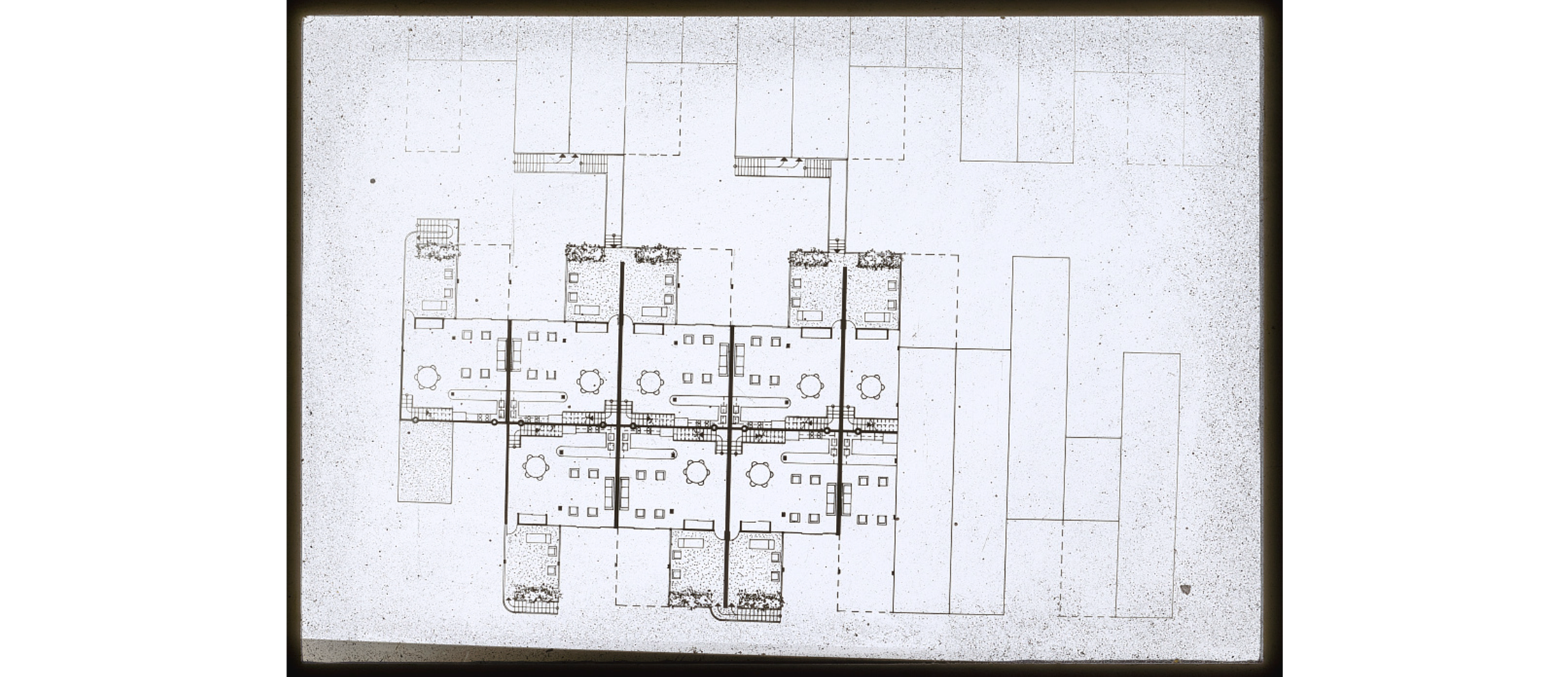
Washington DC Urban Renewal Northwest #1 Master Plan. Paul Rudolph, 1966. Library of Congress.
The Urban Affairs Review editorial team has embarked on an effort to choose annual themes around which we can write new essays and revive older works, dipping into the UAR backlist among other places (all UAR/UAQ articles cited in this essay have been ungated for this series).
For 2026 we have chosen “urban crisis” as a theme, reflecting both the general state of the world and the continued interest in the topic of crisis in the study of urban politics (see, for instance, Beveridge and Davidson 2025, 269-271). We have also hosted a graduate student essay contest around the theme of urban crisis, which has resulted in four winning essays, by Yetimoni Kpeebi, Ang Liu, Michele McLaughlin-Zamora, and Isaac Oates. These essays will be posted on our website (urbanaffairsreview.com) in early May 2026.
In this brief introductory essay, I will focus on articles on urban crisis published in the first two decades of UAR, leading up to the 1985 symposium, “Whatever Happened to the Urban Crisis?”, which included an introductory essay by Mark Gottdiener (1985) and three articles, by Eric Monkkonen (1985), Alexander Ganz (1985), and Irene Rubin (1985). I then provide a quick and admittedly incomplete overview of changing notions of urban crisis since that symposium to suggest that, despite healthy usage of the term in the decades that followed and the invention of new terms such as “permacrisis” and “crisis cities” that suggest some evolution in this particular framework, the framework itself has always been so malleable and potentially inclusive that its subject is not crises per se but rather how and why we might define things as crises. A corollary to this, with which I will conclude my brief essay, is that it thus becomes important to define those things that are not crises, so as to better define urban crises – a potentially interesting case in point being gentrification.
Crisis was a defining element of the study of urban politics after World War II; the very first issue of UAR (then Urban Affairs Quarterly) in 1965 featured an article by Ernest Weissman (then director of the United Nations Center for Housing, Building, and Planning) on “The Urban Crisis in the World” (Weismann 1965). Even prior to that, as Timothy Weaver (2017) has noted in a comprehensive survey on the topic, one of the earlier works after World War II that applied crisis as a conceptual lens was Fred Vigman’s Crisis of the Cities (1955), in which he depicted the American city as one becoming a “great industrial plantation where employees must perforce live and from which all other strata of the population will seek to escape” (Vigman 1955, 146).
Weaver argued that initial postwar conceptualizations by Vigman and others understood the urban crisis to be solvable by government investment and as such they “reflected the key interests within the New Deal coalition, both from business and labor, which stood to benefit from the revival of urban fortunes” (Weaver 2017, 2044). Yet by the 1960s the concept was being used in a nearly opposite fashion, to suggest that government investments through programs like urban renewal were one of the chief causes of urban crisis. This conceptualization was also racialized to mean a crisis specifically for and of Black people or a slightly more diverse “urban underclass” sustained in part through programs like cash assistance welfare and public housing. Simultaneously and relatedly, urban crisis was also defined as fiscal crisis, made particularly salient by New York City’s near-bankruptcy in 1975, and through which crisis could be used as the justification for introducing austerity policies on “putatively profligate city government” (p. 2047).
A simultaneous Marxist version also implicated government in the urban crisis, not for its profligacy but rather as it attempted to overcome contradictions inherent in uneven capitalist development. By the turn of the twenty-first century, historians, following Thomas Sugrue’s (1996) lead, sought to displace the previous focus on an urban underclass by positioning the origins of the urban crisis at an earlier point, during the 1930s and 1940s.
In fact, the earliest articles in UAR on the urban crisis point to a somewhat different use of the term. Weismann (1965), for instance, focused not on suburbanization, welfare dependency, race, or municipal profligacy, but rather on population growth, global rural-to-urban migration, and the subsequent rapid growth of urban regions with increasing concentrations of poverty, declining living conditions, and massive squatter settlements. A later article, by Albert Gorvine and Samuel Margulies (1971) argued somewhat similarly, and quite vaguely, that “the so-called urban crisis is simply the beginning of a breakdown in the capacity of specific institutions to function” (p. 265).
As early as the 1970s perceptive scholars noted that “urban crisis” was suffering from the standard academic ailment that its overuse was rendering it a hollow conceptual vehicle. For instance, in a study of Milwaukee residents’ attitudes in which he found no evidence for one of the more conservative interpretations of the urban crisis, as a problem of disintegrating social norms, Peter Eisinger (1974) also noted that “any current textbook on domestic politics will assure us, America’s cities are in a state of crisis. This has become a very conventional bit of wisdom, and it commands nearly universal acknowledgement. Like many ideas which enter the language of politics so widely, however, it has become a rhetorical formula, a cliché, and it only gains precise meaning according to the identity of a particular commentator of the moment” (p. 437). Three decades later, Dennis Judd (2005) agreed, arguing that the very notion of an urban crisis was simply a stylistic preference for hyperbole among urbanist scholars that stretched from the Chicago School in the 1920s to the LA School in the 1980s and 1990s.
Between Eisinger and Judd lay the 1985 UAR Symposium, the title of which – “Whatever Happened to the Urban Crisis?” – suggested either that the concept had outlived its analytic utility, that some genuine “crisis” had in fact disappeared or otherwise been resolved, or both. Ironically, asking if there was no longer an urban crisis, or if there ever had been such a crisis, reified “crisis” as a framing device; whether there was one or not, it was important to ask about crisis, thereby making it a discursive pivot point. Thus, in his introduction to the symposium, Mark Gottdiener (1985) noted that “the urban crisis literature constitutes a global inquiry into the complex social, economic, and political changes that have affected urban areas since at least the 1960s” (p. 422). That is, the urban crisis included most things that could be called urban.
By including in the analytical frame of crisis not just the specific events that were axiomatically and viscerally crises – riots, crime waves, bankruptcies – but also their near- and long-term causes, “crisis” could become a paradigm, fueling what Gottdiener (1985, 421-422) called “a burgeoning subfield of urban academic literature” and what historian Eric Monkkonen (1985) in his contribution to the symposium called “a subject that has become its own scholarly subindustry in other social sciences” (p. 430) – though not at that point among historians, who he noted had largely stayed away from crisis as an analytical concept, primarily because “Urban history has in fact been mainly social history and almost never city history” (p. 429).
Regardless, Monkkonen argued that there had not been a post-World War II urban crisis. Instead, “the unusual period of postwar growth and stability made the relatively minor crises of the 1970s loom prophetically and disproportionately large to a pampered and wealthy generation” (Monkkonen 1985, 443). To make his point, Monkkonen summarized much of American urban history, noting that the Great Depression was the only event that had actually caused municipal bankruptcies; all others, including New York City in the 1970s, reflected fiscal strain, but whether they resulted in a “crisis” depended on factors internal to specific cities. Such fiscal crises were also much less likely after the Depression and World War II given the growth of multilevel governance and intergovernmental transfers, which meant that cities were far less dependent than they had been previously on local tax bases. For instance, the multilevel welfare state relieved the fiscal strain on cities caused by their previously being the primary provider of social services. Similarly, the crime wave of the 1960s and 1970s was just an anomalous upward oscillation in “a century-long decrease or at least stasis in criminal behavior” (p. 440). The one place that Monkkonen hedged and did see a postwar crisis was in the racial character of the crime wave: Black people were disproportionately both the perpetrators and victims of street crimes yet typically received less constructive services from city police departments. This was thus a three-dimensional crisis, “in service (i.e., crime control); in racial justice; and in the diseconomies of urban danger” (p. 442).
In her contribution to the symposium on city fiscal stress and crisis, Irene Rubin (1985) agreed with Monkkonen that, while many cities faced increased fiscal stress in the 1970s, in only some cases did that stress create a full-blown crisis. To explain this, Rubin moved beyond what she claimed were the dominant but overly-deterministic “neo-Marxist” and “public choice” explanations – that fiscal crises were caused either by governments attempting to accommodate and ameliorate class struggle, or by the inefficient government provision of public services, respectively. Both models provided different structural explanations for why governments spentmore than they could afford, thus leading to fiscal crises. Rubin argued that what both theories missed is that local governments had varying levels of institutional, administrative, and political capacities – or, as she put it, “contingent managerial factors” (p. 484) – by which they were able to successfully manage fiscal stress so that it didn’t result in crisis.
At the same time that she emphasized contingency, Rubin also noted that there were structural implications to fiscal stress, namely that that stress caused municipalities to cut “back on social services just at the time the demand for them was at a peak”; push for “more and expanded business opportunities in communities with declining tax bases”; try to pass services on to other levels of government; and establish user fees on various services to raise revenue without increasing taxes (Rubin 1985, 484). In most instances these structural changes could potentially lay the groundwork for future crises.
While Monkkonen largely denied the existence of a postwar urban crisis, the economist Alexander Ganz (1985) in his symposium essay outlined a crisis that had changed from one of fiscal crises, crime waves, and riots, to one of increasingly unequal cities consisting of affluent workers in service industries (“yuppies”) alongside an urban underclass that had little or no access to meaningful employment. Echoing themes familiar to contemporary ears, Ganz noted the veritable explosion in finance and service jobs that were concentrated in the downtowns of the country’s largest cities, fueling a boom in office building construction and attracting a new population of affluent and relatively small families to enough of an extent that they were creating a new crisis of housing affordability in central city neighborhoods.
Ironically, while Monkkonen looked back at the 1970s to see a chimerical urban crisis, Ganz looked forward from the mid-1980s to see the return of some of the aspects of government and society prior to the New Deal and World War II that possibly hinted at an urban crisis that Monkkonen would recognize from earlier periods in American history. Monkonnen claimed that urban fiscal crises were no longer as likely because of intergovernmental transfers, which had also strengthened the welfare state. Yet by the 1980s the Reagan administration’s tax and funding cuts were weakening parts of the welfare state, and proposals to “sort out” national and state functions under Reagan’s “new federalism” was intended to curtail intergovernmental transfers. Urban economic inequality in the 1980s also had a Victorian feel to it, captured in the phrase “dual city” (see Reichl 2007) that echoed the Dickensian “tale of two cities” – a phrase also used ad nauseum to describe inequality in cities at the turn of the twenty-first century. That increasing urban inequality could be conceived of as a crisis was certainly captured in the 1987 report of New York City’s Commission on the Year 2000, which stated that “the New York of the twenty-first century will be not just a city divided, not just a city excluding those at the bottom from the fullness of opportunity, but a city in which peace and social harmony may not be possible” (quoted in Reichl 2007, 661).
The turn of the twenty-first century hardly saw a diminution of crisis talk, not least in New York City, where increasing inequality and unaffordability were overlaid by a devastating terrorist attack. Indeed, with its popularization by historian Adam Tooze and his effective use of the term “polycrisis” it seems that this particular paradigm has found new legs. A recent symposium in Dialogues in Urban Research on the theme of “crisis and urban research” (Beveridge and Davidson 2025) and a steady stream of books about cities that use crisis as an organizing framework also suggests the strength of the paradigm specifically in urban studies. Yet the essays in the Dialogues symposium noted the same thing as Eisinger did in 1974, that “crisis” was a popular framing device that possibly meant too many things to mean much at all.
A counterpoint to defining urban crisis as encompassing everything urban is to define those things that are not crises. A potentially promising case in this regard is gentrification, which is certainly intimately connected to things routinely referred to as crises, such as housing affordability, homelessness, and the Great Recession, but which is not often referred to itself as a crisis. Even in their comparative study of New Orleans and New York that focused specifically on crisis in two cities in which gentrification has played arguably outsized roles, Gotham and Greenberg (2014) mentioned gentrification only briefing and in passing.
This brief essay is hardly the place to engage in any kind of in-depth discussion about the relationship between gentrification and crisis, but I do want to make two preliminary points. First, gentrification is a largely measurable phenomenon, and measurement and quantitative analysis don’t lend themselves to claims of crisis. Indeed, when crises are subject to measurement, as in the case of Monkkonen (1985), the claim of crisis is often weakened if it doesn’t completely disappear (though this doesn’t necessarily mean a crisis doesn’t exist). Second, gentrification is, like crisis, a topic of academic study that became so ubiquitous a term that it suffered from the expansionist tendencies of over-definition (see Davidson 2011) that ironically also made it a self-perpetuating paradigm. And as a freestanding paradigm, gentrification has no need for competitor paradigms such as crisis.
References
Beveridge, R., and Davidson, M. 2025. “Crisis and Urban Research: Preliminary Reflections.” Dialogues in Urban Research 3 (3): 265-273.
Davidson, M. 2011. Critical Commentary. Gentrification in Crisis: Towards Consensus or Disagreement? Towards Consensus or Disagreement? Urban Studies 48 (10): 1987-1996.
Gotham, K.F., and Greenberg, M. 2014. Crisis Cities: Disaster and Redevelopment in New York and New Orleans. Oxford University Press.
Reichl, A.J. 2007. “Rethinking the Dual City.” Urban Affairs Review 42 (5): 659-687.
Vigman, F. 1955. Crisis of the Cities. Public Affairs Press.
Weaver, T.P.R. 2017. “Urban Crisis: The Genealogy of a Concept.” Urban Studies 54 (9): 2039-2055.
Weissman, E. 1965. “The Urban Crisis in the World.” Urban Affairs Quarterly 1 (1): 65-82.