Inherited Homes and Urban Inequality
What Heirs’ Property Looks Like in Dallas–Fort Worth
Noah Durst (Michigan State University) and Heather Way (University of Texas-Austin)
Introduction

Homeownership has long been one of the primary ways families build wealth in the United States. But when families become homeowners through inheritance, the legal rules governing inherited property can introduce new challenges that threaten housing stability and wealth preservation.
A growing body of research highlights the role of heirs’ property—real estate inherited by multiple family members, often without clear title—and the challenges this form of ownership can create for families. While heirs’ property has historically been studied in rural areas, far less has been known about how it affects cities and shapes housing outcomes in urban areas.
In a recent study of the Dallas–Fort Worth metroplex, we examine the extent and characteristics of residential heirs’ property in Dallas and Tarrant Counties. By combining
county tax, parcel, and title records, we identify more than 10,000 single-family homes held as heirs’ property, offering new insights into how this form of homeownership shapes urban neighborhoods and contributes to patterns of housing inequality.
What Is Heirs’ Property?
Heirs’ property refers to land or housing inherited by multiple family members that is not placed into a formal entity, such as a trust. Instead, the heirs own the property as tenants in common, a form of ownership in which each heir holds a fractional interest in the entire property.
The legal titles for heirs’ properties are also often “clouded.” This can occur when an owner dies without a probated will or other formal estate planning mechanism, leaving the heirs’ names unrecorded in the property records.
Heirs’ property ownership can create a number of complications for families:
Ownership can become increasingly fragmented and clouded over time, as additional family members inherit shares.
Major decisions about the property—such as making improvements, taking out a loan, or selling it—typically require agreement among all the heirs.
Any co-owner can transfer their interest to an outside party, who may then file a partition lawsuit, putting heirs’ property homes at risk of being lost to predatory investors.
A Hidden Urban Phenomenon
Using local property records, our study identified more than 10,000 residential heirs’ properties across Dallas and Tarrant Counties, representing a small but significant share of the region’s housing stock.
Collectively, these homes represent more than $2.2 billion in property value, highlighting the scale of heirs’ property in the metroplex.
We also find that most heirs’ properties exist in highly informal ownership arrangements. Roughly two-thirds remain listed in the name of a deceased owner in county records, indicating that no formal transfer of title has occurred.
Heirs’ Property Homes Are Older and Lower Value
Compared to other single-family homes in Dallas County, heirs’ properties tend to be older (built around 1960 compared to 1975 for other homes), smaller, lower in value, and more likely to be rated below average in housing quality.
These patterns suggest that heirs’ property may contribute to housing maintenance challenges.
Where Are Heirs’ Properties Located?
Although heirs’ properties are spread throughout the region, they are highly concentrated in a relatively small number of neighborhoods.
Just 10 percent of census tracts account for more than 40 percent of all heirs’ properties in the two counties. In the most concentrated neighborhoods, as many as one in ten residential properties are heirs’ properties.
These neighborhoods tend to have higher poverty and unemployment rates, lower median household incomes, older housing stock, and lower home values—patterns that highlight the close relationship between heirs’ property and broader urban inequality. Heirs’ properties are also heavily concentrated in historically Black neighborhoods in the region. To illustrate, the figure below presents the contemporary heir rate (the share of single-family residential properties today that are heirs’ properties) and the share of residents who were Black in 1970.
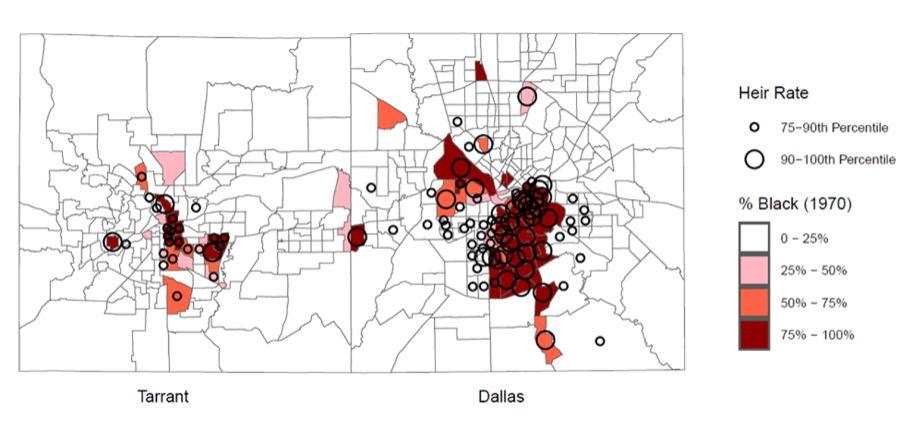
Figure 1. Contemporary Heir Rate and Percent Black in 1970
Why It Matters for Housing Policy
Heirs’ property can play a complicated role in housing markets. On one hand, it represents an important pathway to homeownership, particularly in communities that historically faced barriers to wealth building.
On the other hand, the informal and fragmented nature of heirs’ property ownership can create vulnerabilities, including difficulty accessing credit or repair programs, challenges maintaining housing quality, and increased risk of tax delinquency, foreclosure, and
partition sales. These challenges raise important policy questions about how cities and states can support families navigating inherited property ownership.
Looking Ahead
Urban heirs’ property remains a largely understudied dimension of housing inequality. By documenting its scale and spatial distribution in Dallas–Fort Worth, this research
contributes important new evidence for understanding how heirs’ property shapes urban housing markets and informs future research and policy responses.
Potential policy responses include expanding legal assistance and estate planning services, creating flexible home repair programs for households with clouded titles, and
promoting co-tenancy agreements that help families manage jointly owned property. As cities continue to grapple with housing affordability and wealth inequality,
understanding how inherited property shapes access to stable housing will become increasingly important.
Noah J. Durst is associate professor of Urban and Regional Planning in the School of Planning, Design, and Construction at Michigan State University. In his research, he uses quantitative methods to examine issues of land use and zoning, housing, infrastructure development, and municipal annexation.
Heather Way is a clinical professor at The University of Texas at Austin, where she directs the Law School's Housing Policy Clinic and teaches in the Entrepreneurship and Community Development Clinic. A national expert in affordable housing and community development law, her work focuses on advancing housing justice, expanding economic opportunity, and fostering equitable communities. Her work has shaped numerous high-impact legal reforms that strengthen housing stability and address critical gaps in housing policy.