Want to Pay for Climate Policy Right Now? Look to Cities
Eric Scheuch (Yale University)
Over the last year, the Federal government has waged a war on climate policy: from repealing the Inflation Reduction Act, to paying companies to kill offshore wind leases. At the same time, over the last few years, political scientists have pointed to local politics as a potential venue for progress on a number of policy issues, climate among them. The goal of my paper “Voters Support and are Willing to Pay for Local Climate Adaptation Policies” is to measure the degree to which Americans are willing to pay for climate policy at the local level, with a particular distinction between mitigation policy (reducing emissions) and adaptation policy (reducing the effects of climate change). Voters have reasons why they might wish to make progress on climate change, including implementing their green values, and lessening the impacts of flooding and heat. However, they also may have reasons why they might not wish to do so, including already high tax burdens, and the geographically diffuse benefits of climate mitigation policies in particular. The question of the extent to which individuals are willing to pay for local climate policies is an open one, and one with important policy stakes.
In order to make progress on this question, I conducted a pair of surveys in 2023 and 2024, with samples that were recruited to be as representative of the population as possible given their online nature. The benefit of two surveys is threefold. First, it ensures that results that I observe are not unique to a particular moment or sample. Second, it allows me to test attitudes from samples recruited from two different survey providers. Third, an embedded experiment in my second survey allowed me to ensure that the results from the first survey were not due to any particular way I phrased my survey questions-important, because the willingness to pay numbers I observed in the first survey were surprisingly high, particularly for adaptation policies, but I was concerned that result was due to me framing said policies as not being about climate change. The following table shows the willingness to pay results from my 2023 surveys, followed by bullet-pointed results from the whole paper, incorporating the 2023 and 2024 survey results together.
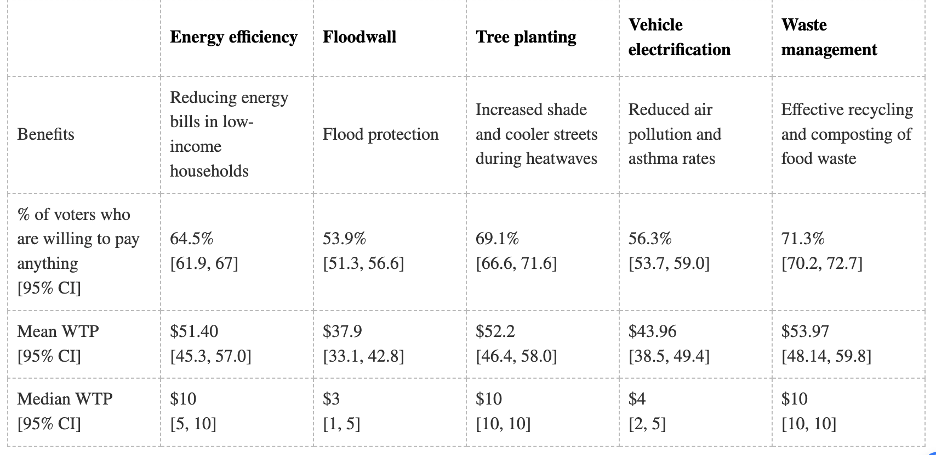
● Respondents are highly willing to pay for local climate policy, to the tune of hundreds of dollars per year ($252 in 2023, $330 in 2024).
● That high willingness to pay is not an artifact of survey year, vendor, or question wording.
● Rather, it appears that respondents are particularly willing to pay for local climate adaptation policies, such as heat and flood protection.
● Mean willingness to pay is much higher than median willingness to pay: while a small number of respondents are willing to pay a lot for local climate action, a much greater number are willing to pay a little.
● Subgroups that are particularly willing to pay are those that are often most supportive of climate policy, including younger respondents, Democrats, and higher income respondents.
● While there is a large partisan gap on willingness to pay, the gap is smaller for adaptation than mitigation policies.
● Independents are a key swing block, prioritizing costs and benefits more similarly to Republicans than Democrats, but having a willingness to pay that is closer to Democrats than Republicans.
I view these results as largely positive for the climate movement, particularly for advocates and policymakers interested in local action. If one assumes these results generalize from the survey population to the broader American population (see the paper for more discussion of generalizability), local climate action could generate tens of billions of dollars in new climate spending ($80.8 billion, based on the 2023 results) at a moment when the national government is cutting climate spending by at least that much. In an era where affordability is the political buzzword of the moment, many local climate policies, such as energy efficiency programs for low income households or heat protection to help lower AC bills, could be broadly popular. However, my findings hold some warnings for climate advocates as well. First, respondents prioritize adaptation over mitigation policies. While adaptation policies are vital, and are logical to implement at the local level given their local benefits, they do little to reduce emissions, the root cause of climate change. While my paper suggests that local climate action can make a major difference in lessening the harms of climate change, especially in urban areas, it also suggests that local policy’s contributions to emission reductions will be limited. Second, when I ask respondents to rank the importance of various types of costs and benefits related to local climate action, respondents rank keeping costs low over any type of benefit, emphasizing that high willingness to pay is concentrated in a minority of the population. This indicates that, while a constituency certainly exists for local climate policy, and should be taken advantage of, cities are unlikely to be a limitless piggy bank for American action on the topic, and will not, by themselves, be able to fully compensate for the deficit created by a lack of federal action on the topic.
Dr. Eric Scheuch is the Deputy Director of Experimental Research at the Yale Program on Climate Change Communication and a researcher at the Yale School of the Environment. He earned his PhD in Political Science at Yale in 2026.