Housing Vacancy, Structural Decline, and Voter Turnout in South Korea
Seungwoo Han (Kyonggi University) & Yookyung Lee (Yongin Research Institute)
Vacant homes are often treated as a technical concern for urban planners or housing officials. They are discussed in terms of land use, neighborhood maintenance, or redevelopment strategies. Yet in many places, empty homes are also a visible sign of deeper change. They tend to appear where people are leaving, where local services shrink, and where the future of a community feels uncertain. In South Korea, this pattern has become increasingly pronounced. While much public attention focuses on high housing prices and speculation in major cities, a different housing reality is unfolding elsewhere, marked by rising vacancy in smaller cities and rural districts.
The present study asks a simple question with important democratic implications. When homes sit empty, does political participation also decline? Examining 252 local districts between 2016 and 2022, we find a clear and consistent relationship: districts with higher housing vacancy tend to have lower voter turnout. This association is especially strong where vacancy is long-lasting, rather than temporary. These findings suggest that vacancy is not only an economic or demographic indicator; it also reflects local conditions that can undermine democratic engagement.
Figure 1 illustrates why this issue matters. The map shows how housing vacancy has increased over time and how unevenly it is distributed across the country. The highest vacancy rates are concentrated outside the Seoul metropolitan area in places experiencing population loss and economic contraction. This spatial pattern is important because political participation is shaped not only by individual motivation but also by the environments in which people live.
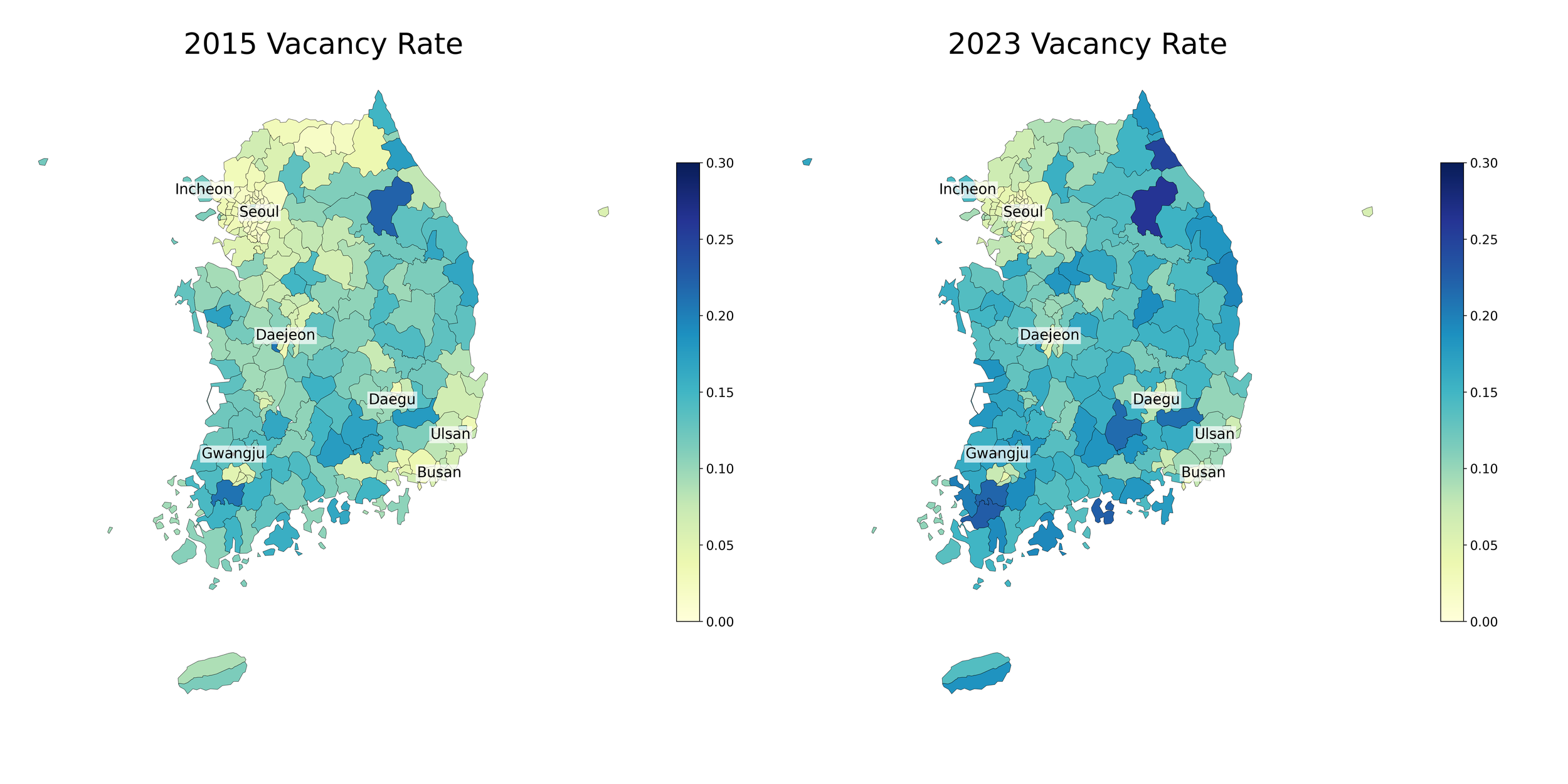
Figure 1. Changes in housing vacancy rates across districts, 2015 to 2023
Source: Korea Statistical Information Service (https://kosis.kr)
Core message
Our analysis links district level turnout in four national elections to local housing conditions. Across a range of statistical models, including those that track changes within the same district over time, the pattern is consistent: higher vacancy is associated with lower turnout. This does not mean that vacancy alone causes political disengagement. Rather, vacancy marks local environments in which participation becomes more difficult to sustain.
One reason is political efficacy. In places where homes are empty and populations are shrinking, residents may feel that their community has lost political attention and influence. When local decline appears persistent, voting can seem like less meaningful way to affect outcomes. Another reason is the erosion of social life that supports participation. Voting is often reinforced through everyday interactions among neighbors, local organizations, and community institutions. As vacancy increases, these networks weaken, making civic engagement harder to maintain. Vacancy may also affect mobilization. Political parties and candidates tend to focus their efforts where turnout is higher and populations are growing. Areas marked by long term decline may receive less outreach, fewer visits, and less sustained organizational presence.
A key contribution of this study is to show that not all vacancy carries the same political meaning. The negative relationship between vacancy and turnout is much stronger where a larger share of empty homes remains unoccupied for extended periods. Long term vacancy signals structural decline rather than short term fluctuation. In such contexts, vacancy reflects durable patterns of outmigration, aging populations, and institutional retreat. Our findings indicate that the political consequences of vacancy are most pronounced in these settings.
Although this study focuses on South Korea, the implications extend more broadly. Many countries face similar challenges of demographic aging, regional inequality, and the concentration of opportunity in major metropolitan areas. As some regions shrink, vacancy may become an increasingly important marker of democratic inequality across space. When participation declines in places experiencing material decline, those communities risk becoming politically less visible and less represented.
Housing shapes politics not only when it is owned, priced, or traded, but also when it is left empty. By drawing attention to housing vacancy, this study highlights how the built environment can influence democratic participation, particularly in places where social and economic decline has become an enduring feature of everyday life.
Yookyung Lee is an Associate Research Fellow at the Yongin Research Institute in Yongin, South Korea. She is an urban policy researcher with expertise in policy analysis and quantitative data analysis. Her research focuses on urban environmental policy, migration, and inequality.
ORCID: https://orcid.org/0000-0003-3722-8407
Seungwoo Han is an Assistant Professor in the Department of Political Science and International Relations at Kyonggi University in Suwon, South Korea. He is a political economist specializing in data analytics, including econometric analysis, large-scale data analysis, and computational methods. His research examines the political economy of inequality, migration, and environmental issues.