Should we Pursue Municipal Mergers?
Insights from a Global Review
Tao Zheng (Nanjing Normal University), Bindong Sun (Zhejiang University), Kristof De Witte (KU Leuven)

Municipal amalgamation, the process of merging smaller administrative units into larger ones, has been a key policy tool globally to address issues like fiscal pressure, governance challenges, and urbanization. But do these mergers deliver the promised benefits? Our recent research provides a comprehensive review of the effects of municipal amalgamations, highlighting key findings that are essential for policymakers and citizens alike.
The Study
This study employs a systematic literature review methodology. We established a workflow to ensure that selecting relevant literature is scientific, transparent, and reproducible. The selection criteria are illustrated in Figure 1. After carefully reviewing the 110 articles, we find that the impacts of amalgamation can be broadly categorized into three dimensions: economy, public services, and politics, which is broadly consistent with the conclusions of existing literature reviews. Further analysis reveals an emerging research trend, namely the growing scholarly attention to issues of equity among internal units after amalgamation. These equity issues are closely linked to the characteristics of the units before amalgamation. To provide a more straightforward presentation of the analytical framework of this study, Figure 2 summarizes the overall structure of the research. It highlights the key themes of the literature and illustrates how the characteristics of amalgamated units shape multiple post-merger effects.

Figure 1. Selection Criteria
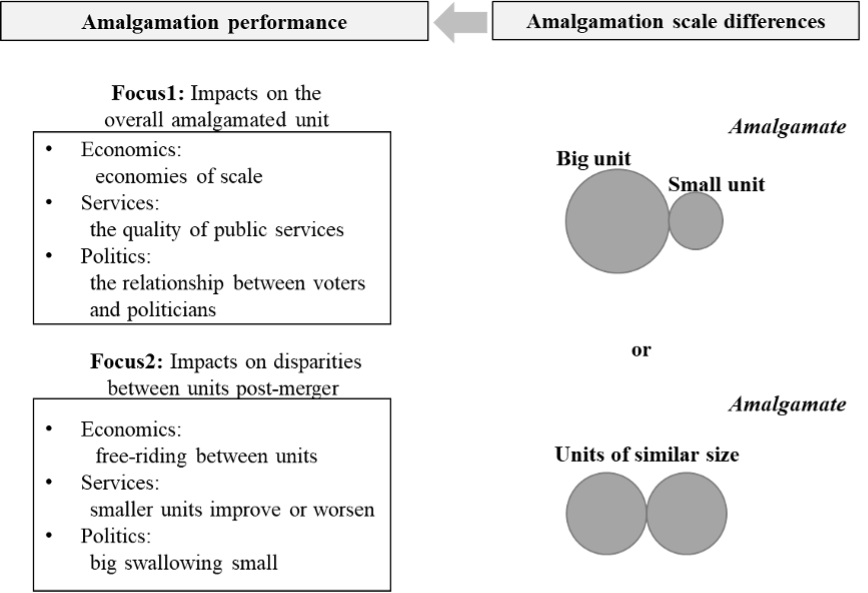
Figure 2. Research focus categories
Key Insights
Efficiency and Economies of Scale
Many proponents of municipal amalgamation argue that larger municipalities can benefit from economies of scale, reducing costs per capita. However, my review found that this is not always the case. In some instances, the increase in administrative complexity, infrastructure needs, and coordination costs can outweigh the potential savings. Studies from diverse contexts, including Denmark, Japan, and Germany, reveal that while some economies of scale are achieved in capital-intensive services, the overall financial benefits are often limited.
Impact on Public Services
One of the key promises of amalgamation is the improvement of public services. Yet the evidence is mixed. Larger municipal units may have the resources to offer a broader range of services, but this does not necessarily translate into better service quality. In fact, smaller regions within amalgamated areas often experience a decline in public services as their influence wanes within the new governance structure. For example, public schools and local health services may remain unaffected in large cities, but smaller towns may see cutbacks or diminished quality.
Political Representation and Democracy
A significant concern with amalgamation is its impact on democratic participation. Studies show that as municipalities grow in size, the relationship between voters and politicians becomes more distant. Voter turnout tends to decrease post-merger, especially in smaller, more rural areas. This decrease in political engagement is linked to a loss of local identity and a feeling of detachment from the central administration.
Emerging Trends in Transitional Economies
In transitional economies, municipal amalgamation has had some positive effects, particularly in environmental governance. By consolidating local governments, these countries have been able to improve pollution control and better coordinate environmental policies. However, the economic impacts are more mixed, with some studies showing positive growth in GDP and others reporting little to no long-term economic improvement.
Contributions
Our study incorporates recent empirical evidence from transitional economies, where growing attention has been paid to the effects of amalgamation on GDP growth, environmental quality, and carbon emissions. This inclusion expands the scope of existing research topics.
This work introduces a spatial scale perspective, moving beyond the traditional domain-based classifications. Based on theoretical considerations and practical needs, the impacts of municipal amalgamation are examined at the levels of entire administrative and subordinate units. Different spatial levels emphasize distinct aspects of amalgamation outcomes. This classification helps to address the gaps in previous reviews and provides policymakers with a more comprehensive reference.
Finally, this study refines the analytical framework by strengthening the integration between theoretical analysis and empirical evidence. Unlike previous reviews that often separate theoretical discussions from empirical findings, this study introduces relevant theoretical frameworks before presenting empirical results in each domain. This approach helps to explain the heterogeneity observed across empirical studies.
Policy Implications
First, recognizing that institutional differences across countries can lead to divergent outcomes, policymakers should adopt context-sensitive strategies that reflect municipal amalgamations' complex and heterogeneous nature rather than relying on simplified cross-national comparisons or policy transfers. This requires moving beyond uniform approaches and conducting ex-ante assessments of local conditions, including population density, fiscal structures, service delivery arrangements, and anticipated restructuring costs, to develop reform strategies aligned with regional development goals and administrative capacities.
Second, in the academic domain, ensuring greater consistency in operationalizing key variables and data collection practices is essential for improving the comparability of outcomes across cases. Such methodological alignment enhances empirical evaluation and supports evidence-based policy design by enabling more robust cross-study learning. It also contributes to theoretical development by creating a more coherent empirical foundation.
Third, future research and policy practice should increasingly prioritize issues of equity and sustainability in the design and evaluation of municipal amalgamations. After consolidation, the persistent marginalization of smaller units highlights the need for institutional safeguards to protect democratic responsiveness and service accessibility. Governments should adopt fiscal and political mechanisms to mitigate pre-merger opportunism and post-merger exclusion, such as transitional funding arrangements, guaranteed representation for peripheral areas, and equalization transfers. In addition, the growing body of research from transitional economies demonstrates the potential of amalgamation to contribute to broader development and environmental governance objectives. Merger reforms should be linked with long-term strategies that promote economic resilience, spatial equity, and regulatory coherence, thereby enhancing institutional legitimacy and fostering more durable outcomes.
Tao Zheng, received his PhD in Regional Economics, School of Urban and Regional Science, East China Normal University, Shanghai, China. Lecturer of Regional Economics, School of Business, Nanjing Normal University, Nanjing, China. Visiting Scholar of Economics, Faculty of Economics and Business, KU Leuven, Leuven, Belgium. Research interests: Public Policy Studies, Urban Geography and Regional Economics.
Bindong Sun, received his Ph.D. in Urban and Regional Planning, Technical University of Berlin, Germany. Full Professor of Regional Economics and Urban Geography, School of Public Affairs, Zhejiang University. Director of Research Center for China Administrative Division, East China Normal University, Shanghai, China. Research interests: Urban Governance, Urban Geography and Regional Economics.
Kristof De Witte, received his Ph.D. in Public Economics, Faculty of Economics and Business, KU Leuven, Leuven, Belgium. Full Professor of Education Economics and Political Economy, Vice Dean for Research of the Faculty of Economics and Business, KU Leuven. Research interests: Public Economics, Public Sector Efficiency, and Economics of Education.