Drivers for Dutch reversal of local party system nationalization
Raymond Gradus, Tjerk Budding, and Vera van Schie (Vrije Universiteit Amsterdam)

Contrary to other countries such as Denmark, in the Netherlands local party systems shows signs of reverse nationalization. Using data from seven municipal elections between 1998 and 2022, we observe that the Dutch local party system nationalization index decreases considerably over time, meaning more independent local parties in the local council. We find that size, rurality, peripherality and mergers all have an influence on the index.
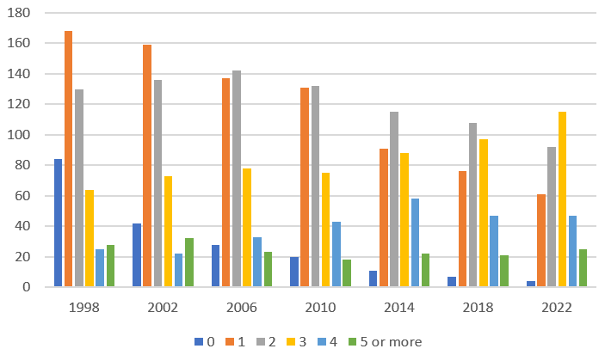
Figure 1: Number of municipalities with the number of local parties
In the Netherlands, the number of local parties that are not registered nationally increased substantially between the 1998 and 2022 elections. Figure 1 shows that on average, the number of local political parties per municipality increased from 1.75 in 1998 to 2.64 in 2022. In 1998, more than 80 Dutch municipalities did not have a local party, while in 2022 this decreased to four. Remarkably, the number of municipalities with three-four local parties increased from 18% in 1998 to almost 50% in 2022 (see the yellow and blue bars, respectively, in Figure 1).
Using the index of local party system nationalisation (between 0, where only independent local parties are elected, and 1, where only national parties are elected), the Dutch index decreased from 0.41 in 1998 to 0.27 in 2022. This is smaller than in Denmark (especially after the local government reform in 2005), Austria (except for the region of Tyrol) and Flanders.
The goal is to explore which factors influenced this development. We analyse four factors. First, size can be an important explanation. In small Dutch municipalities, independent local parties perform better. Second and third, several political scientists show that regional resentment is especially strong in areas located further from the political and cultural, economic center and in rural areas. Fourth, we investigate if mergers influence the extent of local party system nationalization. We expect that independent local parties can be formed to defend the interests of amalgamated villages. Notably, in the Netherlands mergers are an ongoing phenomenon with a limited number each year, whereas in Belgium and Scandinavian countries, big reforms have taken place.
In accordance with previous studies, municipalities with more inhabitants have a higher nationalization index. In addition, municipalities with a higher rurality have a lower nationalization index, and we find that on average, the most rural municipalities have approximately two local parties more than their counterparts in strong urban areas. Moreover, municipalities that are further from the political center of the Hague have a lower nationalization index. Municipalities that are 200 kilometres (124 miles) from this political center have approximately one additional local party. Finally, if a merger took place during the previous five years, such municipalities have approximately one additional local party.
If we distinguish between diverse types of mergers, we find that municipalities which were involved in an annexation do not have a lower nationalization index. However, municipalities that were involved in the past five years in a merger of entities of mixed or equal size on average show a lower nationalization index. An explanation is that the inhabitants of jurisdictions involved may fear that their own interests and local identities are threatened.
Raymond Gradus is Professor of Public Economics and Administration in the School of Business and Economics at the Vrije Universiteit Amsterdam, the Netherlands, and a fellow of the Tinbergen Institute. His research interests are local government, environmental policy, and public administration. He has published widely in journals including Ecological Economics, Public Administration, International Public Management Journal, and European Journal of Political Economy.
Tjerk Budding is Professor in Public Sector Accounting in the School of Business and Economics at the Vrije Universiteit Amsterdam, the Netherlands. His research interests are management accounting, financial reporting, and the role of the controller. He has published widely in accounting and public administration journals, including Management Accounting Research, Journal of Accounting and Public Policy, and International Public Management Journal.
Vera van Schie is a PhD candidate at the School of Business and Economics at the Vrije Universiteit Amsterdam, the Netherlands. Her research focuses on accounting in the healthcare sector, specifically the governance of sustainability, and sustainability reporting by hospitals.