“The City Has Completely Turned Its Back On Us”
Los Angeles Mutual Aid and The Politics of Refusal
Michele McLaughlin-Zamora (University of California, Santa Barbara)
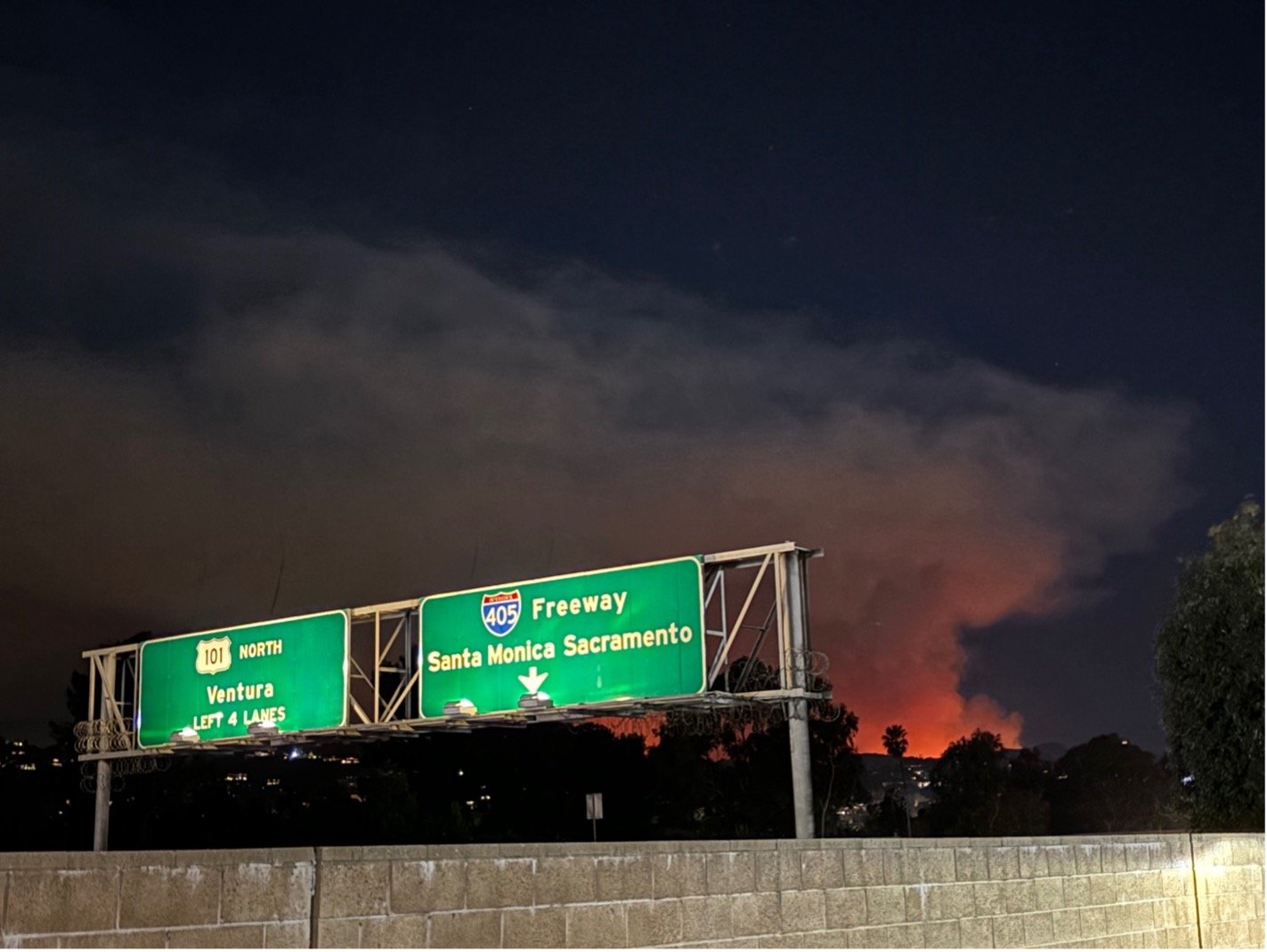
Photo credit: Sara Renner, January 2025
Introduction
Just after New Years Day 2025, the National Weather Service began warning Los Angeles to brace for a life-threatening and destructive windstorm that could result in widespread multi-layered damage and heightened fire threat. [1] On the morning of January 7, 2025, Los Angeles residents awoke to a city ablaze. By 10am there were three major, fast-moving wildfires impacting the west, north, and eastern areas of Los Angeles, with several other smaller but still threatening fires flaring up all over the county. Angelenos spent the next five days in a state of anxious chaos as upwards of 200,000 residents quickly evacuated certain areas or awaited evacuation orders. The winds calmed by January 12, and most evacuation warnings were lifted by January 16. Then, the damage assessment began. The Palisades fire in Pacific Palisades and the Eaton fire in Altadena together would amount to one of the worst wildfire disasters in U.S. history (USGS 2025).
As the actual smoke cleared, people began to express deep dismay, frustration, and anger at the institutional insufficiencies around disaster response and the stark differences in redress and resource allocation between the Palisades and Eaton fire survivors. Mayor Karen Bass returned from a trip to Ghana that many saw as irresponsible considering the extensive weather warnings. California governor Gavin Newsom and newly inaugurated President Donald Trump both made highly visible visits to the wealthy Pacific Palisades burn areas but avoided middle-class and increasingly militarized Altadena. The California Office of Emergency Management, the state entity responsible for mitigating and responding to disasters, is also the subject of a whistleblower case claiming that the person in charge of evacuation alerts for the Eaton Fire, which resulted in 19 fatalities, was literally asleep at the job. Both the Los Angeles Department of Water and Power and Southern California Edison are also subjects of negligence lawsuits. L.A. county (responsible for the Eaton fire) conducted disaster response reviews which confirm sweeping institutional failures (Lawrence 2025), yet survivors claim that the report was not extensive enough (Marquez 2025; Paige 2025). Additionally, Bass and city officials (responsible for investigating the Palisades fire) have been accused of altering the Palisades report to deflect responsibility.
Without responsive institutions with which to actively engage, such as legacy media, elected officials, emergency management systems, or social services, how did everyday Angelenos respond to the wildfire crises and find support? By analyzing digital communication and in-person participation, I demonstrate how Los Angeles mutual aid (LAMA) hubs provide space to process grief, make sense of the chaos, and find outlets for political action and meaning despite institutional failures. LAMAs engage, online and off, in a grassroots “politics of refusal”: a collective rejection of state-oriented reformism in favor of, as an organization of ten hubs summarized, “independent, life-centered structures outside of state control” while simultaneously seeking broad, transformational, systemic social change.
Rebel Cities and Polycrises
This essay views the rise of mutual aid praxis in Los Angeles as a resistance response to the neoliberal urban polycrises. As once uncommon natural disasters become increasingly routine, the conditions from which they arise are more often understood as socio-economic productions of contemporary urbanization (Madden 2021). Urbanization has long been analyzed through crisis terms (Weaver 2017). From limitations of an “idealized” socio-political order to critiques of the effects of neoliberalism, “crisis tendencies are baked into the system” (Madden 2023, 272). Critiques of global capitalist urbanization that arose in the 1960s and 1970s (Harvey 1978; Lefebvre 1996; Williams 1973) are particularly poignant as complex, intersecting, multi-layered sets of reverberating critical events, or polycrises, unsparingly advance and “interact such that the overall impact far exceeds the sum of each part” (Whiting and Park, 2023). At the same time, critical urban scholars highlight the rise of social movements seeking transformational urban change, refusing what David Harvey deems the “[a]cceptance of the globalization language (Harvey 1996, 429). Los Angeles, as a global region, is particularly subject to the violent and unequal process that globalization inflicts through the uneven expansion of neoliberal practices (Madden 2012).[2] Through the lens of critical urban scholarship, polycrises become a driving concept for cross-community organization, the rise of mutual aid praxis in Los Angeles, and resistance to and refusal of entrenched neoliberal policies that weaken public institutions and quality of life (Harvey 2012; Madden 2021; Swyngedouw 2014).
Los Angeles Mutual Aid and the Politics of Refusal
The COVID-19 pandemic catalyzed a resurgence in mutual aid (MA) practice and scholarship (Bell 2021; McKane et al., 2024; Springer 2020). Dean Spade defines MA as a “collective coordination to meet each other’s needs” in times where neoliberal policies and practices are compounding harms (Spade 2020, 7). MA praxis is understood as a nontransactional, cultivation of deep relationships that “transcend political borders” (Benally 2023, 198) and are often experienced as valuable spaces of resilience and resistance. The term “mutual aid” has been traced back to Russian anarchist Peter Kropotkin (1902), however, late Indigenous scholar activist Klee Benally notes that Kropotkin partly developed his analysis by observing Indigenous communities and that non-hierarchical and relational collective care is nothing new (Only 2021). In the U.S., mutual aid groups have historically served marginalized communities in times of crisis and disaster (McKane et al. 2024) and some see the current resurgence of mutual aid as “a revisiting of something much older, enduring, and infinitely more integral to our wellbeing,” a pathway to systemic transformation (Springer 2020 112). Others agree on the necessity of broad systemic transformations but are more pragmatic, noting challenges mutual aid as a movement faces such as non-profit co-optation, collective burnout, or as a vehicle to maintain institutional irresponsibility (Gilmore 2007; Hayes and Kaba 2023; Spade 2020).
Oftentimes, marginalized communities or those who are not finding justice within the political mainframe or who oppose politics-as-usual (Neblo et al. 2010) engage in the “politics of refusal” (González 2011; Holloway 2005; Mora 2017) to find alternative, non-state forms of political action and agency such as mutual aid. The politics of refusal is a form of political activism that holds to the tenets of autonomous community power while simultaneously seeking systemic social change beyond state-oriented reformism. The politics of refusal embraces and builds upon revolutionary ethos of movements such as the Zapatistas, Buen Vivir, The Black Panthers, AIM, and ACT UP and “is less about seizing state power than about exposing, delegitimizing, and dismantling mechanisms of rule” (Widener 2008, 205) while simultaneously building justice-based community systems.[3]
What are LAMA’s refusing?
Los Angeles is both a city and a county (World Population Review, 2026), the second and first most populous in the nation, at approximately 4 million and 10 million people, respectively. There is a total of 88 cities within Los Angeles County, each with their own tentacular, autonomous governing entities. When people talk about L.A., they are usually referring to the city, the most globally recognizable place within the larger area, but municipal authority is dispersed throughout the region (Hoene et al. 2002).
Two important systemic features make Los Angeles an important site to study justice transformations: the purposely diffuse and fragmented governing landscape and its historically racialized structure of policy and practice. These two aspects work in tandem to shape Los Angeles into what James C. Scott (1998) describes as an illegible city.[4] Legibility offers clear and visible order in geographic, architectural “straight lines, right angles, and repetitions” that result in a grid-type urban layout (56). An illegible city, on the other hand, is spatially unintelligible and not immediately navigable to outsiders, offering a kind of protection against external intrusions and “a reliable resource for political autonomy” (54). Both its geographical layout and governing system are sprawling yet heavily segregated, with overlapping but indeterminate boundaries. Industrialization, housing practices, and the freeway network – the most extensive in the U.S. – intentionally create logistical barriers and racialized urban demographics (Boone 2005; Davis 1990; Gibbons 2018; Rothstein 2017) that make collective civic goals extremely difficult to articulate let alone act on.
Additionally, and less known are the deep underpinnings of white-supremacist religious conservativism that shaped Los Angeles urban growth starting in the mid-nineteenth century (Waldie 2011). The railway explosion saw an influx of white Anglo-protestant Midwesterners arrive in Los Angeles seeking refuge from cities they saw as becoming overrun with immoral immigrants (Singleton 1979), bringing with them a strong mix of entrepreneurial ambition, moral superiority, and xenophobia that shaped regional socio-political and economic governing – systems that remain embedded through the strength, structure, and practice of illegibility (Charles 2006; Davis 1998; Gonzalez 2011; Huante 2022; Kim 2008; Lee 2022; Rodriguez 2005; Rothstein 2017).
In the last five years a cascade of mounting systemic corruption issues, including but not limited to hospice fraud, hundreds of millions of dollars in LAPD liabilities, 2028 Olympic chairman Casey Wasserman’s ties to Jeffrey Epstein, and several Los Angeles councilmember scandals have contributed to plummeting public trust. These governing failures are not one-off cases of crisis, but are instead indicative of L.A.’s intentionally diffuse governing landscape and historically racialized structure of policy and practice. LAMA hubs actively refuse to keep “banging heads” with entrenched injustices like criminalization of poverty, political greed and corruption, increased militarized violence and I.C.E. occupation, global genocides, subpar healthcare, economic despair, and, as one member of San Fernando Valley Mutual Aid lamented “the loneliness that results from decades of socio-economic austerity.”[5]
Framework and Methodology
Within the framework of critical environmental justice, critical political ethnography and digital ethnography, this essay explores the evolving regional community organizing power and political influence of LAMA hubs. Ethnographic work is highly interpretive, capturing a very specific moment in time. Reflexive ethnographic research mediates interpretive analysis through the co-creation of ideas and knowledge, and employs the techniques of community immersion that go “beyond face-to-face contact” to engage in community care. This gleans meaning from participants’ socio-political realities to explore how human experiences and behavior shapes and is shaped by those worlds (Schatz 2009). Digital content is substantiated through legacy media reports, citizen journalist reports, local public media reports, in-person ethnography at various mutual aid events, and talking and working within mutual aid hubs.
Digital posts and offline conversations are analyzed to demonstrate the emergence of what scholars of social resistance term a politics of refusal. At the outset, participants highlight the disconnect between neoliberal institutional narratives and community needs:
“Angelenos come together to help each other out, it’s what we do. Thank you to Disney, Netflix, Wasserman, Hilton, Annenberg and so many others for donating millions of dollars to relief funds. And this is just the start. Together we will rebuild a stronger Los Angeles.” Mayor Karen Bass, @MayorOfLA. X formerly Twitter, January 13, 2025.
“I love the people of Los Angeles. For example Netflix.” Anonymous. X formerly Twitter, January 14, 2025.
“I’ve volunteered three days at donation centers in the last week. Not once have I come across a LA City government worker, much less a representative for even a photo op. But sure, Karen Bass, thank corporations.” Anonymous. X formerly Twitter, January 14, 2025.
“National guard & cops with guns out on one side – community organizing mutual aid & resources next to a burnt down house across the way.” @peoplescitycouncil. Instagram, January 13, 2025.
Digital media provides a real-time unfiltered peek at unfolding events and the fundamental affordance these spaces provide for social movement and identity construction: the ability to obtain political information, construct narratives, and act outside of traditionally closed-off avenues of political participation (Rogers 2019).
Digital communications coupled with salient crises provide new opportunities to be drawn into politics in meaningful ways. (Bennett and Segerberg 2013; Crossley 2015; Fisher 2018). Furthermore, “the feeling of belonging to a community puts the question of emotions at the center, which becomes relevant for many experiences born and consolidated within digital spaces” (Antonucci et al. 2024, 165):
“The city has completely turned its back on us.” @peoplesstrugglesfv. Instagram. January 10, 2025.
“I’ve never seen this for real, only in movies. The police are just standing around to block the streets. We see firefighters take care of one house but there are more houses burning. We decide to do something to help. It’s not an easy job. We start with 15 or 14 people but we asked for help on Facebook. The next day we have 100 volunteers and then the next days we have maybe 3,500. We move trees for the first responders to have access. Nosotros somos parte de la comunidad (we are part of this community).” May 2025. National Day Laborer Organizing Network
“The reason we are having fires as bad as they are is because our lands and waters are mismanaged. If we don’t take the time to rematriate the land we are going to be in the same situation soon. We need to slow down and heal together. Government officials are not keeping people in the loop and they are not in communities. We are sharing info and resources through our websites and social media. We are keeping each other safe.” May 2025. Indigenous Mutual Aid Collective.
Through social media diffusion, LAMA hubs engage in consciousness-raising where individuals co-comprehend complex social situations, gradually identify as part of a group having similar experiences and begin to conceive of themselves as uniquely positioned in society, adding a “normative dimension of participation” while both publicizing and politicizing experiences (Whittier 2017, 143). As online sharing increased, so did in-person membership in mutual aid hubs:
“I learned about this through @Ktownforall [on Instagram]. I'm from L.A., born and raised. It's wild. There's people out here from all over the city that have just created a chain. And we've just been handing off and loading cars. So to see L.A. come together like this is really special.” Koreatown Mutual Aid Hubs. January 11, 2025.
“Out of these ashes our community spirit rises up and is actually burning even brighter and bigger than these catastrophic fires. This is a grassroots effort that started out with maybe 15 of us with two folding tables. Now we are mobilizing hundreds of people.” January 18, 2025. North Hills West Mutual Aid Collective
“I had to log off and find my way to these groups that started after the fires and are now mobilizing against I.C.E and taking care of our houseless neighbors and just caring for one another. You know? Go touch grass. You can’t post your way out of fascism” June 2025. Valley Mutual Aid Hub
Urban crises are increasingly spaces of deep mediatization “which all human practices, social relations, and social order are entangled with digital media and their infrastructures” (Hepp 2022, 470). This brief display of online and offline narratives demonstrates how Angelenos observed and shared institutional discontent while also describing their participation in, engagement with, and discovery of renewed agency through the emerging mutual aid hubs.[6] During and immediately after the wildfires, LAMAs largely proliferated through online sharing of a broad array of resources across geo-political boundaries. Most participants joined mutual aid during and after the 2025 wildfires after becoming aware of community needs via TikTok and Instagram, or through word-of-mouth from friends or co-workers. Through shared stories and experiences of systemic failures and hope, Angelenos defied constructed differences and gathered together in new ways and in new spaces.
Conclusion
Los Angeles struggles to develop resilient socio-ecological practices. Decentralized governing, social divisions, economic gaps, and long-embedded racialized mechanisms become more pronounced as the polycrises escalate. At the same time, there is a strong and vibrant mutual aid network forming which challenges local systems of intentionally designed geo-political division. What emerges is a politics of refusal that challenges pernicious race-class spatial boundaries and mobilizes a solidarity movement that demands a regenerative and resilient Los Angeles that rejects the status quo. As threats to collective action mount and state violence increases, LAMA hubs are actively growing their offline presence with efforts such as the #powerbeyondplatforms campaign, a “coordinated effort to turn digital connection into real-world action” and the formation of a Mutual Aid Union of Los Angeles to increase capacity and regional solidarity. Understanding the structure and potential impact of LAMA hub-making is critically significant for those committed to a socio-ecological resilient and just Los Angeles, and for other highly diverse and complex urban areas across the world.
Notes
[1] National Weather Service Los Angeles (@nwslosangeles): “HEADS UP!!! A LIFE-THREATENING, DESTRUCTIVE, Widespread Windstorm is expected Tue afternoon-Weds morning across much of Ventura/LA Co.” Instagram, January 6, 2025. https://www.instagram.com/p/DEfsPGUPcRg/
[2] For a brief but thorough explanation of the urban neoliberal crises see David Harvey’s A Brief History of Neoliberalism (2005).
[3] Following the Eaton fire a group of survivors frustrated “with the existing disaster recovery system” created PostFire https://postfire.org mutual aid, a free, non-means tested online resource to guide other disaster survivors through recovery. While the organization transparently utilizes institutional resources they are also involved in public campaigns to hold institutions accountable and counter misinformation. PostFire is both active in seeking systemic change but not waiting around for incremental reform.
[4] For a modern, entertaining conversation on the illegible city see L.A. Times critic Christopher Hawthorne’s acerbic response to the N.Y. Times’ assessment of Los Angeles’ illegibility: https://www.latimes.com/entertainment/arts/la-ca-cm-building-type-new-york-times-20180211-story.html?fbclid=IwAR3Dp3gU5-fUrQQAsy5JIcJUDaZUmMBnZ_kbDItrRxX3L79tIz4sWzvlMx0
[5] San Fernando Valley Mutual Aid (@sfv_mutualaid), community organization. Instagram. https://www.instagram.com/sfv_mutualaid
[6] Most identities have been coded, generalized, or amalgamated for privacy. Many participants are from highly vulnerable populations. Because of the Trump Administrations NSPM-7, https://www.federalregister.gov/documents/2025/09/30/2025-19141/countering-domestic-terrorism-and-organized-political-violence, and Los Angeles ordinance 41.18, https://codelibrary.amlegal.com/codes/los_angeles/latest/lamc/0-0-0-128514, much of the activity that LAMA’s engage in can now be considered criminal.
References
Antonucci, Maria Cristina, Michele Sorice, and Andrea Volterrani. 2024. “Liminalities: Social Vulnerabilities Between Participatory Processes and Digital Space in the Neoliberal Era.” Continuities and Transformations in Forms of Collective Action. 15(29): 163-178. https://oajournals.fupress.net/index.php/smp/issue/view/627
Bell, Finn McLafferty. 2021. “Amplified injustice and mutual aid in the COVID-19 pandemic.” Qualitative Social Work. 20(1-2): 410-415. https://doi.org/10.1177/1473325020973326.
Benally, Klee. 2023. No Spiritual Surrender: Indigenous Anarchy in Defense of the Sacred. Detritus Books.
Bennett, W. Lance, and Alexandra Segerberg. 2013. The Logic of Connective Action: Digital Media and the Personalization of Contentious Politics. Cambridge University Press.
Boone, Christopher G. 2005. “Zoning and Environmental Inequity in the Industrial East Side.” In Land of Sunshine: An Environmental History of Metropolitan Los Angeles, edited by William Deverell and Greg Hise. University of Pittsburgh Press.
Charles, Camille Zubrinsky. 2006. Won’t You Be My Neighbor: Race, Class, and Residence in Los Angeles. Russell Sage Foundation.
Crossley, Alison Dahl. 2015. “Facebook Feminism: Social Media, Blogs, And new Technologies of Contemporary Feminism.” Mobilization. 20(2): 253-268. https://doi.org/10.17813/1086-671X-20-2-253.
Davis, Mike. 1990. City of Quartz. New York: Verso.
Fisher, Dana R. 2018. “Climate of Resistance: How the Climate Movement Connected to the Resistance,” in The Resistance: The Dawn of the Anti-Trump Opposition Movement, edited by David S. Meyer and Sidney Tarrow. Oxford University Press.
Gibbons, Andrea. 2018. City of Segregation: One Hundred Years of Struggle For Housing in Los Angeles. Verso Books.
Gilmore, Ruth Wilson. 2007. “In the Shadow of the Shadow State.” In The revolution will not be funded: beyond the non-profit industrial complex, edited by INCITE! Women of Color Against Violence. South End Press.
Gonzalez, Pablo. 2011. Autonomy Road: the Cultural Politics of Chicana/o Autonomous Organizing in Los Angeles, California. PhD diss., University of Texas at Austin. http://hdl.handle.net/2152/25882
Harvey, David. 1978. “The Urban Process Under Capitalism: A Framework for Analysis.” International Journal of Urban and Regional
Research 2 (1-3): 101–131. https://doi.org/10.1111/j.1468-2427.1978.tb00738.x.
Harvey, David. 2012. Rebel Cities: From the Right to the City to the Urban Revolution.” Verso.
Hayes, Kelly, and Mariame Kaba. 2023. Let This Radicalize You: Organizing and the Revolution of Reciprocal Care. Haymarket Books.
Hepp, Andreas. 2022. “Agency, social relations, and order: Media sociology’s shift into the digital.” Communications 47(3): 470-493. https://doi.org/10.1515/commun-2020-0079
Hoene, Christopher, Mark Baldassare, and Michael Shires 2002. “The Development of Counties and Municipal Governments: A Case Study of Los Angeles County in the Twenty-First Century.” Urban Affairs Review 37(4): 575-591. https://doi.org/10.1177/107808702221854.
Holloway, John. 2005. “Zapatismo Urbano.” Humboldt Journal of Social Relations. 29(1): 168-178. https://www.jstor.org/stable/23263128
Huante, Alfredo. 2022. “Planning the Barrio: Racial Order and Restructuring in Neoliberal Los Angeles.” Urban Affairs Review 58(4): 996–1027. https://doi.org/10.1177/10780874211021.
Kim, Jinah. 2008. “Immigrants, Racial Citizens, and the (Multi)Cultural Politics of Neoliberal Los Angeles.” Social Justice 35(2): 36-56. https://www.jstor.org/stable/29768487
Kropotkin, Peter. 1902. Mutual Aid: A Factor in Evolution. McClure, Phillips & Co.
Lawrence, Steven. 2025. “Eaton Fire Response Report Published: Confirms & Defines Gaps in Evacuation Alerts, Resource Limitations & Failures.” South Pasdenan, September 26, 2025. https://southpasadenan.com/eaton-fire-response-report-published-confirms-defines-gaps-in-evacuation-alerts-resource-limitations-failures/
Lefebvre Henri. 1996. Writings on Cities edited by Eleonore Kofman and Elizabeth Lebas. Blackwell.
Lee, Shelley Sang-Hee. 2022. Koreatown, Los Angeles: Immigration, Race, and the “American Dream.” Stanford University Press.
Loyola Marymount University. 2025. “LMU StudyLA Data Brief – 2025 LA County Governance Reform Data Brief” https://lmu.app.box.com/s/240xsifw32thin1q2fi7axoalzr64odj
Madden, David J. 2012. “City becoming world: Nancy, Lefebvre, and the global-urban imagination.” Environment and Planning D: Society and Space. (30): 772-787. https://doi.org/10.1068/d17310.
Madden, David J. 2021. “Disaster Urbanization: The City Between Crisis and Calamity.” Sociologica 15 (1): 91-108. https://orcid.org/0000-0003-0669-7841
Madden, David J. 2023. “Polycritical city?” City, 27(3-4): 271-274, https://doi.org/10.1080/13604813.2023.2232682.
Marquez, Natalia. 2025. “Los Angeles fires ravage communities, expose systemic issues.” Peoples Dispatch, January 13, 2025. https://peoplesdispatch.org/2025/01/13/los-angeles-fires-ravage-communities-expose-systemic-issues/
McKane, Rachel, Patrick Trent Greiner, and David Pellow. 2024. “Mutual Aid as a Praxis for Critical Environmental Justice: Lessons from W.E.B. Du Bois, Critical Theoretical Perspectives, and Mobilising Collective Care in Disasters.” Antipode. 56(2): 581-602. https://doi.org/10.1111/anti.12986.
Mora, Mariana. 2017. Kuxlejal Politics: Indigenous Autonomy, Race, and Decolonizing Research in Zapatista Communities. University of Texas Press.
Neblo, Michael A., Kevin M. Esterling, Ryan P. Kennedy, David M.J. Lazer, and Anand E. Sokhey. 2010. “Who Wants To Deliberate – And Why?” American Political Science Review. 104(3): 566-583. https://doi.org/10.1017/S0003055410000298.
Only, Ryan. 2021. “Anarchist Profiles: Klee Benally on Indigenous Mutual Aid.” Agency. August 2, 2021. https://anarchistagency.com/anarchist-profiles-klee-benally-on-indigenous-mutual-aid/
Paige, Jamie. 2025. “ ‘We Lived the Failures’: Public Outcry Frames LA County’s Fire After-Action Hearing.” Westside Current, October 1, 2025. https://www.msn.com/en-us/news/us/we-lived-the-failures-public-outcry-frames-la-countys-fire-after-action-hearing/ar-AA1NF911
Rogers, Richard. 2019. Doing Digital Methods. 2nd edition. Sage.
Rodriquez, Gregory. 2005. “L.A.’s puritan roots still show.” Los Angeles Times. December 4, 2005. https://www.latimes.com/archives/la-xpm-2005-dec-04-oe-rodriguez4-story.html
Rothstein, Richard. 2017. The Color of Law: A Forgotten History of How Our government Segregated America. Liveright Publishing Corporation.
Schatz, Edward. 2009. Political Ethnography: What Immersion Contributes to the Study of Power. The University of Chicago Press.
Scott, James C. 1998. Seeing Like A State: How Certain Schemes to Improve the Human Condition Have Failed. Yale University Press
Singleton, Gregory H. 1979. Religion in the City of Angels: American Protestant Culture and Urbanization, Los Angeles, 1850-1930. UMI Research Press.
Spade, Dean. 2020. Mutual Aid: Building Solidarity During This Crisis (And The Next). Verso.
Springer, Simon. 2020. “Caring geographies: The COVID-19 interregnum and a return to mutual aid.” Dialogues in Human Geography 10(2): 112–115. https://doi.org/10.1177/20438206209312
Swyngedouw, Erik. 2014. “Insurgent Architects, Radical Cities and the Promise of the Political,” in The Post-Political and Its Discontents: Spaces of Depoliticisation, Spectres of Radical Politics, edited by Japhy Wilson and Erik Swyngedouw. Edinburgh University Press.
USGS. 2025. “Greater Los Angeles Wildfires – January 2025. Before/After Images Landsat Missions. January 15, 2025. https://www.usgs.gov/media/before-after/greater-los-angeles-wildfires-january-2025
Waldie, D.J. 2011. “How We Got This Way (Los Angeles has Always Been Suburban)” Lost LA, PBS SoCal. December 12, 2011. https://www.pbssocal.org/shows/lost-la/how-we-got-this-way-los-angeles-has-always-been-suburban
Weaver, Timothy. 2017. “Urban Crisis: The Genealogy of a Concept.” Urban Studies 54 (9): 2039–2055. DOI: 10.1177/0042098016640487
Whiting, Kate, and HyoJin Park. 2023. “This is Why ‘Polycrisis’ is a Useful Way of Looking at the World Right Now.” WEForum.com, March 7. https://www.weforum.org/stories/2023/03/polycrisis-adam-tooze-historian-explains/
Whittier, Nancy. 2017. “Identity Politics, Consciousness Raising, and Visibility Politics,” in The Oxford Handbook of U.S. Women's Social Movement Activism, edited by Holly J. McCammon, Verta Taylor, Jo Reger, and Rachel L. Einwohner. Oxford University Press.
Widener, Daniel. 2008. “Another City is Possible: Interethnic Organizing in Contemporary Los Angeles.” Race/Ethnicity: Multidisciplinary Global Contexts. 1(2): 189-219. https://dx.doi.org/10.2979/rac.2008.1.2.189
Williams, Raymond. 1973. The Country and the City. New York: Oxford University Press.
World Population Review. 2026. “U.S. Cities – California – Los Angeles” and “U.S. Counties – California – Los Angeles County”: https://worldpopulationreview.com/us-cities/california/los-angeles and https://worldpopulationreview.com/us-counties/california/los-angeles-county respectively.
Michele McLaughlin-Zamora is a PhD candidate in political science at University of California, Santa Barbara. Her work focuses on building justice-oriented bridges between institutions and the communities they are obliged to serve, fostering a more equitable, sustainable, and resilient Los Angeles.