Who Should Social Housing Be For? Towards a Redistributive Majoritarianism
H. Jacob Carlson (Kean University) & Gianpaolo Baiocchi (New York University)

When designing social policy, a central question is: who is this for? In figuring out who should benefit from social welfare policy, there are broadly two schools of thought. First, you have a targeted perspective, which argues that we social programs should only be for the neediest. There are many good reasons for targeted policy. It could be because you want to prioritize scarce public money, or you want to redistribute to the have-nots. The second perspective is the universalist one, which instead tries to make policy for everyone – or at least an extremely broad constituency. The rationale for universalism is that it reduces the stigma that often gets attached to policies for low-income beneficiaries, and it also broadens the coalition, making it harder to cut when political winds change. In our paper, we argue for a hybrid—redistributive majoritarianism—which attempts to create a majoritarian constituency while also creating explicit targets for the neediest.
This question of targeting versus universalism is a very live question in the conversations around “social housing.” Social housing is a bit of an ambiguous term but generally refers to housing that reduces the influence of markets on who gets to live there and how much you pay. Under this umbrella can include government-owned public housing, limited equity cooperatives, community land trusts, housing by mission-driven nonprofits, and other versions that create permanently affordable housing. Social housing includes options for both renters and owners.
Social housing is generally agreed to be mixed income, but how mixed income it should be is where the debate comes in. Some social housing advocates what it to have deep priorities for the lowest income households, who are in dire need and have been consistently underserved by various permutations of affordable housing policy. Others want social housing to be more universalist, to broaden the coalition, stabilize building finances, and address an affordability crisis that is also climbing through the middle class.
In our paper, “Redistributive Majoritarianism: Urban Inequalities and the Struggle for Social Housing,” we propose a middle path to maximize political viability while prioritizing the neediest. In redistributive majoritarianism (RM), the idea is that policies are won and kept if they are backed by a set of beneficiaries that constitute a political majority. The more people can see that they might actually benefit from a policy, the more likely they’ll be to support it (and fight to defend it when it comes under attack). This means setting eligibility rules that include not only the lowest income people, but those farther up the income spectrum. But for this majoritarian policy to be redistributive, it needs to create explicit, quantitative priorities for the neediest. This is not only a question of justice but also strategy. If social movements of the marginalized do not see themselves in the policy, they will likely not mobilize for another social program that only pretends to benefit them.
RM creates priorities for the neediest, so that they receive a larger share of the benefits. To understand the potential need for social housing, we created estimates of housing affordability, broken out along the “area median income” (AMI) spectrum commonly used in housing policy. In addition to the common measure of housing cost burden (“what percent of your income goes to housing costs,” the “ratio approach”) we also estimate housing unaffordability based on whether a household has enough money to cover expenses after they pay their housing costs (the “residual income approach”).
We find that essentially all households, both owners and renters, below 50% of AMI have unaffordable housing. However, we also find that most people at 100% of AMI also cannot afford other household expenses. This shows that while people below 50% of AMI have the direst need, households higher up the income distribution also have unaffordable housing.
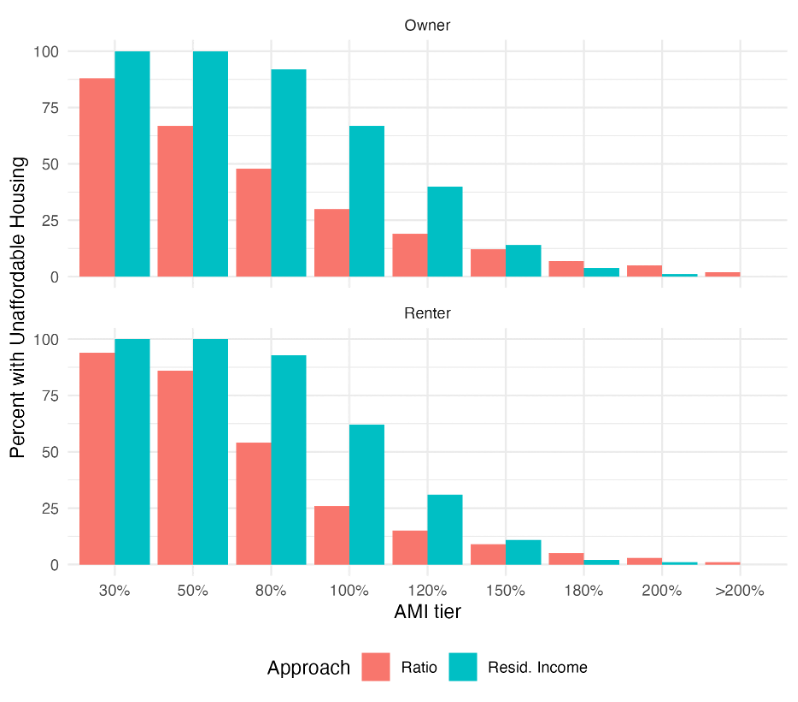
RM is simultaneously about trying to find a political majority. For social housing, to reach a simple numerical majority in most metropolitan areas, we find that eligibility would need to be set at either 100% or 120% of the area median income (AMI). However, in many countries, the pool of eligible social housing residents is not a simple majority but a supermajority. In Vienna, Austria, one of the most robust and longest-lasting social housing systems in the world, 75% of the population are eligible for social housing. We find that to create a beneficiary pool that equates to 75% of the population, eligibility for social housing would need to be closer to 180% of AMI.
The challenge of determining who policy is for is especially difficult when the rollout of policy is delayed – even if we could snap our fingers and have unlimited money to spend on social housing, it would take years to build. If a social housing policy started from the bottom of the income spectrum and worked its way up, the implementation lag and the depth of need would likely mean that social housing would come under attack before it could become more universalist. Redistributive majoritarianism could be used to create a durable system of social housing that simultaneously serves the neediest while also creating a broader set of people who can see themselves as potential future beneficiaries.
H. Jacob Carlson is assistant professor of sociology at Kean University. He was previously a postdoctoral research associate at Brown University’s Spatial Structures in the Social Sciences (S4) and the Population Studies and Training Center (PSTC). His research examines how community- and city-level processes exacerbate social inequality – and how we can reduce those disparities through institutional innovations and reforms.
Gianpaolo Baiocchi is professor of individualized studies and sociology at New York University and is the founding director of the Urban Democracy Lab, a center that currently works with more than a dozen housing rights organizations in the US and abroad on visioning plausible alternatives to market-based housing. A Brazilian-born and New York City-based engaged scholar, his work has helped inspire and support progressive policy and legislation in the US and abroad.