Delivering the New Urban Crisis
Inequality in New York’s Food-Delivery Economy
Isaac Oates (CUNY Graduate Center)
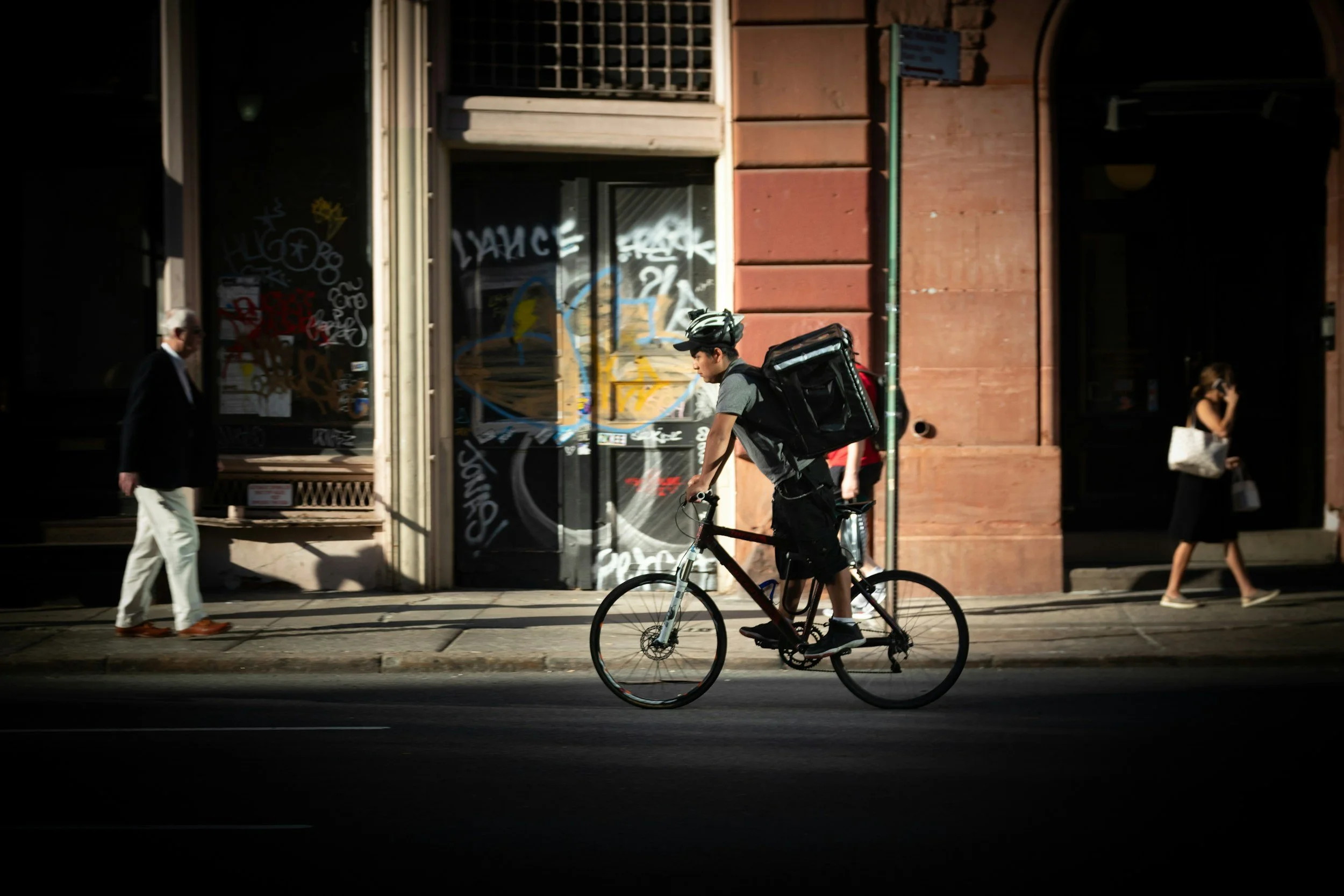
On October 15, 2020, while New York City was still reeling from COVID-19, bicycle delivery workers marched to City Hall under the Los Deliveristas Unidos banner and demanded worker protections (Guerrero 2022). Platform-based food delivery in the U.S. had doubled that spring and summer (Ahuja et al. 2021), drawing heavily on workers who already had ties to the restaurant economy. In NYC, nearly seven in ten delivery workers had previously worked in or for a restaurant (NYC Department of Consumer and Worker Protection 2022c). City Hall responded: the council passed a six-bill package in September 2021 including minimum pay, wage protection, and the right to use restaurant restrooms (Irizarry Aponte and Velasquez 2021). Delivery workers, deemed essential workers during the pandemic (Offenhartz 2020; New York State Governor 2020), had been working for well below minimum wage in conditions that were frequently dangerous (NYC Department of Consumer and Worker Protection 2022b). The new protections were overdue. They were also counterproductive: by raising pay without reclassifying workers as employees, the legislation gave platforms an incentive to extract more output per worker hour, shifting the cost of higher wages onto workers in the form of greater strain and risk.
Since the minimum pay requirement took effect in January 2024, two things happened simultaneously. The first was visible: reports of dangerous cyclist behavior began appearing in municipal hearings and the press (Stewart 2024; Brewer 2025). By spring 2025, the issue had entered the political arena, and the police commissioner held press conferences announcing a crackdown on out-of-control cyclists (Duggan 2025). The second was in the numbers, and less visible. Between the second half of 2023 and the second half of 2024, the number of deliveries completed per hour rose 75%, a figure that delivery platforms report directly to the city under the 2021 legislation (NYC Department of Consumer and Worker Protection 2025). Over the same period, worker earnings including tips rose from roughly $11.53 to $22.53 per hour. Total consumer spending per delivery stayed roughly flat. The increased earnings came at a cost workers paid themselves: greater output and the accompanying strain and risk.
Delivery platforms charge consumers per delivery but, under the 2021 legislation, must pay workers per hour. To remain competitive while absorbing higher labor costs, platforms must extract more deliveries per hour from their workforce. They do this algorithmically: workers who complete more deliveries get more jobs; workers who don’t are sidelined or deactivated (Griesbach et al. 2019). Delivery workers have no sick pay, no workers’ compensation, and no access to unemployment insurance. Many are undocumented (NYC Department of Consumer and Worker Protection 2022b). Every red light is a dilemma: they can break the law, or they can risk their income. Minimum pay regulation, the city’s most significant labor protection for delivery workers, increases pay and precarity together, without significantly redistributing costs between workers, consumers, and platforms.
In The New Urban Crisis, Richard Florida (2017) identifies rising inequality, unaffordable housing, and deepening segregation as the defining features of the contemporary urban condition. Urban agglomeration produces gains that accrue primarily at the top; low-wage service workers are left behind. His prescription follows: “Expand the middle class by turning low-wage service jobs into family-supporting work” (Florida 2017, 11). It is a reasonable ambition, and New York City’s delivery worker legislation is, in a narrow sense, an attempt to do exactly that. Both Florida’s framework and the legislation focus on the distribution of income without considering the distribution of risk. When the city mandated higher wages without changing the legal status of the workers earning them, the cost of those wages had to be borne somewhere. Consumers didn’t pay more, nor did platforms absorb much of the cost. Instead, it fell on workers in the form of higher output requirements and greater physical danger. Underlying Florida’s new urban crisis is power: who has it, and who does not.
In 2021, New York City Council passed legislation establishing a minimum hourly pay rate, excluding tips, for delivery workers. On its face, the new regulation is effective. Data reported under the legislation (NYC Department of Consumer and Worker Protection 2025) shows that delivery worker pay excluding tips more than tripled when the rates went into effect, from $6.33 per hour in the second half of 2023 to $19.36 per hour in the second half of 2024. Tips, however, declined 39% over the same period from $5.19 to $3.17 per hour. Consumer spending remained virtually flat at about $8.50 per delivery, fees and tips combined; consumers offset higher platform fees by tipping less, suggesting a ceiling on what they are willing to pay for food delivery. Because delivery platforms operate in a competitive market, a single platform cannot raise prices alone. Consumers will switch to other platforms, leaving the platform with less revenue to cover fixed expenses such as technology infrastructure and marketing. Platform gross profit per delivery decreased 13%, from $5.79 in the second half of 2023 to $5.02 in the second half of 2024. If consumers aren't paying more and platforms have absorbed only a modest share of the cost, where did the increased worker earnings come from? As Figure 1 shows, delivery worker output increased 75% over the period, from 1.44 to 2.52 deliveries per hour. Platforms allocate work algorithmically, assigning jobs to the fastest available workers; slow workers lose income and exit. The 22% decline in delivery workers over 2024 from 81,000 to 63,400 suggests that platforms increased their efficiency by shedding their slowest workers. The risks are substantial: Delivery workers face a fatality rate five times higher than construction, which historically held the highest fatality rate in New York City (NYC Department of Consumer and Worker Protection 2022a). More than one-quarter of full-time delivery gig workers report having been assaulted (Laskaris et al. 2024). Workers fully dependent on the platform, who face the greatest output pressure, have significantly higher injury and assault rates than partially dependent workers (Laskaris et al. 2024).
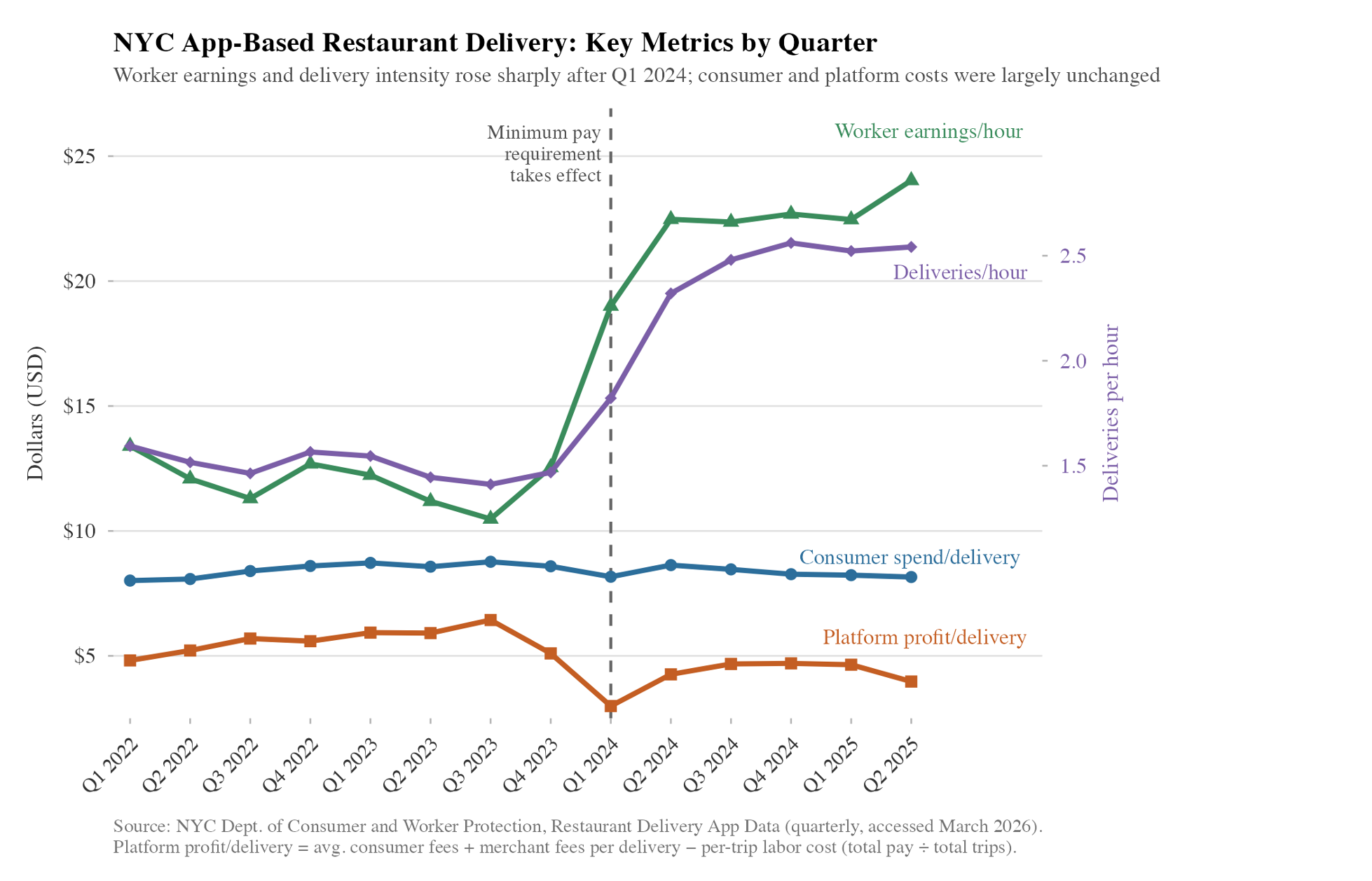
Figure 1. Consumer spending per delivery, platform gross profit per delivery, worker earnings per hour, and deliveries per worker per hour, Q1 2022–Q2 2025. Minimum pay rule initially took effect Q1 2024.
Source: NYC Department of Consumer and Worker Protection 2025
Delivery workers routinely run red lights, ride against traffic, and bike on the sidewalk in response to platform algorithms that reward speed and penalize delay. While tension between cyclists and neighborhood groups has existed in New York City for decades (Sadik-Khan and Solomonow 2017, 146–47), the surge in “street chaos” coverage beginning in mid-2024 coincides with the post-mandate rise in deliveries per worker per hour (Stewart 2024; Toussaint 2024). The policy response followed accordingly: by spring 2025, police were issuing criminal summonses rather than traffic tickets to cyclists, a sanction that falls on workers rather than the platforms whose incentive structures produce the behavior (Russo-Lennon 2025; Maag 2025).
The current compromise—a minimum pay requirement without employee status for delivery workers—creates a stable equilibrium in which politicians can deliver for their progressive constituents, delivery platforms can maintain profitability, and consumers can continue to pay pre-mandate prices for delivery. Workers win nominally but pay for it themselves; those who cannot keep up exit the delivery labor market. This equilibrium is stable because the platforms and consumers, who have the power to disrupt it, all benefit from it continuing. Delivery workers, who would benefit from a different arrangement, are fragmented, often undocumented, and electorally weak. While workers could, in principle, coordinate to slow their pace and demand that platforms abandon algorithmic penalization of slower workers, the organizational capacity required for that kind of collective action remains nascent.
Given the interests involved, this outcome is predictable. Treating delivery workers as employees would impose substantial costs on delivery platforms. First, independent contractor status allows firms to deny responsibility for their workers' behavior on the street; if they formally employed workers, they would be responsible for on-the-job conduct. Given that delivery workers routinely violate traffic rules in the performance of their work, this would create significant liability. Second, platforms would be required to verify work authorization which, given that many delivery workers are undocumented, would fundamentally change the labor pool to which platforms have access. Third, employee regulations related to predictable work weeks, overtime pay, and discrimination protection would add substantial friction to worker scheduling and termination. The minimum pay mandate, by contrast, raised labor costs without changing the fundamental arrangement.
The California experience shows how platforms have deliberately pursued this outcome. When California passed Assembly Bill 5 in 2019, which would have required platforms to classify drivers as employees, platform companies took the position that the bill did not apply to them (Rodd 2020). The platforms then spent over $220 million campaigning for Proposition 22, which imposed a minimum pay requirement while maintaining independent contractor status for workers (Said 2021). The result was predictable: following the passage of Proposition 22, Uber removed features that had given drivers discretion over which trips to accept, citing the need to reduce driver refusal rates (Hiltzik 2021), thus improving worker output. The NYC council bills suggest analogous effects.
The equilibrium proves durable even when challenged directly. In January 2026, the NYC council enacted new legislation that limits platforms' ability to deactivate worker accounts (Wrongful Deactivation of App-Based Contracted Delivery Workers 2026). The legislation will not, however, change the mechanism described above: platform workers can still be terminated for failing to meet performance standards defined by platforms. Temporary suspensions from the platform, a tool used to manage worker performance (Simet and Toh 2025), are not covered by the new law, nor are reductions in hours or algorithmic deprioritization, all forms of economic sanction reported by a quarter of surveyed delivery workers (NYC Department of Consumer and Worker Protection 2022c). These new procedural requirements will add some friction to the deactivation process, but they will not change who bears the cost of higher pay rates.
This power structure is not unique to New York City, one of the most progressive and labor-friendly cities in the U.S. Platform companies have struck compromises in other states that establish pay floors or the right to unionize while keeping delivery workers as independent contractors (Marshall 2022; Marr 2025). In February 2026, the U.S. Department of Labor proposed to roll back the Biden-era worker classification standard (U.S. Department of Labor 2026), making it easier for platforms to maintain contractor status for their workers nationally. With this structure intact, we can expect delivery workers to bear the brunt of the cost, in the form of increased risk, for any gains made from minimum pay requirements. For this class of worker, at least, Florida’s prescription of turning low-wage jobs into family-supporting work remains aspirational for the foreseeable future.
Using New York City as a case study, this paper shows that wage regulation for delivery workers without the accompanying classification reform can burden the very workers it intends to protect. Technology is not, in this instance, converting low-wage jobs into good jobs, as Florida hopes; it is converting stable informal arrangements into precarious commoditized ones. Full protection of these workers presents a dilemma: higher labor costs would likely cause the food delivery market to shrink, including the amount of available delivery work. The compromise thus persists. Rather than seeing it as a policy failure that better intentions could fix, we can see it as a feature of how platform labor markets distribute power.
References
A Local Law to Amend the Administrative Code of the City of New York, in Relation to the Wrongful Deactivation of App-Based Contracted Delivery Workers, Int 1332-2025, New York City Council (2026). https://legistar.council.nyc.gov/LegislationDetail.aspx?ID=7480055&GUID=265D0ED3-FB2F-48B9-AF70-79973B11E094.
Ahuja, Kabir, Vishwa Chandra, Victoria Lord, and Curtis Peens. 2021. Ordering in: The Rapid Evolution of Food Delivery. McKinsey & Company. https://www.mckinsey.com/~/media/mckinsey/industries/technology%20media%20and%20telecommunications/high%20tech/our%20insights/ordering%20in%20the%20rapid%20evolution%20of%20food%20delivery/ordering-in-the-rapid-evolution-of-food-delivery_vf.pdf.
Brewer, Gale A. 2025. Micromobility Safety. Policy Memo. New York City Council. https://council.nyc.gov/gale-brewer/wp-content/uploads/sites/90/2025/01/2025-Micromobility-Safety-Memo-Council-Member-Gale-A.-Brewer.pdf.
Duggan, Kevin. 2025. “Policy Change: NYPD Will Write Criminal Summonses, Not Traffic Tickets, for Cyclists.” Streetsblog New York City, May 2. https://nyc.streetsblog.org/2025/05/02/policy-change-nypd-will-write-criminal-summonses-not-traffic-tickets-for-cyclists.
Florida, Richard L. 2017. The New Urban Crisis: How Our Cities Are Increasing Inequality, Deepening Segregation, and Failing the Middle Class—and What We Can Do about It. Basic Books.
Griesbach, Kathleen, Adam Reich, Luke Elliott-Negri, and Ruth Milkman. 2019. “Algorithmic Control in Platform Food Delivery Work.” Socius: Sociological Research for a Dynamic World 5 (January): 2378023119870041. https://doi.org/10.1177/2378023119870041.
Guerrero, Martha. 2022. “Migrant Gig Workers Organize in New York City: Deliveristas Unidos & the Fight to Regulate Food Delivery Apps.” IEHS Online, December 12. https://iehs.org/migrant-gig-workers-organize-in-new-york-city-deliveristas-unidos-the-fight-to-regulate-food-delivery-apps/.
Hiltzik, Michael. 2021. “Uber Reneges on the ‘flexibility’ It Gave Drivers to Win Their Support for Proposition 22.” Business. Los Angeles Times, May 28. https://www.latimes.com/business/story/2021-05-28/uber-flexibility-prop-22.
Irizarry Aponte, Claudia, and Josefa Velasquez. 2021. “New York City Passes Landmark New Protections for Food Delivery Workers.” The City, September 23. https://www.thecity.nyc/2021/09/23/new-york-city-landmark-food-delivery-worker-law/.
Laskaris, Zoey, Mustafa Hussein, Jim P. Stimpson, et al. 2024. “A Price Too High: Injury and Assault among Delivery Gig Workers in New York City.” Journal of Urban Health: Bulletin of the New York Academy of Medicine 101 (3): 439–50. https://doi.org/10.1007/s11524-024-00873-9.
Maag, Christopher. 2025. “Drivers Who Run Red Lights Get Tickets. E-Bike Riders Get Court Dates.” New York. The New York Times, May 24. https://www.nytimes.com/2025/05/24/nyregion/ebikes-scooters-cyclists-nyc.html.
Marr, Chris. 2025. “Gig Drivers Unionize without Employee Status under State Plans.” Bloomberg Law, July 26. https://news.bloomberglaw.com/daily-labor-report/gig-drivers-unionize-without-employee-status-under-state-plans.
Marshall, Aarian. 2022. “Washington State Passed a Contentious New Gig Worker Law.” Tags. Wired, April 1. https://www.wired.com/story/uber-lyft-washington-state-prop-22/.
New York State Governor. 2020. “Governor Cuomo Issues Guidance on Essential Services under the ‘New York State on PAUSE’ Executive Order.” March 20. https://www.governor.ny.gov/news/governor-cuomo-issues-guidance-essential-services-under-new-york-state-pause-executive-order.
NYC Department of Consumer and Worker Protection. 2022a. A Minimum Pay Rate for App-Based Restaurant Delivery Workers in NYC. https://www.nyc.gov/assets/dca/downloads/pdf/workers/Delivery-Worker-Study-November-2022.pdf.
NYC Department of Consumer and Worker Protection. 2022b. Compilation of Written Testimony Received for the Delivery Worker Public Hearing Held on June 15, 2022. New York City Department of Consumer and Worker Protection. https://www.nyc.gov/assets/dca/downloads/pdf/workers/Delivery-Worker-Public-Hearing-Written-Testimony-061522.pdf.
NYC Department of Consumer and Worker Protection. 2022c. “Delivery Worker Study Survey Data.” NYC Department of Consumer and Worker Protection, November. https://www.nyc.gov/assets/dca/downloads/datasets/Delivery-Worker-Study-Survey-Data.zip.
NYC Department of Consumer and Worker Protection. 2025. “Delivery App Data.” June. https://www.nyc.gov/assets/dca/downloads/xlsx/Restaurant-Delivery-App-Data-Quarterly.xlsx.
Offenhartz, Jake. 2020. “De Blasio Pauses Crackdown on E-Bikes, as Delivery Cyclists Become ‘frontline Workers’ in Coronavirus Crisis.” News. Gothamist, March 16. https://gothamist.com/news/de-blasio-pauses-crackdown-e-bikes-covid-19.
Rodd, Scott. 2020. “Uber, Lyft, Postmates Refuse to Comply with California Gig Economy Law.” National. NPR, January 4. https://www.npr.org/2020/01/04/793142903/as-california-tries-to-make-contract-workers-employees-industries-push-back.
Russo-Lennon, Barbara. 2025. “Adams Plans Crackdown on Reckless Mopeds and E-Bikes.” NYC Transit. amNY, July 30. https://www.amny.com/news/mopeds-and-e-bikes-delivery-app-companies/.
Sadik-Khan, Janette, and Seth Solomonow. 2017. Streetfight: Handbook for an Urban Revolution. Penguin Books.
Said, Carolyn. 2021. “Here’s What You’re Paying for Proposition 22.” San Francisco Chronicle, January 19. https://www.sfchronicle.com/business/article/Here-s-what-you-re-paying-for-Prop-22-15870617.php.
Simet, Lena, and Amos Toh. 2025. The Gig Trap. Human Rights Watch. https://www.hrw.org/report/2025/05/12/the-gig-trap/algorithmic-wage-and-labor-exploitation-in-platform-work-in-the-us.
Stewart, Dodai. 2024. “Have E-Bikes Made New York City a ‘Nightmare’?” New York. The New York Times, May 27. https://www.nytimes.com/2024/05/27/nyregion/street-wars-e-bikes.html.
Toussaint, Kristin. 2024. “‘Chaos in the Streets’: Behind NYC’s Plan to Regulate Delivery Workers.” Inc., January 26. https://www.inc.com/kristin-toussaint/chaos-in-the-streets-behind-nyc-plan-to-regulate-delivery-workers.html.
U.S. Department of Labor. 2026. Employee or Independent Contractor Status under the Fair Labor Standards Act, Family and Medical Leave Act, and Migrant and Seasonal Agricultural Worker Protection Act. Notice of Proposed Rulemaking (NPRM) RIN 1235-AA46. Federal Register. https://public-inspection.federalregister.gov/2026-03962.pdf.
Isaac Oates is a doctoral student in political science at the CUNY Graduate Center, where his research focuses on comparative urban public policy.